

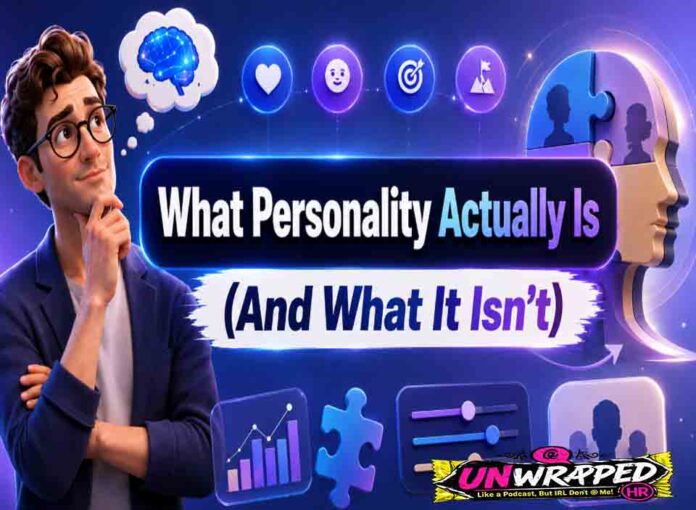
Personality is one of the most talked-about concepts in psychology, self-help, leadership, and modern culture—yet it is also one of the most misunderstood. Online quizzes promise instant labels, workplace assessments reduce people to letters, and social media encourages fixed “types” that sound more like costumes than complex human systems. As a result, many people walk away believing personality is something rigid, inherited, and limiting.
In reality, personality is neither a static identity nor a trendy label. It is a living pattern—shaped by biology, environment, experience, and choice. Understanding what personality actually is, and separating it from what it isn’t, helps people grow without self-erasure, adapt without losing integrity, and relate to others with more nuance and compassion.
What Personality Actually Is
A Pattern of Tendencies, Not a Script
Personality refers to consistent patterns in how a person thinks, feels, reacts, and relates over time. According to decades of research summarized by the American Psychological Association, personality reflects probabilities, not certainties. A person may be more likely to act a certain way—but never locked into one response.
For example, someone described as “introverted” may recharge through solitude, but that does not mean they avoid leadership, public speaking, or social connection. It means their default energy pattern differs from someone who thrives on stimulation. This distinction is supported by research published in Psychological Science, which shows that traits predict tendencies—not fixed outcomes.
See Also: Why Some People Want Deep Bonds, Not Big Social Circles
A System of Adaptation
Personality exists to help a person survive and function in their world. Traits such as caution, dominance, empathy, or independence are not moral qualities—they are adaptive strategies. Psychology Today frequently emphasizes that many “flaws” are actually overused strengths that once served a protective role.
For instance:
High vigilance can become anxiety
Strong independence can become emotional distance
Deep empathy can turn into burnout
Seen this way, personality is not a flaw to fix—but a system to understand.
What Personality Is Not
It Is Not a Box You’re Stuck In
One of the most damaging myths is that personality types are permanent cages. While traits show stability, behavior remains flexible. People routinely act “out of character” when motivated, supported, or placed in new environments.
Personality explains what feels natural—not what is possible.
It Is Not the Same as Mood or Mental Health
Personality is often confused with temporary emotional states. Feeling anxious during a stressful season does not make someone “an anxious personality.” Likewise, burnout can mimic traits like withdrawal or irritability without reflecting long-term disposition.
Mental health conditions are not personality traits, even though they may influence behavior. Personality operates beneath the surface, while mood fluctuates with circumstances.
It Is Not a Measure of Worth
Traits are descriptive—not evaluative. There is no scientific basis for ranking personalities as better or worse. The tendency to praise extroversion, assertiveness, or positivity is cultural, not psychological. Susan Cain’s work, highlighted by Quiet: The Power of Introverts, demonstrates how societies often reward certain traits while overlooking others that are equally valuable.
A calm observer, a strategic thinker, and an emotional anchor are just as essential as a charismatic motivator.
The Difference Between Traits and Identity
Traits Describe How, Not Who
Personality traits describe how a person approaches the world—not who they fundamentally are. Identity includes values, beliefs, ethics, culture, and chosen commitments. Confusing traits with identity leads people to say things like “That’s just who I am” when what they really mean is “That’s what I’m used to doing.”
This distinction matters because identity can guide growth without forcing personality change.
Personality Is the Vehicle, Not the Destination
Think of personality as the vehicle through which values are expressed. Two people may value honesty—one delivers truth gently, another bluntly. The value is shared; the expression differs. Values-driven behavior leads to greater well-being than trait-driven self-judgment.
People Also Love: Why Some People Are Great Starters but Bad Finishers
Why Modern Personality Tests Often Miss the Mark
Oversimplification for Speed
Many popular personality systems trade depth for accessibility. While tools like the Big Five have strong scientific backing, online adaptations often flatten complex spectra into catchy categories.
This can be helpful for self-reflection, but harmful when taken as destiny.
Labels Without Context
Traits do not exist in isolation. A person may be decisive at work and hesitant in relationships. Context shapes expression. Situational factors can outweigh traits in predicting behavior.
Without context, personality labels become misleading caricatures.
Call to Action
Understanding personality accurately changes how people relate—to themselves and others. Share this article with someone who feels boxed in by a label, discuss it with a team or classroom, or bookmark it as a reminder that personality explains patterns, not limits. For more psychology-backed insights, subscribe or follow the platform where this article appears and join the conversation in the comments.
Conclusion
Personality is not a fixed identity, a trendy label, or a life sentence. It is a dynamic pattern shaped by biology, experience, and adaptation—designed to help people survive, connect, and navigate complexity. When understood correctly, personality becomes a map rather than a cage.
By separating traits from worth, patterns from destiny, and behavior from identity, people gain something far more valuable than a label: clarity with freedom. That clarity allows growth without denial and self-acceptance without stagnation—exactly what personality science was meant to offer.
Another Must-Read: Why Some People Feel Responsible for Everyone