


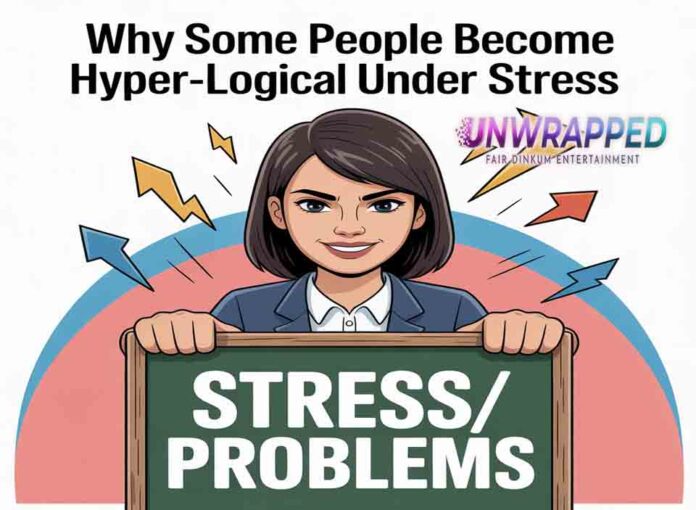
When stress hits, people change. Some cry. Some withdraw. Some become irritable. And some do something that often confuses the people around them: they become intensely logical.
They focus on facts. They strip emotion from conversations. They argue technicalities, timelines, and efficiency, while others are talking about feelings. This shift is often criticized as being cold, dismissive, or emotionally unavailable.
But becoming hyper-logical under stress is not a lack of emotion. It is a protective strategy—one rooted in how the brain survives threat.
Understanding this response helps decode conflict, reduce misinterpretation, and explain why logic sometimes shows up exactly when empathy seems to disappear.
Stress Changes How the Brain Prioritizes
Stress Narrows the Brain’s Focus
Under stress, the brain reallocates resources. The goal is not connection or nuance—it is control and predictability.
Stress activates survival circuits that prioritize clarity, certainty, and rapid decision-making. Emotional processing becomes secondary.
For some people, this shift moves attention away from feelings and toward systems, rules, and logic.
Logic Feels Safer Than Emotion
Emotions are ambiguous. They fluctuate. They require interpretation. Logic, by contrast, feels solid and controllable.
When stress rises, logic becomes a psychological anchor—something the mind can rely on when everything else feels unstable.
See Also: Why Some People Need Company to Recover
Hyper-Logic Is a Regulation Strategy
Thinking Is How Some People Calm Themselves
For certain nervous systems, thinking is soothing. Breaking problems into parts, identifying cause and effect, and reducing situations to variables helps lower internal chaos.
Research shows that cognitive strategies can dampen emotional intensity by engaging different neural pathways.
Logic isn’t the absence of emotion—it’s the method used to contain it.
Emotion Gets “Parked,” Not Deleted
Hyper-logical people under stress are often still feeling intensely. The feelings are just temporarily sidelined so the person can function.
This is why emotions may resurface later—sometimes unexpectedly—once safety returns.
Why This Can Look Like Coldness
Logic Communicates Differently
Logic-focused communication tends to be:
concise
factual
solution-oriented
emotionally neutral
In emotional moments, this can feel invalidating to others—even if that was never the intent.
Mismatched stress responses are a major source of relational conflict. One person seeks emotional attunement while the other seeks clarity and structure.
Both are coping—just differently.
Control vs Chaos: The Deeper Driver
Hyper-Logic Restores a Sense of Control
Stress often comes with helplessness. Logic restores agency:
What are the facts?
What can be predicted?
What can be solved?
This doesn’t mean the person doesn’t care. It means caring feels overwhelming without structure.
Emotional Ambiguity Feels Dangerous
For some people, emotional ambiguity triggers anxiety. Logic reduces that ambiguity by narrowing interpretation and limiting emotional exposure.
This pattern is especially common in people who:
grew up needing to stay composed
were rewarded for problem-solving
learned early that emotion complicated situations
The Nervous System Perspective
Stress Pushes Toward Cognitive Control
Under stress, the nervous system seeks efficiency. Emotional processing is slower and less predictable than analytical reasoning.
Stress reduces access to flexible, integrative thinking and increases reliance on familiar coping strategies.
If logic has worked before, the brain uses it again.
When Hyper-Logic Is Most Likely to Appear
during conflict
under time pressure
when stakes feel high
when emotions escalate around them
when outcomes feel uncertain
In these moments, logic acts as emotional body armor.
Why “Just Feel Your Feelings” Doesn’t Help
Emotional Demands Can Increase Stress
Telling a hyper-logical person to “talk about how they feel” during peak stress can backfire. It removes their stabilizer before they are ready.
Emotional access usually returns after safety and clarity are restored—not before.
Timing Matters
Once stress lowers, many hyper-logical people become thoughtful, reflective, and emotionally articulate. During stress, logic is the bridge that keeps them functional.
Burnout Makes Hyper-Logic Stronger
When Capacity Drops, Precision Rises
Burnout reduces tolerance for emotional complexity. Logic becomes sharper, stricter, and more dominant.
Burnout is associated with emotional distancing—not because people stop caring, but because caring becomes too costly.
Hyper-logic is often a last-line defense against overload.
How to Communicate With Someone in Hyper-Logic Mode
What Helps
clarity
structure
specific questions
calm tone
acknowledging their effort to stabilize
Examples:
“Can we map this out together?”
“What information would help right now?”
“I know you’re trying to solve this.”
What Escalates Things
accusing them of not caring
demanding emotional expression immediately
framing logic as cruelty
escalating emotional intensity
Validation opens access. Pressure closes it.
People Also Love: The Difference Between Burnout and Boredom
How Hyper-Logical People Can Self-Support
recognize logic as a stress signal, not identity
allow decompression time after problem-solving
schedule emotional processing later, not never
communicate needs (“I need to think first”)
Logic is useful—but it shouldn’t have to do all the work alone.
Call to Action
If this article reframed a behavior you’ve been judged—or have judged—share it. Understanding hyper-logic as a stress response reduces unnecessary conflict and misinterpretation. Subscribe or comment to explore more psychology explained in real-world language.
Conclusion
Becoming hyper-logical under stress is not a loss of humanity—it’s a bid for stability. Logic steps in when emotions feel too volatile to manage safely.
When this response is understood, it stops being seen as coldness and starts being recognized as what it really is: a mind doing its best to keep everything from falling apart.
Another Must-Read: Why Some People Spiral When Plans Change