


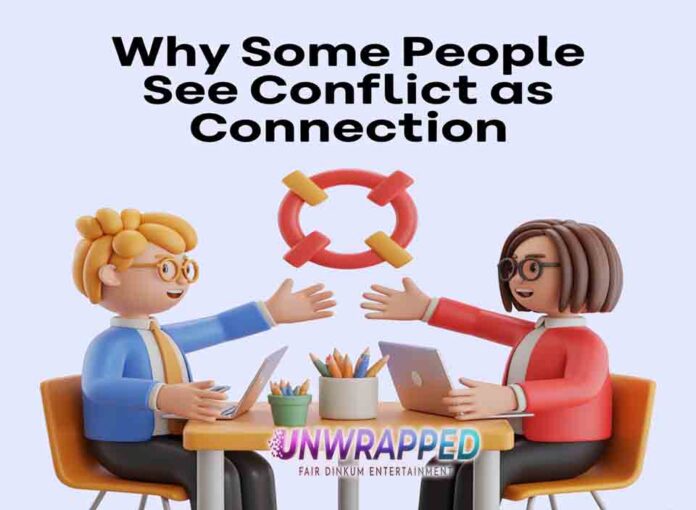
For many people, conflict signals danger—something to avoid, soften, or shut down as quickly as possible. Raised voices, disagreement, or emotional intensity trigger withdrawal, anxiety, or a strong urge to smooth things over. Yet for others, conflict feels strangely familiar, even bonding. Arguments can feel like proof that a relationship is alive, engaged, and real.
This difference is not about personality alone. It is shaped by psychology, early relational experiences, and how the nervous system learned to recognize “connection.” Understanding why some people experience conflict as closeness helps explain recurring relationship patterns—why some chase intensity, others retreat from it, and why misunderstandings can arise even between people who care deeply.
Conflict Isn’t Just Disagreement—It’s a Signal
Conflict is often framed as a breakdown in communication, but psychologically, it is also a signal of engagement. Disagreement requires attention, energy, and emotional presence. In that sense, conflict can feel like proof that someone cares enough to respond.
Conflict itself is not inherently harmful; its impact depends on how it is interpreted and managed. For some individuals, conflict activates threat. For others, it activates familiarity.
This difference starts early.
See Also: When “Motivation” Is Actually Nervous System Management
How Early Environments Shape the Meaning of Conflict
In childhood, the nervous system learns what connection looks like by observing how caregivers show attention.
In emotionally consistent homes, connection may have looked like:
Calm conversation
Repair after disagreement
Predictable affection
In more chaotic or emotionally intense environments, connection may have arrived through:
Raised voices
Emotional reactions
Crisis-driven closeness
If attention, validation, or care appeared mainly during moments of conflict, the brain can wire conflict = engagement. Over time, calm may feel empty, while intensity feels relational.
Attachment research shows that individuals raised in unpredictable environments may associate emotional intensity with closeness, even when that intensity is stressful.
The Nervous System’s Role: Arousal as Familiarity
The nervous system does not prioritize comfort—it prioritizes what is familiar.
For some people, calm connection feels foreign. Low emotional intensity can register as distance, boredom, or emotional absence. Conflict, by contrast, raises arousal levels, releasing adrenaline and activating attention. That physiological activation can feel like presence.
Heightened arousal states can feel grounding to people whose baseline nervous system expects stimulation.
In these cases, conflict is not consciously chosen to cause harm. It is unconsciously used to feel connected.
People Also Love: The Real Reason You Procrastinate
Why Conflict Can Feel Safer Than Calm
Paradoxically, conflict can feel safer than peace for those who learned that calm preceded withdrawal or abandonment.
For example:
Calm periods in childhood may have meant emotional neglect
Silence may have followed unresolved tension
Peace may have been temporary before disruption
As a result, the absence of conflict does not feel reassuring—it feels like waiting for something to go wrong.
The Gottman Institute, known for decades of relationship research, notes that some couples mistake emotional intensity for intimacy, even when it undermines trust.
Conflict as Proof of Importance
Another reason conflict can feel connective is that it signals importance.
If someone argues, reacts, or pushes back, it confirms:
“I matter enough to respond to”
“This relationship has emotional weight”
“I’m not being ignored”
In contrast, calm boundaries or quiet disengagement can feel more threatening than an argument. Conflict reassures some people that they are seen—even if the attention comes wrapped in tension.
This dynamic often appears in romantic relationships but also shows up in families, friendships, and workplaces.
When Conflict Becomes the Only Language of Connection
Problems arise when conflict becomes the primary or only way someone experiences closeness.
Signs of this pattern include:
Feeling disconnected during peaceful periods
Creating arguments when things feel “too quiet”
Interpreting calm responses as lack of care
Escalating emotions to feel heard
Over time, this can exhaust partners who associate safety with calm rather than intensity. The result is a push–pull dynamic: one person seeks closeness through conflict, the other seeks safety through distance.
Chronic relational stress—especially unresolved conflict—can increase anxiety and emotional fatigue for both parties.
Healthy Conflict vs. Connection Through Chaos
It is important to separate healthy conflict from conflict-as-connection.
Healthy conflict:
Allows disagreement without attacking identity
Leads to repair and understanding
Strengthens trust over time
Conflict used to create connection:
Feels cyclical and unresolved
Escalates quickly
Leaves one or both parties emotionally depleted
Healthy connection does not require emotional spikes to feel real.
Learning New Forms of Connection
For people who associate conflict with closeness, the goal is not to eliminate disagreement—but to expand the definition of connection.
This often involves:
Learning to tolerate calm without assuming disconnection
Building comfort with steady, predictable engagement
Practicing emotional expression without escalation
Nervous system regulation plays a key role in shifting relational patterns.
As the body learns that calm can coexist with care, connection no longer needs conflict to survive.
Call to Action
If this article clarified a pattern you recognize in yourself or others, consider sharing it with someone navigating relationship tension. Subscribe or follow for more psychology-based insights into how connection actually works.
Conclusion
Some people see conflict as connection not because they enjoy discord, but because their nervous system learned that intensity equals presence. Conflict became a language of closeness long before it became a problem.
Recognizing this pattern allows for change without shame. Conflict does not need to disappear—but it no longer has to carry the entire weight of connection.
True closeness can exist without emotional spikes. When calm becomes safe, connection becomes sustainable.
Another Must-Read: The Difference Between Loyalty and Fear of Leaving