


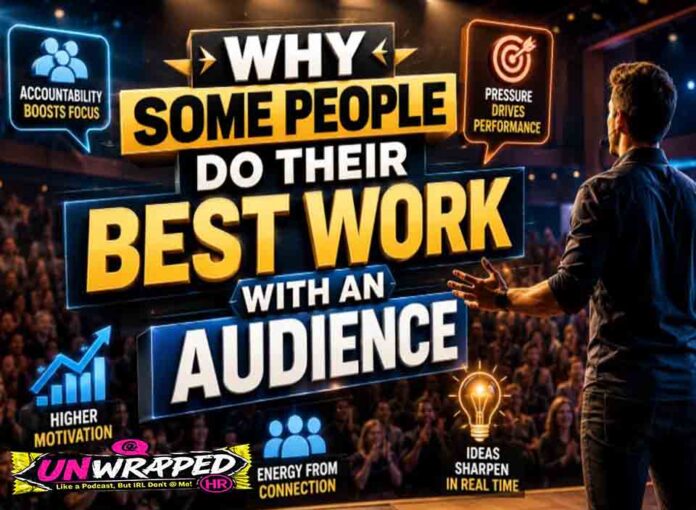
Some people produce their sharpest ideas in silence, while others reach their peak when someone is watching. This difference is often misunderstood. Working best with an audience is frequently mistaken for attention-seeking, insecurity, or dependence on validation—but that interpretation barely scratches the surface.
For many high performers, an audience functions as a catalyst, not a crutch. Presence sharpens focus, raises standards, and transforms effort into energy. Understanding why this happens reveals something important about motivation, accountability, and how human performance actually works.
Performance Changes When Someone Is Watching—and That’s Not a Flaw
Psychologists have long studied how observation affects behavior. One of the earliest findings, known as social facilitation, shows that people often perform better on familiar or well-practiced tasks when others are present.
For people who thrive with an audience:
Focus increases under observation
Energy levels rise
Distractions fade
The presence of others signals importance. The task feels real, not theoretical.
See Also: Decision Styles: Fast Deciders vs Deep Deciders
Accountability Turns Intention Into Action
An audience creates a form of external structure. Deadlines, expectations, and visibility reduce procrastination and ambiguity.
Research on accountability shows that people are significantly more likely to follow through on goals when progress is visible to others.
For audience-oriented workers:
Visibility creates momentum
Commitment feels concrete
Effort intensifies near performance moments
This isn’t about pressure—it’s about clarity.
Some Minds Think Out Loud to Think Clearly
Not all thinking happens internally. For some people, cognition becomes sharper when ideas are spoken, demonstrated, or performed.
Educational psychology research frequently highlights verbal processing as a legitimate thinking style, where articulation refines understanding.
These individuals don’t perform instead of thinking. They think through performance.
Energy Is Social for Certain People
Motivation does not arise from the same source for everyone. While some people recharge in solitude, others generate energy through interaction.
Social energy is a real motivational driver, especially for people who are externally oriented in how they process stimulation.
For these individuals:
Silence drains momentum
Interaction creates flow
Feedback loops fuel engagement
Working alone can feel flat—not freeing.

Why Feedback Feels Safer in Real Time
People who do their best work with an audience often prefer live feedback over delayed evaluation. Immediate reactions allow rapid adjustment, reducing anxiety about unknown outcomes.
For audience-driven workers:
Live cues reduce uncertainty
Iteration feels natural
Progress is visible as it happens
Waiting weeks for feedback feels more stressful than performing publicly.
Performance Creates Meaning Through Witnessing
Human effort often feels more meaningful when it is seen. Sociological research shows that recognition doesn’t only reward ego—it reinforces purpose.
For some people:
Work feels incomplete without an audience
Meaning increases when impact is visible
Contribution feels real when shared
This is about significance, not applause.
The Workplace Bias Against Visible Performers
Modern work culture often favors quiet productivity, equating seriousness with silence. As a result, people who work best with an audience can be unfairly labeled as:
Performative
Distracted
Needing validation
McKinsey & Company’s research on performance diversity emphasizes that effective teams require different execution styles—not uniform ones.
Visibility is not inefficiency. It’s a different operating mode.
Where Audience-Driven Work Excels
Working with an audience is especially powerful for:
Teaching and training
Sales and persuasion
Leadership and facilitation
Live problem-solving
Creative iteration
In these contexts, interaction doesn’t interrupt productivity—it is productivity.
People Also Love: Why Some People Need Options and Others Need Commitment
Designing Systems That Support Audience-Oriented Workers
High-performing teams don’t force everyone into silent focus or constant collaboration. They allow both.
Helpful structures include:
Live demos instead of written updates
Regular presentations or stand-ups
Pair work or co-working sessions
Visible milestones rather than private deadlines
Research on hybrid work shows that flexible visibility improves engagement when matched to individual styles.
Call to Action
If this article clarified your own work style—or helped you understand someone else’s—share it. Subscribe for more psychology-backed insights that challenge one-size-fits-all productivity myths and help people work the way they actually function best.
Conclusion
Some people sharpen their thinking in silence. Others sharpen it in front of others. Neither approach is superior—but ignoring one limits human potential.
When an audience is recognized as a legitimate performance tool rather than a weakness, teams gain energy, clarity, and momentum. The most effective environments don’t minimize visibility—they use it intentionally.
Another Must-Read: Why Some People Do Their Best Work Alone