



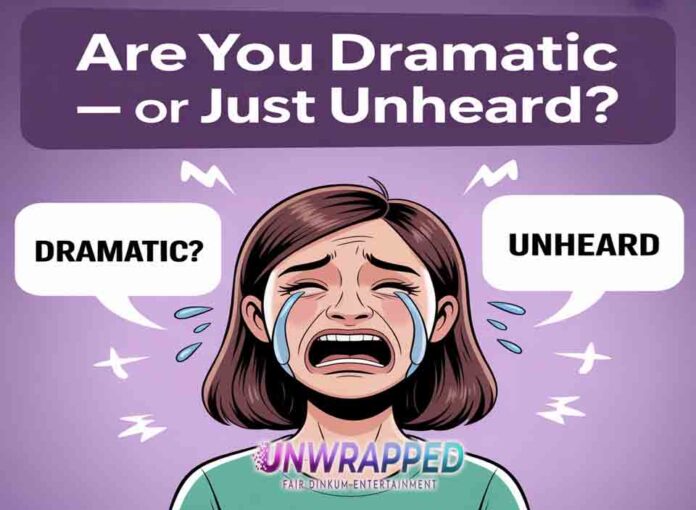
Few labels sting as quietly as being called “dramatic.” It suggests excess, irrationality, and emotional overreaction—often shutting down conversation before it even begins. Yet in many cases, what gets labeled as drama is not exaggeration at all. It is unacknowledged emotion repeating itself, trying to finally land.
Psychology increasingly shows that intensity is not always a personality flaw. It is often a communication failure. When people feel consistently unheard, misunderstood, or dismissed, emotions tend to escalate—not because they want attention, but because previous signals didn’t register. Understanding this difference changes how emotional expression is interpreted, both personally and socially.
Why “Drama” Is a Lazy Explanation
Calling someone dramatic simplifies a complex interaction into a character judgment. It moves the focus away from what is being said and toward how it is being expressed.
This label often appears when:
Emotions are inconvenient or uncomfortable to engage with
The listener feels overwhelmed or defensive
The speaker has repeated the same concern multiple times
In many environments—families, workplaces, relationships—emotion is tolerated only when it is tidy and brief. Anything persistent is framed as excess rather than unresolved communication.
People Also Love: Why Some People Need Labels — and Others Reject Them
What Happens When People Aren’t Heard
When emotional signals go unacknowledged, the nervous system adapts.
Ignored emotions don’t disappear. They intensify. The brain interprets being unheard as a social threat, which increases emotional arousal.
Common outcomes include:
Repeating the same point with more intensity
Raising volume or urgency
Adding emotional detail to “make it land”
Feeling embarrassed afterward for “overreacting”
From the inside, this doesn’t feel like drama. It feels like trying harder after softer attempts failed.
The Escalation Loop
Many people labeled dramatic are caught in an escalation loop:
A concern is expressed calmly
It is minimized, dismissed, or ignored
The concern resurfaces with more emotion
The increased emotion is criticized
The original issue remains unresolved
Over time, the person learns—often unconsciously—that calm expression doesn’t work. Emotional intensity becomes a learned strategy, not a personality trait.
Why Some People Are More Likely to Be Labeled “Dramatic”
Not everyone is equally allowed emotional range. Social and cultural dynamics play a significant role.
People more likely to receive the “dramatic” label include:
Those socialized to be expressive
Individuals in lower-power positions
People whose emotions challenge group comfort
Those with unmet emotional needs in relationships

Being Unheard vs. Being Dysregulated
It’s important to distinguish between two different experiences:
Being unheard: emotions escalate because they are not acknowledged
Being dysregulated: emotions overwhelm the ability to self-soothe
These can overlap, but they are not the same.
Someone can be emotionally regulated and still become more expressive if they feel repeatedly ignored. Likewise, someone can be dysregulated even when others are listening. Labeling everything as “drama” collapses this nuance—and blocks real understanding.
Why Emotional Expression Changes Under Invalidation
When people feel heard, emotions tend to soften naturally. When they feel invalidated, emotions sharpen.
Validation doesn’t require agreement. It requires recognition.
Simple acknowledgments such as:
“I hear that this matters to you.”
“I may not see it the same way, but I understand why you’re upset.”
These responses often reduce intensity faster than logic or problem-solving. Feeling understood directly lowers emotional arousal.
The Internal Cost of Being Labeled Dramatic
Over time, being dismissed as dramatic can distort self-perception.
People may:
Question their emotional legitimacy
Suppress feelings until they overflow
Apologize for emotions rather than behavior
Struggle to trust their own reactions
Ironically, this suppression often leads to more intense emotional release later, reinforcing the very label they’re trying to avoid.
See Also: The Difference Between Privacy and Secrecy
When Drama Is Actually a Boundary Signal
Not all emotional intensity is about being heard. Sometimes, it’s about crossed boundaries.
Strong reactions often appear when:
Limits have been repeatedly ignored
Needs have been consistently deprioritized
Someone feels pressured to tolerate what they can’t
In these cases, emotion is doing its job: signaling that something is unsustainable. Calling it drama reframes a boundary signal as a flaw.
How to Tell the Difference in Yourself
A helpful self-check is not “Am I being dramatic?” but:
Have I expressed this calmly before?
Was it acknowledged or acted on?
Does the intensity rise after being dismissed?
If the answer is yes, the issue may not be emotional excess—it may be emotional neglect.
Call to Action
If this article reframed how emotional expression is understood, consider sharing it with someone navigating difficult conversations or self-doubt. Readers can also subscribe for more psychology-based content that replaces judgment with clarity.
Conclusion
Not all intensity is drama. Often, it is the sound of something important failing to be acknowledged. When emotions grow louder, it is usually because earlier, quieter signals were missed.
Understanding the difference between being dramatic and being unheard allows for better communication, healthier boundaries, and more compassionate self-understanding. Sometimes the problem isn’t how strongly someone feels—it’s how long they’ve felt invisible.
Another Must-Read: The Myth of the “Real You”