


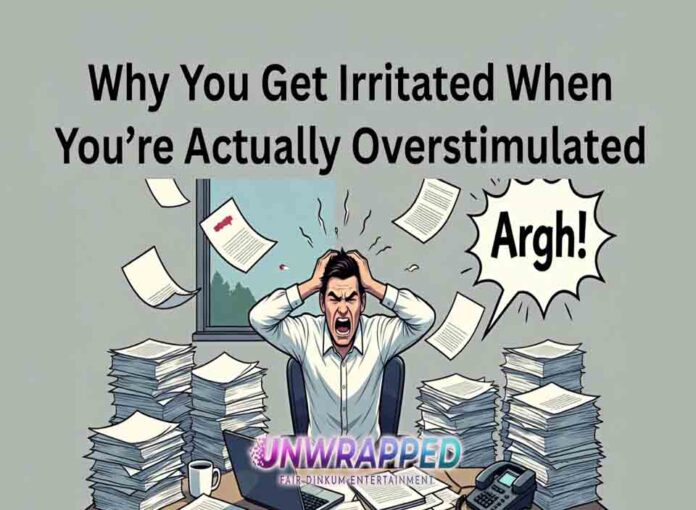
Irritability often looks like impatience and being overstimulated may play a big reason. A sharp tone. A short reply. A sudden wave of frustration over something minor. But in many cases, irritation is not about attitude—it is about overload.
Modern life delivers a constant stream of input: notifications, conversations, traffic noise, bright screens, deadlines, background music, social expectations. When the brain absorbs more stimulation than it can comfortably process, the result is overstimulation. And one of the most common emotional signals of overstimulation is irritability.
Understanding why irritation appears when someone is overstimulated reveals an important truth: anger is sometimes just a nervous system asking for relief.
What Is Overstimulation?
Overstimulation occurs when the brain receives more sensory or emotional input than it can regulate effectively. This can include:
Loud environments
Bright lighting
Multitasking
Emotional conflict
Social demands
Constant digital notifications
Prolonged exposure to stressors activates the body’s stress response system. When stimulation accumulates, the nervous system becomes taxed.
The brain begins prioritizing survival over patience.
See Also: Why Some People Need to Talk It Out Immediately
The Nervous System Under Pressure
Fight-or-Flight Isn’t Always Dramatic
Overstimulation activates the sympathetic nervous system—the same system responsible for the fight-or-flight response. The body releases adrenaline. Heart rate increases slightly. Muscles tense.
Even if no visible threat exists, the nervous system interprets overload as pressure.
Stress hormones shift the body into alert mode. In this state:
Tolerance decreases
Patience shrinks
Emotional reactions intensify
Irritability becomes a shortcut response.
Why Irritation Shows Up First
Anger is often a secondary emotion. It is easier to express than vulnerability or fatigue.
When overstimulated, individuals may actually feel:
Overwhelmed
Mentally exhausted
Physically tense
Emotionally flooded
But instead of identifying exhaustion, the brain converts overload into irritability. It is faster. Simpler. Protective.
Self-awareness plays a key role in identifying primary emotions. Without awareness, overload is mislabeled as anger.

Sensory Overload and Modern Life
The digital age amplifies stimulation. Notifications interrupt thought patterns. Social media floods attention with emotional cues. Multitasking becomes constant.
Chronic stress exposure impacts both cognitive function and mood.
Common overstimulation triggers include:
Back-to-back meetings
Crowded spaces
Extended screen time
Loud public environments
Emotional labor
When the brain has no recovery window, irritability increases.
Personality Differences in Overstimulation
Highly Sensitive Individuals
Some people process sensory input more deeply. They may react strongly to noise, light, or emotional intensity. Overstimulation for them happens faster and feels stronger.
Their irritation is not weakness—it is threshold sensitivity.
Task-Oriented Personalities
Individuals who value focus and order may experience irritability when interruptions pile up. Multitasking fragments attention, increasing cognitive load.
The brain resists fragmentation, and irritation follows.
Cognitive Overload and Decision Fatigue
Overstimulation is not only sensory—it is mental.
Decision fatigue occurs when the brain makes too many choices without rest. According to psychological research frequently cited in behavioral science, repeated decision-making depletes cognitive resources.
Symptoms include:
Impatience
Reduced empathy
Snap judgments
Emotional reactivity
Irritability signals depleted bandwidth.
Emotional Overstimulation
Not all overload is environmental. Emotional overstimulation can stem from:
Conflict
Social gatherings
Caretaking roles
High emotional responsibility
Constant emotional processing consumes energy. The nervous system becomes fatigued.
In these situations, irritability may surface even in quiet rooms. The overload is internal.
Physical Signals of Overstimulation
The body often sends subtle warnings before irritability peaks.
Common signs include:
Headaches
Jaw tension
Clenched shoulders
Shallow breathing
Racing thoughts
Difficulty concentrating
When these signals go unnoticed, irritation escalates.
Recognizing physical cues early to prevent emotional overflow.
Why Rest Alone Isn’t Always Enough
Many assume sleep solves irritability. While rest helps, overstimulation requires active nervous system regulation.
Passive rest without mental disengagement—such as scrolling social media—can continue stimulation.
Effective regulation strategies include:
Stepping into quiet environments
Deep breathing exercises
Gentle movement like walking
Short digital detox periods
Sensory reduction (dim lights, silence)
When input decreases, irritation often subsides quickly.
Practical Tools to Reduce being Overstimulated
1. Schedule Recovery Windows
Five-minute silence between meetings
Short walks after intense conversations
Screen breaks every hour
2. Protect Sensory Boundaries
Use noise-canceling headphones
Lower screen brightness
Reduce background noise
3. Monitor Emotional Load
Ask daily:
Have I been around constant conflict?
Have I had uninterrupted time?
Have I had moments of quiet?
These small adjustments prevent irritability from escalating.
People Also Love: When Your Coping Skills Become Your Personality
Conclusion
When irritation rises unexpectedly, overstimulation is often the hidden cause. The brain and body operate within limits. When those limits are exceeded—through noise, multitasking, emotional strain, or digital overload—patience shrinks.
Recognizing irritability as a signal rather than a flaw changes the response. Instead of self-criticism, the solution becomes regulation. Quiet. Pause. Recovery. The nervous system, once supported, returns to balance. And with balance comes patience.
Understanding the link between overstimulation and irritation allows individuals to design environments that support clarity rather than chaos. Awareness transforms reaction into intention.
Call to Action
If this explanation helped clarify sudden irritability, share this article with someone who feels “short-tempered” after long days. Comment below about the most common overstimulation trigger you’ve noticed. Subscribe for more psychology-based insights on how the mind and body interact under pressure.
Another Must-Read: Why You Feel “Flat” After a Big Goal