


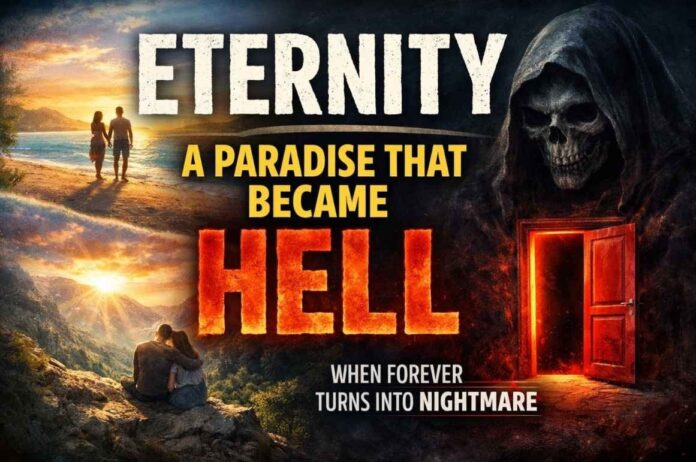
When a romantic afterlife story builds a paradise so static it becomes a prison.
There’s a particular kind of horror that doesn’t need monsters, blood, or even darkness.
All it needs is a promise.
A promise that you will go on — forever — as yourself, with your thoughts intact, your cravings intact, your doubts intact, your mind locked in the same shape… while time stretches into an endless sheet with no edge.
That’s the quiet terror the movie Eternity stumbles into. Not because it wants to. Because it takes the idea of “heaven” and designs it like a lifestyle brochure.
A beach. A mountain pass. A week to decide. A door you’re not allowed to open.
And suddenly, what’s meant to be romantic becomes existentially violent.
The Movie’s “Heaven” Is a Closed System
Eternity presents an afterlife that looks calm on the surface: a tidy “Junction” where you get one week to choose where you’ll spend forever. The pitch is gentle, almost soothing. It’s the kind of structure you’d build if you believed happiness was a location, and love was a final selection you make once, like picking wallpaper.
But that’s exactly the problem: the afterlife here isn’t transcendence. It’s real estate.
A beach is nice for a few hours.
A mountain pass can be moving for a few days.
Even paradise becomes punishing when it’s static.
Because human consciousness isn’t built for infinity. It’s built for contrast. For change. For narrative arcs. For endings that give meaning to beginnings. Remove the ending, and you don’t get “more life.” You get life without structure — an endless run-on sentence of awareness.
That’s why, in the movie’s own logic, the “good ending” is secretly a nightmare: it’s the eternal continuation of a finite mind in a finite environment.
And that’s not heaven.
That’s a glass box.
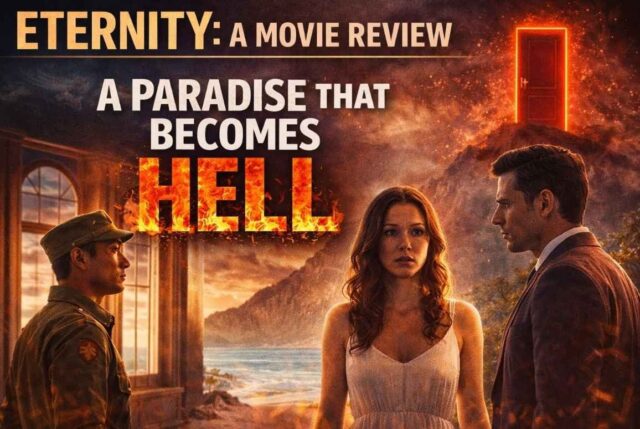
The Red Door Reveals the Moral Spine of the World
The moment the movie introduces the idea of punishment — afterlife enforcement, consequences for trying to opt out — the whole thing turns from whimsical to sinister.
It’s not just that there’s a rule. It’s why the rule exists.
If you try to leave, you don’t get freedom. You get threatened with eternal blackness.
That detail does something brutal: it reveals the system isn’t built around flourishing. It’s built around compliance. The world’s moral logic becomes: choose your eternity and don’t question the architecture.
And the second a heaven needs police, it stops being heaven.
Because now the afterlife isn’t a gift. It’s a contract enforced by fear.
Eternal Blackness Might Be Kinder Than Eternal Stasis
The movie clearly treats “eternal blackness” as the worst fate imaginable.
But if we take its structure seriously, the truly horrifying thing isn’t blackness.
It’s consciousness without end.
If eternal blackness means awareness continues — trapped in nothing — then yes: torture. But if it means ceasing to exist as a distinct self, then it’s not torture. It’s release. It’s reintegration. It’s the universe reclaiming your energy without forcing “you” to keep performing “you” for infinity.
In a world like this, the most merciful outcome wouldn’t be a beach. It would be something like:
You return to the universe, and you will never be you again.
That’s not bleak. It’s natural. It has humility. It doesn’t demand that the ego be preserved like a museum exhibit. It accepts that endings aren’t a defect — they’re a form of kindness.
In other words: annihilation isn’t the darkest option here.
Endless continuity is.
The Romance Collapses Under the Weight of Forever
The movie’s central engine is a romantic dilemma: two men competing for a woman, and she must decide which relationship becomes her eternity.
On paper, it’s melodrama. In practice, it’s metaphysical madness.
Because eternity changes the meaning of choice.
A love triangle in a normal movie is “Who do you pick?”
A love triangle in Eternity becomes “Who do you sentence to infinite loss?”
In mortal life, doubt is human. Time is forgiving. People change. There’s room for confusion, repair, growth, second chances. But in this afterlife:
a moment of hesitation becomes cosmic
a flicker of uncertainty becomes a permanent fracture
one decision defines trillions of years
Half a second of doubt isn’t “romantic tension.” It’s existential betrayal.
Because if love is supposed to be absolute in eternity, then there is no space for indecision. The stakes are too large for anything adolescent — and yet the movie often plays the triangle with a youthful, almost teenage energy. The characters squabble in a story that should shatter them.
That mismatch is where the audience either goes with the fantasy… or starts to see the horror.
The Most Beautiful Moment Is Also the Most Damning
One of the movie’s emotional high points is the man who died decades earlier and waited — 67 years — to see her again.
On a human scale, it’s devastatingly beautiful. A love that endures. A life cut short. A fidelity that survives time.
But the second you zoom out, the beauty mutates into something darker:
67 years is not even one second of eternity.
The movie wants that number to feel enormous. But in its own framework, it proves the opposite: that time in eternity destroys proportion. It makes everything either meaningless or unbearable.
Waiting 67 years sounds romantic until you realise: if you can wait 67 years, you can wait 6,700,000,000 years. And then you’re not talking about love anymore. You’re talking about obsession made infinite.
“Heaven” Becomes Boredom, and Boredom Becomes Dread
The film assumes paradise is a setting where you stop wanting more.
But humans don’t stop wanting more. Even contentment has a rhythm. Even peace needs texture. Even joy needs change.
So what happens when joy becomes repetitive?
It thins out. It becomes grey. It becomes background noise.
And then paradise begins to resemble a sensory deprivation tank with better lighting.
That’s when “eternity” stops sounding like reward and starts sounding like punishment disguised as comfort.
The Movie Mistakes “Forever” for “Meaning”
The movie’s core romantic idea is: if you can choose your forever, you can find your meaning.
But meaning doesn’t come from duration.
Meaning comes from limits.
A song is moving because it ends.
A day matters because it can be wasted.
A love is precious because it can be lost.
If you remove loss, you don’t automatically get deeper love. You sometimes get a flatter version of it — love with no urgency, no edge, no fear, no risk.
Love becomes a room you can’t leave.
The movie keeps trying to sell forever as a warm blanket.
But forever is not a blanket.
Forever is a pressure test. And the movie fails its own test.
The Real Villain Isn’t the Love Triangle — It’s the System
By the time you’re thinking “did they design hell?” you’re seeing the story’s true antagonist: the afterlife design itself.
A world that:
forces an eternal choice
polices escape
threatens a void as punishment
reduces an entire person to which partner they belong with
offers static settings as salvation
…is not a loving metaphysics.
It’s a cosmic bureaucracy with romantic branding.
And that’s why the movie lands so dark: it gives you nostalgia and calls it heaven — but the machinery underneath says compliance matters more than wellbeing.
Final Verdict: A Prison With Good Marketing
If Eternity wanted its premise to feel genuinely comforting, it would need one of two things:
Transformation (you do not remain the same mind forever), or
Release (there is an endpoint, reintegration, dissolution)
But the movie doesn’t offer either. It offers continuity as-is, forever, in a fixed environment, enforced by fear.
So it accidentally reveals a terrifying possibility:
Not that death is scary — but that immortality without transcendence is worse.
The movie gives you romance.
But if you take its worldbuilding seriously, what it really gives you is this:
A paradise so permanent it becomes a prison — and a system so rigid it accidentally invents hell.