



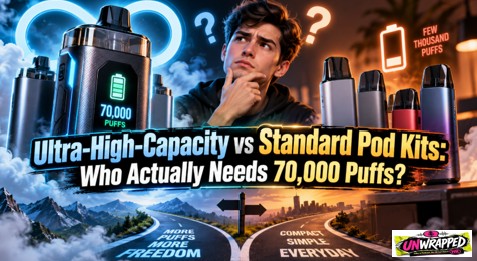
Puff count ratings on UK pod kits now span an unusually wide range, from standard devices rated in the low thousands up to ultra-high-capacity kits advertising 70,000 puffs or more from a single box. The instinct is often to assume more is simply better, but a 70,000 puff kit is a meaningfully different product to a standard pod kit, not just a bigger version of the same thing, and it genuinely suits a narrower set of habits than the marketing suggests.
What Actually Separates the Two Categories
A standard pod kit is typically built around a single 2ml pod paired with a modest battery, usually somewhere in the low hundreds to low thousands of mAh, and is designed to be replaced or refilled every few days under regular use. An ultra-high-capacity kit takes a different structural approach entirely: rather than one small pod, it’s built from multiple compliant components working together, commonly two or more 2ml pods paired with several 10ml auto-refill containers, combining to hold well over 40ml of total e-liquid across the full kit.
This structure exists because of UK regulation as much as design choice. Under the Tobacco and Related Products Regulations 2016, which implement the Tobacco Products Directive (TPD), no single sealed pod or tank is permitted to hold more than 2ml of nicotine-containing liquid. A kit advertising tens of thousands of puffs isn’t breaching that limit with one oversized tank, it’s combining several individually compliant 2ml and 10ml components, each staying within its own legal limit, to reach a much higher total capacity than a standard single-pod device could ever offer on its own.
The Case for a Standard Pod Kit
For a lot of vapers, a standard kit remains the more sensible choice, and it’s worth being honest about why rather than assuming bigger is automatically better. Standard kits are smaller and lighter, easier to carry in a pocket without being noticeable, and generally cheaper upfront since they involve less battery and less total hardware. For someone vaping lightly or moderately through the day, a standard kit’s smaller e-liquid volume is unlikely to run out before it needs replacing anyway, which means the extra capacity of an ultra-high-capacity kit would largely go unused. Paying a premium for capacity that never actually gets drawn on isn’t really a saving, it’s just carrying a bulkier device for no practical benefit.
Where Ultra-High-Capacity Kits Genuinely Earn Their Size
The case for an ultra-high-capacity kit is strongest for a specific, identifiable group: heavier daily vapers who want to minimise how often they think about pods, refills, or reordering at all. The HQD Glow Air 70K dual-flavour pod kit is a good example of what this category is actually built around: an 850mAh rechargeable battery, a 1.1-ohm dual mesh coil, and two complete pod setups shipped in one box, each pairing a 2ml pod with two 10ml auto-refill containers, giving roughly 44ml of total e-liquid and up to 70,000 puffs across the full kit. For someone genuinely vaping several hundred puffs a day, that structure means going weeks or even a couple of months between reorders, rather than every few days.
The dual-flavour design common to this category is also a genuine, non-marketing benefit for heavier users specifically, since it removes the need to carry a second device just to switch flavour through the day, a slider or twist mechanism handles that on a single unit instead.
Who Doesn’t Need This Much Capacity
It’s worth being direct about who this category isn’t really built for. Someone who vapes occasionally, or only a handful of times a day, will likely find a standard kit lasts nearly as long in practical terms simply because daily consumption is the limiting factor, not tank size. In that scenario, an ultra-high-capacity kit mostly adds bulk and upfront cost without a proportional benefit, since the extra e-liquid volume just sits unused for longer rather than genuinely reducing how often the device needs attention.
There’s also a battery-life nuance worth knowing: on most kits in this bracket, the battery, not the e-liquid, tends to be what needs daily attention regardless of tank size, since an 850mAh cell is generally built to last a full day of typical use before needing a USB-C recharge. This means the main benefit of the larger tank isn’t fewer charges, it’s fewer pod swaps and reorders, which matters far more to a heavy user than to someone vaping lightly through the day.
Working Out Which Category Actually Fits
A few honest questions tend to settle the decision better than comparing puff counts side by side:
- How many times a day does the device actually get used? Light or occasional use rarely benefits from the extra capacity of an ultra-high-capacity kit.
- How much does reordering pods or refills bother you? Heavier users who dislike frequent reordering are the clearest fit for the ultra-high-capacity category.
- Does the bulk of a larger device matter for how it’s carried day to day? A standard kit’s smaller footprint is a real advantage for anyone prioritising discretion or pocket comfort.
- Is dual-flavour switching actually useful, or just a nice-to-have? For heavier users switching moods through the day, it’s a genuine convenience; for lighter users it may never get used.
Nicotine Strength Is the Same Across Both Categories
One thing that doesn’t change between a standard and an ultra-high-capacity kit is nicotine strength itself. Most UK prefilled pod kits, regardless of category, are built around 20mg/ml nic salt, the legal maximum under TPD, so choosing a bigger kit doesn’t mean a stronger vaping experience, only a longer interval before the pod needs replacing. Strength and capacity are entirely separate decisions, worth keeping distinct when comparing options across the two categories.
The Bottom Line
Ultra-high-capacity kits like a 70,000 puff device aren’t a universally better upgrade from a standard pod kit, they’re built for a specific, heavier usage pattern where minimising pod changes and reorders genuinely matters. For lighter or moderate daily vapers, a standard kit is usually the more sensible, more portable, and more cost-effective choice, since the extra capacity of an ultra-high-capacity device would largely go unused. The right category comes down to honest daily habits rather than which kit has the largest number printed on the box.