

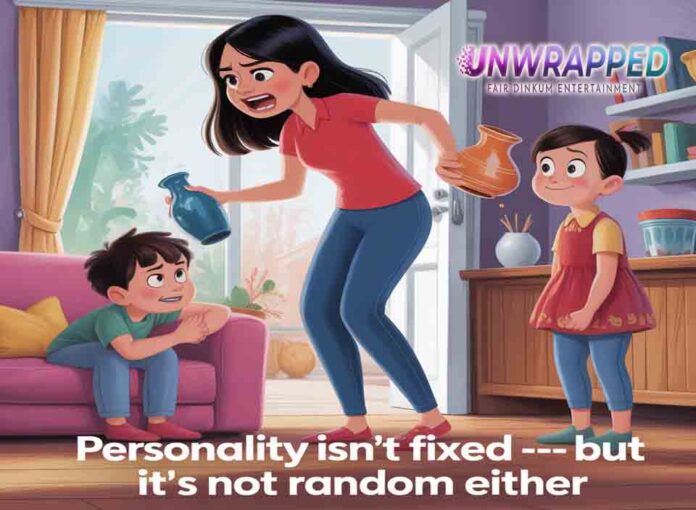
For decades, personality has been framed as something people are simply “born with”—a fixed identity stamped early and carried unchanged through life. Popular quizzes, labels, and stereotypes reinforce this idea, suggesting that once a personality type is identified, behavior becomes predictable and permanent. Yet real life tells a different story.
People change. They adapt after loss, mature through responsibility, soften with safety, and sharpen under pressure. Still, this change is not chaotic or arbitrary. Personality evolves in patterned, meaningful ways. Modern psychology increasingly agrees: personality is flexible—but it follows structure, not randomness.
The Myth of the Static Personality
The belief that personality never changes stems from early trait theories that emphasized stability. While traits like introversion or conscientiousness do show consistency, long-term research paints a more nuanced picture.
Personality traits shift gradually across adulthood—often becoming more emotionally stable, agreeable, and self-regulated over time. Change doesn’t mean becoming someone else; it means expressing the same core tendencies differently.
Why Personality Feels Stable (Even When It’s Not)
Personality appears fixed because:
People repeat familiar coping strategies
Social roles reinforce certain behaviors
Environments reward consistency
Neural pathways strengthen with repetition
The brain prefers efficiency. Repeated emotional and behavioral patterns become easier to access, giving the illusion of permanence.
But efficiency is not destiny.
See Also: Why Some People Seem Intense (Even When They’re Not)
Personality Develops Through Patterns, Not Chaos
Personality change follows recognizable influences:
Temperament: innate emotional sensitivity and energy levels
Attachment history: early relational safety or instability
Environment: cultural norms, work demands, social expectations
Adaptation: responses to stress, loss, success, or safety
These factors interact continuously. Personality is better understood as a dynamic system—stable enough to feel recognizable, flexible enough to evolve.
The Role of Temperament: The Starting Point
Temperament refers to biologically influenced traits such as:
Reactivity to stress
Sensitivity to stimulation
Baseline emotional intensity
Temperament sets the range—not the script.
For example, a highly sensitive temperament may express as anxiety in unsafe environments, creativity in supportive ones, or leadership when paired with confidence. The core sensitivity remains, but its expression changes.
Adaptation Shapes Personality More Than Identity
Many personality traits are actually adaptive strategies developed over time.
Common examples include:
“Independence” shaped by early unreliability
“Easygoing” behavior formed through conflict avoidance
“Logical” identity developed to manage emotional overwhelm
“Strong” personas built through emotional suppression
These adaptations are not flaws—they are intelligent responses to context. Personality often reflects what worked, not who someone truly is.

Why Change Feels Risky to the Personality System
Even when growth is desired, personality resists sudden change.
This happens because:
Familiar patterns feel safer than unknown ones
Identity coherence matters to the nervous system
Social feedback reinforces old roles
Changing behavior can feel like losing protection. Behavioral shifts often trigger stress responses—not because change is bad, but because predictability is biologically calming.
Personality Is Context-Sensitive, Not Contradictory
People often feel confused by their own inconsistency:
Calm at work, reactive at home
Confident socially, doubtful privately
Empathetic with friends, guarded with family
This is not fragmentation—it’s contextual expression.
Personality traits activate differently depending on:
Safety levels
Power dynamics
Emotional load
Relationship history
This adaptability explains why people can appear “different” without being inauthentic.
What Actually Changes Over Time
Research consistently shows that personality change tends to follow patterns rather than randomness:
Emotional regulation improves with age
Impulsivity often decreases
Self-awareness increases
Values become clearer
Coping strategies mature
Growth Doesn’t Mean Becoming Someone Else
One of the biggest misconceptions about personality change is that it requires reinvention.
In reality, growth usually looks like:
The anxious becoming discerning
The sensitive becoming boundaried
The logical becoming emotionally fluent
The independent becoming selectively connected
The core remains. The expression evolves.
People Also Love: Why “Good Vibes Only” Can Feel Unsafe
What This Means for Self-Understanding
Understanding that personality isn’t fixed—or random—offers relief:
Growth is possible without erasure
Patterns can be changed without losing identity
Past behavior doesn’t define future capacity
Personality is not a verdict. It is a living system.
Call to Action
If this article helped reframe how personality works, share it with someone questioning whether they’re “stuck” being a certain way. For more evidence-based insights into personality, emotional patterns, and self-development, follow or subscribe for future articles.
Conclusion
Personality is not a rigid identity carved in stone, nor is it a random collection of traits. It is a patterned system shaped by biology, experience, and adaptation. Change happens slowly, meaningfully, and within recognizable boundaries.
Understanding this balance—between stability and flexibility—allows people to grow without self-betrayal. Personality doesn’t need to be escaped. It needs to be understood, supported, and allowed to evolve.
Another Must-Read: The Difference Between Standards and Self-Worth