


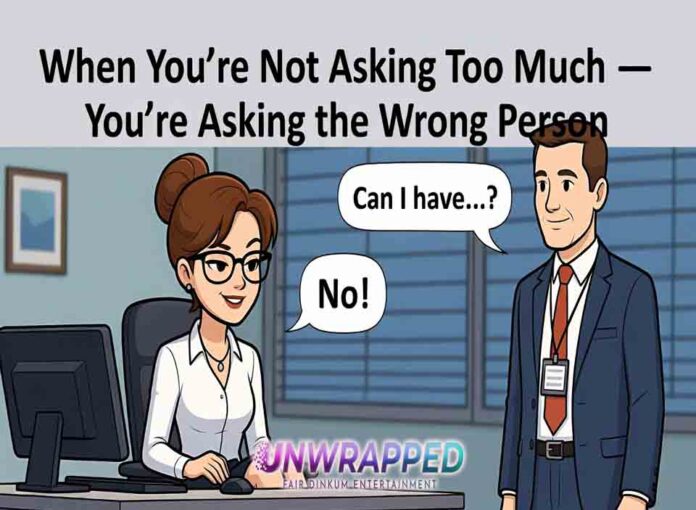
Many people carry a quiet fear that their needs are excessive. When requests are met with defensiveness, dismissal, or silence, it is easy to assume the problem is asking too much. Over time, this belief hardens into self-doubt, shrinking needs before they are even voiced.
But psychology and relationship research suggest a different explanation. Often, the issue is not the size of the request—it is a mismatch between what is being asked and who is being asked. This article explores why that mismatch happens, how it gets misinterpreted as personal failure, and how to tell the difference between unreasonable demands and incompatible capacity.
Why “Too Much” Is a Convenient Story
The idea of “asking too much” is emotionally efficient. It allows relationships, workplaces, and families to avoid harder truths about limits, emotional availability, or willingness.
In many situations:
Needs are valid but unmet
Requests are reasonable but unsupported
Effort exists on one side but not the other
People are more likely to internalize blame than confront relational imbalance, especially when harmony feels at risk.
Calling oneself “too much” can feel safer than acknowledging that someone else is unable—or unwilling—to meet a need.
See Also: The Personality Clash That Looks Like “Chemistry”
Capacity vs. Character: The Critical Difference
A common misunderstanding is assuming that inability equals lack of care. In reality, people differ widely in emotional, cognitive, and situational capacity.
Someone may genuinely care but still lack:
Emotional regulation skills
Time or energy
Communication tools
Psychological safety
Emotional availability is influenced by stress, mental health, and learned behavior—not just intention.
When capacity is missing, repeated requests can feel like pressure rather than connection—even when the request itself is fair.
Why the Same Need Feels “Too Much” to the Same Person
When people keep asking the same thing from the same person and receive the same response, frustration grows on both sides.
This happens because:
The request targets a known limitation
The person lacks tools to respond differently
The dynamic becomes reactive rather than relational
Over time, the asker begins to self-edit, while the responder becomes increasingly defensive. The need remains, but the conversation deteriorates.
This is a “repetition compulsion,” where unmet needs drive repeated attempts for resolution in the same relational context.
The Hidden Cost of Asking the Wrong Person
Persistently seeking validation, reassurance, or support from someone who cannot provide it carries real psychological consequences.
Common outcomes include:
Chronic self-doubt
Emotional exhaustion
Over-functioning in relationships
Resentment and withdrawal
Over time, the individual learns to equate needing with burdening. This belief often follows people into new relationships unless consciously examined.
How Power Dynamics Distort “Reasonable” Requests
In workplaces, families, and romantic relationships, power dynamics strongly influence whose needs are labeled excessive.
For example:
Employees may feel “too demanding” for requesting boundaries
Children may feel “too sensitive” for asking for emotional safety
Partners may feel “too needy” for asking for consistency
Unequal power often reframes legitimate needs as personal shortcomings rather than systemic issues.
What feels like “too much” is often simply inconvenient to someone with more control.
Compatibility Matters More Than Communication
Good communication is important, but it cannot compensate for fundamental incompatibility in values, priorities, or emotional bandwidth.
For example:
Someone who values independence may struggle to provide frequent reassurance
Someone who avoids conflict may resist emotional processing
Someone overwhelmed by stress may not have relational capacity
Compatibility in emotional needs predicts long-term satisfaction more strongly than communication style alone.
No amount of clearer wording can create capacity where it does not exist.
Signs You’re Asking the Wrong Person
Certain patterns suggest the issue is not excess, but mismatch:
Needs are minimized or reframed as flaws
Requests are met with irritation rather than curiosity
Temporary change is followed by regression
You feel smaller after expressing yourself
These signs do not mean the other person is bad. They mean the relationship may not be designed to support that particular need.
Reframing the Question That Actually Matters
Instead of asking:
“Why am I too much?”
A more useful question is:
“Who is capable of meeting this need consistently and willingly?”
This shift moves the focus from self-judgment to relational alignment. It allows people to distribute needs across appropriate relationships—friends, partners, colleagues, professionals—rather than overloading one person.
People Also Love: What Emotional Safety Actually Feels Like
Call to Action
If this article reframed how you think about your needs, share it with someone who might be questioning themselves in the same way. Subscribe for more psychology-based insights that challenge self-blame and clarify relationship dynamics.
Conclusion
Needing support, clarity, reassurance, or consistency does not make someone demanding. More often, it reveals a mismatch between expectation and capacity.
When people stop asking whether they are “too much” and start asking whether they are asking the right person, self-respect grows. Needs become information rather than accusations—and relationships become clearer, even when they do not continue.
Another Must-Read: Why You Keep Having the Same Argument