


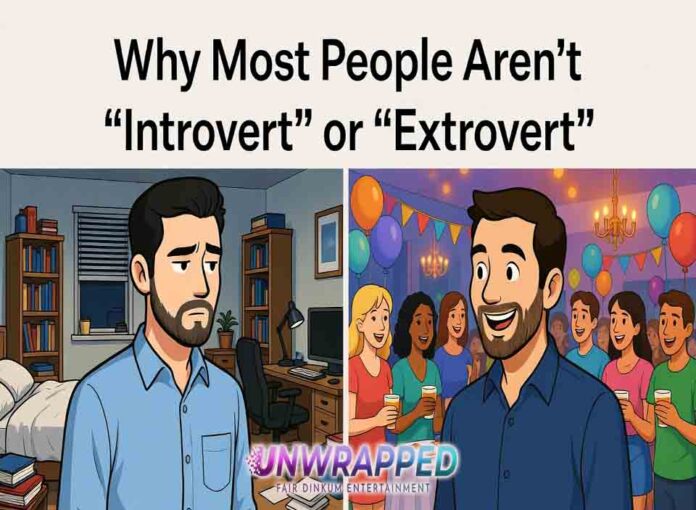
Few ideas in psychology have traveled faster—or been flattened more—than the introvert–extrovert divide. In everyday conversation, people are routinely sorted into one of two camps: quiet or outgoing, reserved or social, drained by people or energized by them. The simplicity is appealing. It feels explanatory. It feels neat.
Yet the lived reality of human behavior rarely fits that clean split. Most people recognize themselves in both descriptions depending on context, season, or role. Modern personality research increasingly shows that the introvert–extrovert binary survives not because it is accurate, but because it is convenient. Understanding why most people are neither strictly introvert nor extrovert opens the door to a more flexible, realistic view of personality.
Where the Introvert–Extrovert Idea Came From
A Spectrum Turned Into a Shortcut
The concepts of introversion and extraversion originated in early personality theory as ranges, not categories. Even Carl Jung, whose work popularized the terms, described them as orientations—not boxes. Contemporary psychology continues this view. Extraversion exists on a continuum, with most people clustering near the middle.
The problem arose when nuance was traded for speed. In pop culture, “spectrum” quietly became “either/or.”
See Also: What Personality Actually Is (And What It Isn’t)
Why the Binary Spread So Easily
The introvert–extrovert split stuck because it:
Offers quick self-recognition
Provides social shorthand
Feels predictive in familiar situations
Humans prefer categories because they reduce mental effort. The brain likes shortcuts—even when accuracy suffers.
What Personality Research Actually Shows
Most People Are Ambiverted
Large-scale studies consistently find that most people fall between extremes. These individuals—often called ambiverts—display both introverted and extroverted tendencies depending on circumstances. Ambiverts adapt more easily across environments because they are not locked into one response style.
An ambivert may:
Enjoy social gatherings but need recovery time
Speak confidently in meetings yet value solitude
Alternate between leading and observing
This flexibility is not inconsistency—it is responsiveness.
Energy Is Contextual, Not Categorical
One of the most common myths is that introverts are “drained by people” and extroverts are “energized by people.” In reality, energy levels depend heavily on context, meaning, and safety. A quiet person may feel energized by deep conversation and exhausted by small talk. A socially bold person may thrive on collaboration but feel depleted by emotional conflict.
Why People Misidentify as Introvert or Extrovert
Confusing Preference With Identity
Enjoying quiet does not make someone an introvert. Enjoying social connection does not make someone an extrovert. Preferences describe what feels good—not who someone is. When preferences are mistaken for identity, people overcommit to labels that only describe part of them.
Mistaking Stress Responses for Personality
Burnout, anxiety, grief, or prolonged stress can dramatically change social behavior. Withdrawal during overload is often labeled “introversion,” while high-energy coping can be mislabeled “extroversion.” Mental health resources emphasize that temporary states can look like personality shifts without reflecting core disposition.
Personality is stable; stress responses are not.
A Better Way to Understand Social Energy
Think in Patterns, Not Poles
Instead of asking which one am I?, a more accurate question is:
In which situations does social interaction energize or drain me?
Patterns reveal far more than categories.
Separate Stimulation From Connection
Many people dislike high stimulation (noise, crowds, chaos) but enjoy connection. Others enjoy stimulation but struggle with emotional closeness. Collapsing both into introversion or extraversion blurs critical distinctions discussed in modern personality research.
People Also Love: Why Personality Labels Feel True — Until They Don’t
Call to Action
If this article challenged the introvert–extrovert labels you’ve relied on, share it with someone who feels boxed in by personality categories. Start a conversation about context, energy, and flexibility—or subscribe to continue exploring psychology beyond oversimplified labels.
Conclusion
Most people are not introvert or extrovert in the way popular culture suggests. They are responsive, contextual, and adaptive—shifting with roles, environments, and stages of life. The binary persists because it is simple, not because it is accurate.
When personality is understood as a dynamic system rather than a fixed category, people gain permission to evolve without contradiction. Letting go of the introvert–extrovert divide doesn’t erase self-understanding—it deepens it, replacing labels with clarity and flexibility.
Another Must-Read: Traits vs Types: Why Both Can Mislead You