

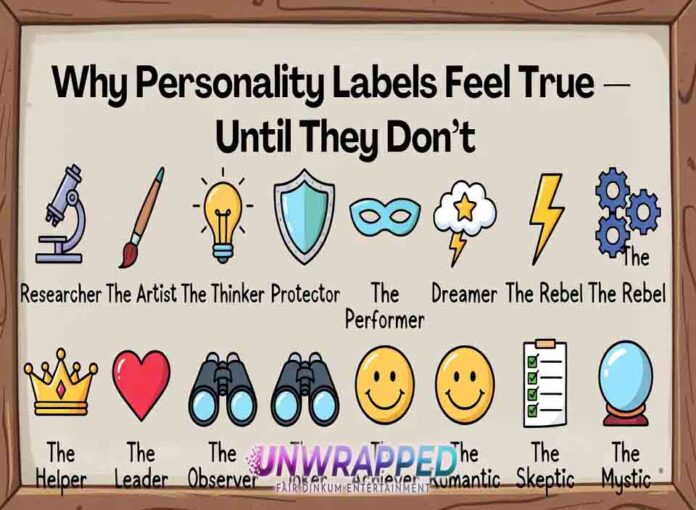
Personality labels have an uncanny way of clicking into place. A short description, a few familiar traits, and suddenly a person feels seen. Whether it’s a workplace assessment, a psychology article, or a popular online quiz, these labels often arrive with a rush of recognition—this explains so much. They feel accurate, validating, even comforting.
But for many people, that sense of truth doesn’t last forever. Over time, the same label that once brought clarity begins to feel tight, outdated, or incomplete. Behaviors shift. Priorities change. Life introduces contradictions the label can’t explain. This raises an important question: why do personality labels feel so true at first—and why do they eventually stop fitting?
Why Personality Labels Feel So Accurate at First
They Name Patterns People Already Notice
Most personality systems work because they put language to experiences people have already observed. A description of someone as “analytical,” “empathetic,” or “highly driven” resonates because it reflects repeated behaviors. Humans naturally seek patterns to make sense of themselves and others, making labels feel like confirmations rather than discoveries.
When a label matches lived experience, the brain treats it as insight—even if it is only a partial one.
They Reduce Inner Chaos
Life is complex. Emotions conflict. Motivations shift. Personality labels simplify this complexity into something manageable. According to articles published in Psychological Science, the brain prefers coherent narratives over ambiguity. A label offers a story: this is why things feel this way.
That sense of order can feel deeply reassuring, especially during periods of uncertainty or transition.
See Also: Why Some People Feel Responsible for Everyone
They Create Social Belonging
Labels don’t just explain behavior—they connect people. Being “an introvert,” “a strategist,” or “a feeler” provides instant community and shared language. Platforms often discuss how identity frameworks foster belonging by offering shorthand for connection.
When a label helps someone feel less alone, it can feel profoundly true—even if it’s incomplete.
The Psychological Mechanisms Behind the “This Is Me” Feeling
Confirmation Bias at Work
Once a person adopts a personality label, the brain starts filtering experiences through it. Behaviors that match the label are noticed and remembered, while contradictions are overlooked. This well-documented effect, known as confirmation bias, is explored extensively in cognitive psychology research.
Over time, the label appears increasingly accurate—not because it explains everything, but because attention narrows around it.
The Barnum Effect
Many personality descriptions are broad enough to apply to a wide range of people. This phenomenon, called the Barnum Effect, explains why people find vague statements personally meaningful. The concept is frequently referenced in behavioral science articles showing how general traits feel specific when framed personally.
This doesn’t make personality systems useless—but it explains why early resonance can feel almost magical.
When Personality Labels Start to Break Down
Life Changes Faster Than Labels Do
Personality labels often assume stability, while life demands adaptation. A person who once thrived on structure may become more flexible after navigating uncertainty. Someone known for independence may become more relational after deep partnership or caregiving.
Traits do shift gradually across adulthood, especially following major life events. When growth outpaces the label, friction appears.
Context Reveals Contradictions
People are not consistent across all situations. A person may be cautious at work and spontaneous with friends, assertive in crisis and reserved in calm settings. Context strongly influences behavior—sometimes more than traits themselves.
Labels struggle when they try to flatten context into a single identity.
The Label Becomes a Ceiling
At a certain point, labels stop describing behavior and start justifying limits. Statements like “that’s just how this type is” can quietly discourage growth. Behavioral psychologists warn that over-identification with labels can reduce motivation to change.
What once felt explanatory begins to feel restrictive.
The Difference Between Useful Labels and Limiting Ones
Helpful Labels Are Descriptive, Not Prescriptive
A healthy personality label describes tendencies without dictating outcomes. It explains what comes easily—not what is impossible. For example:
“Prefers preparation” does not mean “can’t improvise”
“Emotionally sensitive” does not mean “emotionally fragile”
When labels leave room for choice, they remain useful longer.
Limiting Labels Freeze Identity
Problems arise when labels harden into identity. When people confuse patterns with essence, they stop experimenting with new responses. Growth requires space to surprise oneself.
People Also Love: Why Some People Are Great Starters but Bad Finishers
How to Use Personality Labels Without Getting Trapped by Them
Treat Labels as Tools, Not Truths
Personality frameworks work best when used as maps—not territories. They can suggest tendencies, blind spots, and strengths without defining identity. Educational psychology sources often emphasize that tools should evolve as understanding deepens.
A tool that cannot adapt eventually loses relevance.
Ask Better Questions Than “What Type Am I?”
More useful questions include:
When does this pattern show up—and when doesn’t it?
What does this trait protect or optimize for?
How has this tendency changed over time?
These questions turn labels into starting points rather than endpoints.
Call to Action
Personality labels can illuminate—but only if they remain flexible. If this article sparked reflection, share it with someone navigating self-discovery, or start a conversation about how labels have helped—or limited—you. For more psychology-backed insights into identity, behavior, and growth, consider subscribing or following the platform where this article appears.
Ending Thoughts
Personality labels feel true because they resonate with real patterns, reduce complexity, and offer belonging. They give language to experiences people already sense but struggle to name. In that early stage, they can be powerful tools for self-understanding.
But labels lose their grip when life, context, and awareness expand beyond their boundaries. At that point, the discomfort isn’t failure—it’s growth. Personality labels are most useful when held lightly, updated often, and never mistaken for the full story of a human being.
Another Must-Read: What Personality Actually Is (And What It Isn’t)