


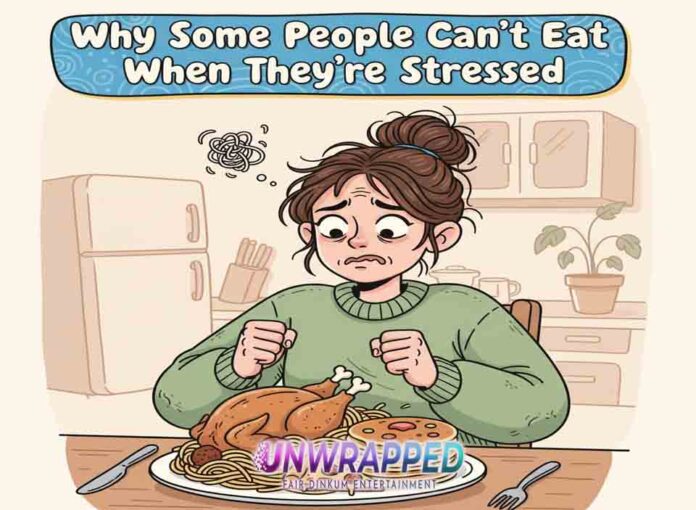
Stress affects appetite in wildly different ways. Some people reach for comfort food the moment pressure rises, while others lose all interest in eating—even when their body clearly needs fuel. The latter response is often misunderstood, framed as willpower, pickiness, or “just being anxious.” Psychology and physiology tell a very different story.
For many individuals, stress doesn’t spark hunger—it shuts the digestive system down. Appetite loss under stress is not a choice or a quirk. It is a coordinated biological response shaped by the nervous system, hormones, and survival wiring. Understanding why some people can’t eat when they’re stressed reveals how deeply the mind and body are intertwined.
Stress Redirects the Body’s Priorities
When stress hits, the body makes a clear decision about what matters most. Digestion does not make the cut.
Stress activates the sympathetic nervous system—the same system responsible for fight-or-flight responses. Blood flow is redirected away from the digestive tract and toward muscles, lungs, and the brain.
In this state:
Hunger signals weaken
Stomach activity slows
Digestive enzymes decrease
Food can feel heavy or repulsive
The body is not malfunctioning. It is reallocating resources for perceived survival.
See Also: Why Australians Can Be Friendly but Hard to Know
The Nervous System: Fight, Flight… or Fast?
Appetite suppression under stress is closely tied to nervous system dominance.
When the sympathetic nervous system is active, digestion pauses. When the parasympathetic nervous system (rest-and-digest) is active, appetite returns.
People who lose appetite under stress often:
Stay in high alert longer
Have slower transitions back to calm
Experience stress as internalized tension rather than outward energy
Prolonged sympathetic activation suppresses gastrointestinal function, even in the absence of conscious anxiety.
Why Stress Can Cause Nausea or Food Aversion
For some individuals, stress doesn’t just reduce hunger—it creates physical discomfort around eating.
This happens because stress hormones like cortisol and adrenaline affect the gut-brain axis. The stomach becomes more sensitive, and normal digestive sensations are interpreted as nausea, tightness, or fullness.
Common experiences include:
Feeling full after a few bites
A “knot” in the stomach
Gag reflex when trying to eat
Aversion to textures or smells
Stress-related gastrointestinal symptoms as a major contributor to appetite disruption, especially in high-pressure environments.
Appetite Loss Is Not the Same as Disordered Eating
One of the most important distinctions psychology makes is between stress-induced appetite loss and intentional restriction.
People who can’t eat when stressed are not trying to control intake. In fact, many want to eat and feel frustrated or worried that they can’t.
Key differences include:
Desire to eat is present, but body resists
Appetite returns when stress resolves
No motivation around weight or appearance
Stress-related appetite loss is a physiological response, not a behavioral disorder.

Emotional Stress vs. Cognitive Stress
Not all stress affects appetite equally.
Emotional stress—conflict, grief, fear, relational tension—tends to suppress appetite more strongly than cognitive stress like deadlines or problem-solving.
This is because emotional stress activates threat circuits more intensely. The brain interprets emotional threat as more immediate and less controllable, keeping the body in alert mode longer.
People who are emotionally perceptive or empathetic often experience this more acutely. Their nervous systems respond deeply to interpersonal tension, directly impacting digestion.
Why Some People Eat More—and Others Eat Less
Stress responses are not uniform. Appetite increase and appetite loss are two sides of the same stress coin.
Stress eating often occurs when food is used to activate calming pathways
Stress undereating occurs when stress overwhelms those same pathways
Neurobiology research shows that individual differences in cortisol sensitivity and dopamine response influence which pattern emerges.
Neither response is “better.” They reflect different regulation strategies within the nervous system.
Why Forcing Food Often Backfires
Well-meaning advice often urges people to “just eat something.” Unfortunately, forcing food while the nervous system is still activated can increase nausea and aversion.
The body resists digestion when it does not feel safe. Ignoring this signal can reinforce negative associations with eating under stress.
More effective approaches focus on downregulating stress first, not pushing calories immediately.
Supporting Appetite During Stress
Psychology and health research emphasize gentle regulation over pressure.
Helpful strategies include:
Small, neutral foods rather than full meals
Warm liquids to support digestion
Eating in low-stimulation environments
Reducing emotional pressure around food
The goal is not to override the body, but to help it return to safety.
People Also Love: The Aussie Habit of Self-Deprecation (and When It Turns Toxic)
When Appetite Loss Becomes Chronic
Occasional stress-related appetite loss is normal. Persistent appetite suppression, however, can signal chronic stress or nervous system dysregulation.
Long-term stress keeps digestion offline, increasing fatigue and nutritional depletion. This creates a feedback loop: low intake reduces resilience, making stress harder to regulate.
Rethinking Appetite as a Signal, Not a Problem
Loss of appetite under stress is often treated as something to “fix.” Psychology reframes it as information.
It signals:
The body does not feel safe yet
Stress load is exceeding recovery capacity
Regulation is needed before nourishment
Listening to this signal leads to faster recovery than fighting it.
Conclusion
Some people can’t eat when they’re stressed because their nervous system shifts into survival mode, temporarily shutting down digestion. This response is biological, predictable, and deeply human.
Appetite loss under stress is not weakness, lack of discipline, or indifference to health. It is the body’s way of prioritizing safety over fuel when threat—real or perceived—feels present.
Call to Action
If this article resonated, share it with someone who struggles to eat under pressure. Start a conversation, leave a comment, or subscribe for more psychology-based insights into stress, the nervous system, and everyday human responses.
Another Must-Read: Why Australians Respect Competence More Than Confidence