


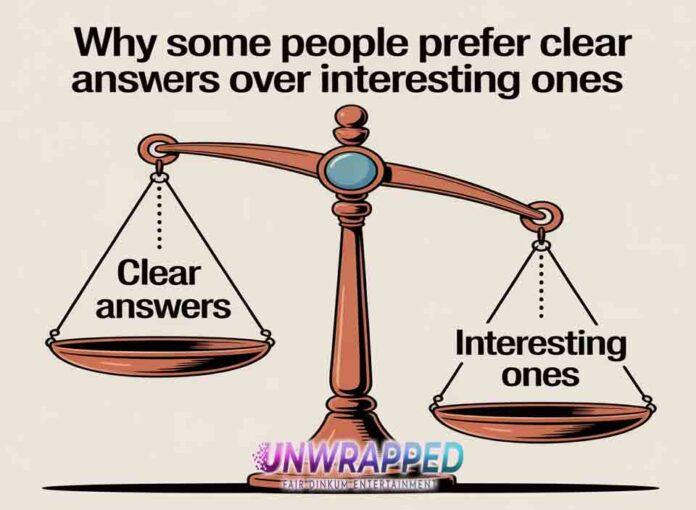
Not everyone is drawn to complexity. While some people enjoy nuance, ambiguity, and open-ended exploration, others gravitate toward clarity, structure, and direct conclusions. In conversations, classrooms, workplaces, and online spaces, this difference becomes visible when one group asks, “But what’s the answer?” while another asks, “What else could this mean?”
The preference for clear answers over interesting ones is not a lack of curiosity or imagination. It is shaped by psychology, environment, education, cognitive style, and even survival instincts. Understanding why some people value certainty more than intrigue helps explain communication breakdowns, learning preferences, leadership styles, and why certain ideas spread faster than others in modern culture.
Clarity vs. Curiosity: What’s the Real Difference?
Clear answers aim to resolve uncertainty. They provide closure, direction, and a sense of control. Interesting answers, on the other hand, often expand uncertainty. They invite reflection, raise new questions, and resist neat conclusions.
For people who prefer clarity, ambiguity can feel inefficient or even stressful. For those who prefer interesting answers, simplicity can feel reductive or uninspiring. Neither preference is inherently superior—but they serve different psychological needs.
See Also: Tall Poppy Syndrome as a Personality Stress-Test
The Psychological Comfort of Certainty
The Brain’s Desire to Reduce Uncertainty
Human brains are prediction machines. Clarity reduces cognitive load. When an answer feels definitive, the brain can stop scanning for threats, alternatives, or errors.
This explains why some people feel relief when given a clear rule, label, or explanation. Certainty creates mental rest.
Ambiguity Triggers Anxiety for Some People
Tolerance for ambiguity varies widely. People with lower ambiguity tolerance experience discomfort when outcomes are unclear or information feels incomplete.
For these individuals, interesting but unresolved answers can feel destabilizing rather than engaging. Clear answers restore emotional equilibrium.
How Education Shapes Answer Preferences
School Systems Often Reward Certainty
Traditional education frequently emphasizes correct answers over exploratory thinking. Multiple-choice tests, standardized grading, and time pressure reinforce the idea that knowing the answer matters more than exploring the question.
Over time, learners internalize this framework. Clear answers become associated with success, safety, and approval, while open-ended thinking feels risky.
Curiosity Without Structure Can Feel Unsafe
When curiosity is not guided or rewarded, it may feel like wandering without direction. People who thrive on clarity often prefer structured learning environments where expectations are explicit and outcomes are measurable.
Students vary widely in how much uncertainty they can productively tolerate before disengaging.

Personality Traits and Cognitive Styles
Need for Cognitive Closure
Psychologists describe a trait called need for cognitive closure, which reflects how strongly someone desires firm answers and resists ambiguity. Individuals with high need for closure prefer decisiveness, order, and predictability.
This trait influences political beliefs, leadership preferences, and information consumption. Clear answers feel trustworthy; complex ones feel unreliable.
Analytical vs. Exploratory Thinkers
Some cognitive styles prioritize efficiency and application. Others prioritize exploration and synthesis. People who prefer clear answers often think in terms of usefulness and actionability: What should be done next?
Interesting answers, while stimulating, may feel impractical if they do not lead to a clear course of action.
Communication Styles and Misunderstandings
When Interesting Answers Feel Like Avoidance
For clarity-oriented individuals, exploratory responses may feel evasive. They want resolution, not reflection.
This is common in workplaces, where one person asks for a clear directive and another offers context, nuance, or possibilities. Without awareness of these preferences, frustration builds.
When Clear Answers Feel Limiting
Conversely, people who enjoy interesting answers may feel constrained by overly definitive responses. They may perceive clarity as premature closure rather than helpful guidance.
Effective communication often requires matching the level of certainty to the listener’s needs.
The Modern Information Environment
Algorithms Favor Clear Answers
Search engines and social platforms reward clarity. Direct answers, bold claims, and simplified narratives perform better than nuanced explorations.
This reinforces the preference for certainty. Complexity struggles to compete with confidence in attention-driven systems.
Complexity Takes Time—Clarity Travels Faster
Interesting ideas often require patience. Clear answers are easier to share, remember, and repeat. In fast-moving digital environments, speed often wins over depth.
Is One Preference Better Than the Other?
Clear answers are valuable when:
Decisions must be made quickly
Safety or coordination is critical
Instructions need to be followed
Cognitive load is high
Interesting answers are valuable when:
Innovation is needed
Problems are complex or novel
Long-term thinking matters
Assumptions need to be challenged
Healthy thinking involves flexibility—the ability to seek clarity when needed and curiosity when appropriate.
People Also Love: Types Are Stories — Spectrums Are Maps: What’s the Difference?
Call to Action: Rethink How Answers Are Shared
Understanding this preference gap can transform communication. Whether teaching, leading, writing, or debating, clarity and curiosity both deserve space.
Readers are encouraged to share this article with teams, educators, or communities where misunderstandings around “simple vs. complex” thinking often arise. Subscribing for more psychology-backed insights can help deepen awareness of how people think—and why.
Conclusion
The preference for clear answers over interesting ones is not about intelligence or openness. It is about comfort, context, and cognitive needs. For many people, clarity provides safety, efficiency, and emotional regulation in a complex world.
Recognizing this helps reduce judgment on both sides. Some minds seek resolution; others seek expansion. When clarity and curiosity are seen as complementary rather than competing, conversations become more productive—and understanding becomes possible without forcing everyone to think the same way.
Another Must-Read: Why Some People Feel Guilty When They Rest