

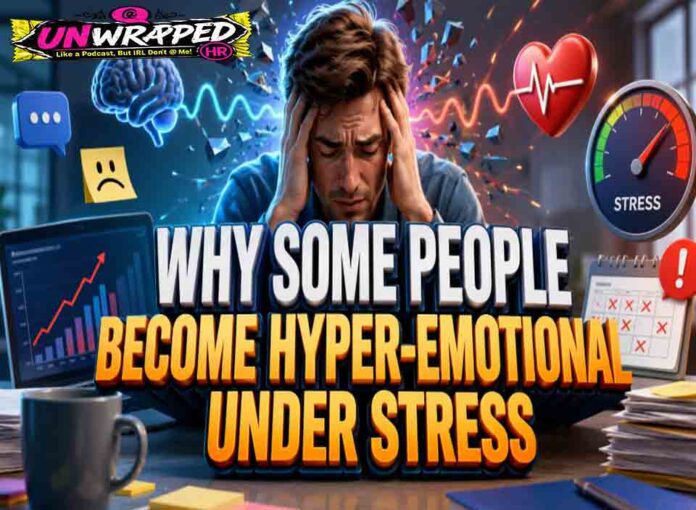
When stress enters the picture, people don’t just feel more pressure—they change how they express it. Some shut down. Some become hyper-logical. And some experience a sudden surge of emotion that feels intense, fast, and hard to control.
Tears come easily. Anger spikes. Anxiety floods the system. Reactions feel bigger than the trigger. To outsiders, this can look like drama or instability. In reality, becoming hyper-emotional under stress is a biologically valid stress response, not a personality flaw.
Understanding why this happens helps shift the conversation from judgment to regulation—and explains why telling someone to “calm down” almost never works.
Stress Amplifies Emotion Before It Clarifies Thought
The Brain Prioritizes Feeling Over Thinking
Under stress, the brain does not aim for rational analysis first. It aims for rapid signaling. Emotion is faster than logic.
According to the American Psychological Association, stress activates the brain’s threat systems, increasing emotional intensity while temporarily reducing access to higher-order reasoning.
For some people, this means emotion becomes the front-line response.
See Also: The Difference Between Burnout and Boredom
Emotion Is the Alarm System
Fear, anger, sadness, and panic are not mistakes. They are alarms designed to:
signal danger
mobilize support
prompt action
communicate urgency
When stress is high, the volume on that alarm gets turned up.
Hyper-Emotion Is a Regulation Attempt, Not a Failure
Feeling Is How Some People Stabilize
For certain nervous systems, emotional expression is regulating. Crying, venting, raising the emotional signal—these behaviors help discharge stress from the body.
Research shows that emotional expression can reduce physiological stress markers when it is not suppressed or shamed.
What looks like loss of control is often the body trying to return to balance.
Suppressing Emotion Makes It Worse
People who become hyper-emotional under stress often feel more overwhelmed when they try to contain it. The emotion builds pressure instead of releasing it.
This is why emotional expression can feel urgent—not indulgent.
Why Emotions Come Out “All at Once”
Stress Removes the Filters
In calmer states, the brain moderates emotion. Under stress, those filters weaken.
Articles explain that stress reduces the brain’s ability to sequence, prioritize, and pace emotional information. Everything arrives at once.
This creates:
sudden overwhelm
emotional flooding
difficulty separating past from present feelings
The reaction is intense because the system is overloaded, not because the person is fragile.
Sensitivity Is Not the Same as Weakness
Emotional Sensitivity = Fast Processing
People who become hyper-emotional under stress often have:
high emotional awareness
strong empathy
fast internal processing
deep attunement to cues
These traits are strengths in stable conditions. Under stress, they simply activate too quickly.
Emotionally sensitive nervous systems detect threat earlier—and react sooner.
Why Logic Disappears Temporarily
Emotion Takes the Wheel First
When emotional centers are highly activated, the brain’s reasoning systems go partially offline. This is not choice—it’s neurology.
The more someone is told to “be rational” in that moment, the more invalidated and escalated they may feel.
Logic usually returns after emotional safety is restored.
Common Triggers for Hyper-Emotional Stress Responses
relational conflict
feeling misunderstood
sudden rejection or loss
uncertainty with emotional stakes
cumulative stress without release
These situations activate connection-related threat systems, where emotion is the fastest messenger.
Burnout Makes Emotions Louder
Why Burned-Out People Cry or Snap More Easily
Burnout lowers emotional tolerance. Small stressors feel huge because reserves are depleted.
Emotional exhaustion as a core feature of burnout—often expressed through irritability, tearfulness, or emotional volatility.
The reaction isn’t overreaction. It’s under-resourced regulation.
Why “Calm Down” Backfires
Emotional Safety Comes Before Emotional Control
Telling someone to calm down assumes control is immediately available. Under stress, it often isn’t.
What helps instead:
validation (“I can see this is a lot”)
presence
slowing the environment
reducing demands
Once safety increases, intensity naturally decreases.
How to Support Someone Who Becomes Hyper-Emotional
What Helps
listening without fixing
acknowledging feelings without judging
staying steady rather than reactive
reducing stimulation
What Escalates
minimizing (“it’s not that bad”)
rushing solutions
criticizing emotional expression
demanding instant logic
Containment, not correction, is what brings regulation.
People Also Love: Why Some People Spiral When Plans Change
For People Who Recognize This in Themselves
Hyper-emotional responses are not something to “eliminate.” They are something to work with.
Helpful strategies include:
recognizing early stress signals
allowing safe emotional release sooner
scheduling decompression time
communicating needs before overload
Emotion becomes less explosive when it’s allowed to move earlier and more gently.
Call to Action
If this article reframed how you view emotional reactions—yours or someone else’s—share it. Understanding hyper-emotion as a stress response reduces shame and conflict. Subscribe or comment to explore more psychology explained in human, practical terms.
Conclusion
Becoming hyper-emotional under stress is not a sign of weakness or immaturity. It is a nervous system responding quickly and loudly to perceived threat.
When emotion is understood as information rather than inconvenience, people stop trying to shut it down—and start learning how to regulate it safely. And when that happens, intensity softens, clarity returns, and connection becomes possible again.
Another Must-Read: Why Some People Become Hyper-Logical Under Stress