


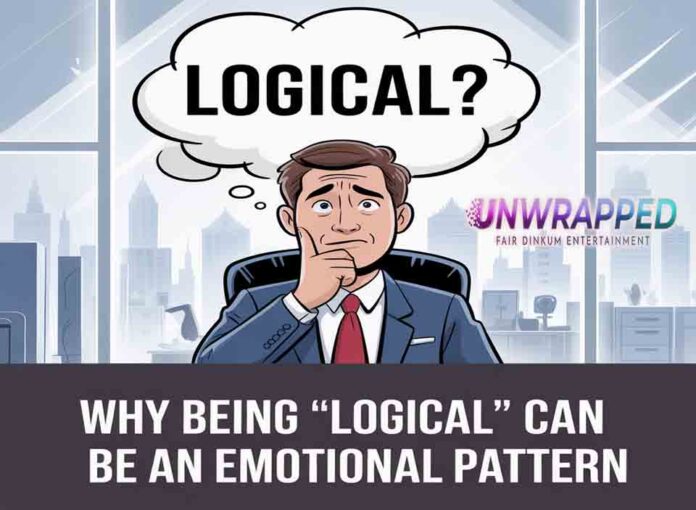
Logic is often praised as the opposite of emotion—clean, rational, controlled. In workplaces, relationships, and decision-making, being “logical” is treated as a marker of maturity and intelligence. Emotional responses, by contrast, are often framed as messy, biased, or unreliable.
Yet psychology tells a more nuanced story. In many cases, being intensely logical is not the absence of emotion—it is an emotional strategy. For some people, logic becomes a learned pattern for managing uncertainty, discomfort, vulnerability, or loss of control. Understanding this reframes logic not as a neutral trait, but as a protective emotional style shaped by experience.
Logic Is Not Emotion-Free—It’s Emotion-Regulating
Neuroscience has consistently shown that emotion and cognition are deeply intertwined. Emotions guide attention, priorities, and meaning—even in highly analytical thinking.
When someone defaults to logic:
Emotions are not removed
They are regulated, contained, or delayed
Reasoning becomes a stabilizing mechanism
In this sense, logic functions less as detachment and more as emotional regulation.
See Also: When “Strong” Is Actually Numb
When Logic Becomes a Safety Strategy
For many people, logic develops as a way to stay safe.
Psychodynamic theories describe how some individuals cope with stress by analyzing rather than feeling. This process, known as intellectualization, allows emotional distance from overwhelming experiences.
Common drivers include:
Growing up in emotionally unpredictable environments
Being rewarded for “staying calm” during stress
Learning that emotions lead to conflict or rejection
Logic becomes a shield—not a lack of feeling, but a controlled channel for it.
“Logical” Responses Can Mask Emotional Load
People who pride themselves on logic often experience strong emotions internally—but process them privately.
Suppressing emotional expression does not eliminate emotion. Instead, it redirects it inward, often increasing physiological stress.
This can look like:
Calm speech with internal tension
Rational explanations that avoid emotional meaning
Frustration when others “overreact”
The logic is real—but so is the emotion beneath it.
Why Logic Feels Safer Than Feelings
Emotions are uncertain. Logic feels predictable.
Cognitive research suggests that humans seek cognitive closure during uncertainty. Logic provides:
Clear frameworks
Cause-and-effect narratives
A sense of control
For individuals who associate emotion with chaos or helplessness, logic offers psychological ground to stand on.

The Cultural Reward for Being “Rational”
Social norms also reinforce logic as superior.
In many cultures and professional settings:
Logic is equated with competence
Emotional expression is equated with weakness
Calmness is mistaken for neutrality
People often learn to suppress emotion to gain credibility, especially in leadership or technical roles.
Over time, this external reward system internalizes logic as identity.
Logic as an Identity, Not Just a Tool
When logic becomes central to identity, challenges to reasoning can feel personal.
Instead of:
“This argument may be flawed”
It can feel like:“I am being threatened or misunderstood”
Logic stops being a method—and becomes an emotional anchor.
Emotional Blind Spots of Over-Logic
While logic is powerful, over-reliance can create blind spots.
These include:
Difficulty naming internal emotional states
Impatience with ambiguity or grief
Dismissing emotional data as “irrelevant”
Clinical psychology research highlights that emotional attunement is a skill, not an instinct. When logic dominates, this skill may remain underdeveloped—not absent.
Being Logical vs. Being Emotionally Integrated
There is a difference between:
Using logic
Using logic to avoid emotion
Emotionally integrated reasoning includes:
Acknowledging feelings before analysis
Using logic with emotional information
Allowing emotion to inform priorities, not control outcomes
People Also Love: Why Some People Mistake Anxiety for Intuition
Reframing Logic as an Emotional Strength
Logic is not the problem. Avoidance is.
When logic is reframed as:
A tool rather than a defense
A process rather than an identity
A partner to emotion rather than a replacement
It becomes more flexible, humane, and effective.
Emotion does not weaken logic—it grounds it.
Call to Action
If this perspective resonates, readers are encouraged to reflect on when logic feels clarifying—and when it feels protective. Share this article with colleagues, partners, or friends who value rationality, and subscribe for more psychology-based insights into human behavior that challenge everyday assumptions.
Conclusion
Being “logical” is often seen as emotional neutrality. In reality, it can be an emotional adaptation—one shaped by environment, reinforcement, and experience. Logic may regulate emotion, protect against uncertainty, or provide identity-level safety.
True emotional intelligence is not choosing logic over emotion, but integrating both. When logic listens to emotion instead of silencing it, reasoning becomes not just smarter—but wiser.
Another Must-Read: The Difference Between Confidence and Certainty