



Some experiences are difficult to explain, even years after they happen. Others stay with people long enough to become the stories they write, the characters they create or the questions they spend their lives trying to answer. For bestselling thriller author and screenwriter Scott Wells, exploring the complicated realities of human behaviour is central to his writing.
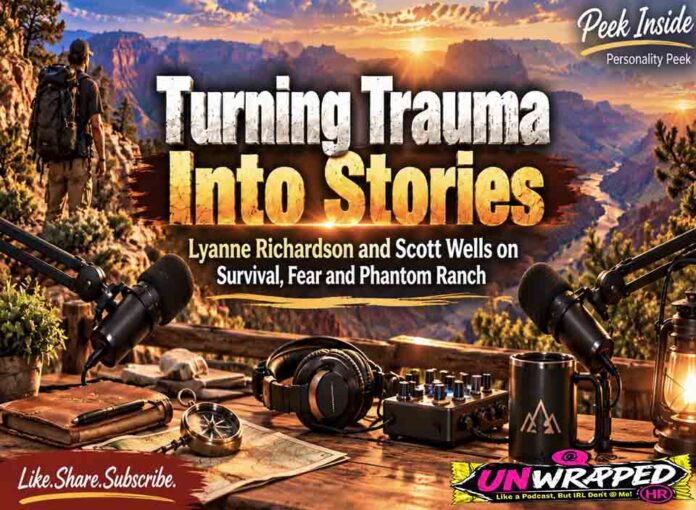
In Turning Trauma into Stories, Lyanne Richardson and Scott Wells explore the relationship between personal experiences, psychological suspense and creative storytelling. Drawing on the themes behind his novel Phantom Ranch, the discussion considers how fear, family conflict, identity and survival can become the foundations of fiction that reflects recognisable human struggles.
From Real-Life Trauma to Psychological Thriller Writing
There is an important difference between using a difficult experience as inspiration and simply recreating it on the page.
Scott Wells approaches storytelling with an interest in what happens beneath people’s outward behaviour. His work explores fear, deception, complicated relationships and the choices individuals make when circumstances become overwhelming.
His novel Phantom Ranch brings these interests together in a suspenseful story inspired by real events and set within the Grand Canyon.
Rather than relying entirely on physical danger, the narrative also explores emotional pressures. Its characters carry unresolved relationships, questions surrounding identity and personal histories that influence how they respond to threatening situations.
This creates an interesting question about writing trauma: can fiction help people explore experiences that might otherwise be difficult to discuss directly?
Stories offer a degree of distance between real events and imagined characters. That distance can give writers room to examine uncomfortable emotions, moral uncertainty and conflicting perspectives without presenting every experience as having a simple explanation.
For readers, these fictional situations can also raise questions about their own understanding of trust, vulnerability and resilience.
Scott’s interest in these subjects reflects his broader fascination with the darker and less predictable aspects of human nature.
Phantom Ranch: Family Secrets, Fear and Survival in the Grand Canyon
At the centre of Phantom Ranch are two estranged brothers brought together by their father’s dying wish.
Their relationship introduces emotional conflict before the external dangers of the wilderness begin to unfold.
The Grand Canyon provides a particularly compelling setting for this kind of psychological thriller. Its remarkable landscape offers beauty, solitude and adventure, but also isolation, uncertainty and genuine physical risks.
As an experienced outdoor adventurer, Scott brings his interest in hiking and camping into the fictional world he creates.
The setting allows two kinds of danger to exist simultaneously: threats arising from the natural environment and threats created by human behaviour.
That combination raises questions about survival.
When individuals face extreme circumstances, how much do their decisions reflect practical necessity? How much is shaped by fear, unresolved resentment or the instinct to protect themselves?
The novel also incorporates themes of coming out, friendship, loss and difficult family relationships, giving its suspense a more personal dimension.
These elements matter because a thriller becomes more than a sequence of dangerous events when readers understand what its characters stand to lose emotionally.
Beyond the Story: Reinvention, Creativity and Finding Meaning Through Fiction
Scott Wells’ creative journey also reflects the unpredictable process of turning an idea into a finished work.
Phantom Ranch originally began as a screenplay and became a semifinalist at the Atlanta Screenplay Awards. Scott subsequently developed it into a novel, recognising that the longer format offered greater room to explore the characters and their relationships.
His experience illustrates how creative projects can evolve when their original form no longer accommodates everything the writer wants to express.
Scott is also the author of Marked by the Ouija, a young adult horror novel, and writes across dark fiction, suspense and related genres.
Across these projects, a recurring interest remains: the relationship between extraordinary circumstances and ordinary human emotions.
Ultimately, Turning Trauma into Stories opens a broader conversation about how experiences influence creativity, how fiction examines uncomfortable truths and why people are drawn to stories about fear, survival and complicated relationships.
For anyone interested in psychological thrillers, true-crime-inspired fiction, creative reinvention or the human experiences behind storytelling, the conversation offers an opportunity to look beyond the finished book and consider the ideas that shape it.
Watch the full conversation with Lyanne Richardson and Scott Wells to explore the inspiration behind Phantom Ranch, the psychology of storytelling and the experiences that influence the stories people choose to tell.
Watch the full conversation on Peek Inside: