



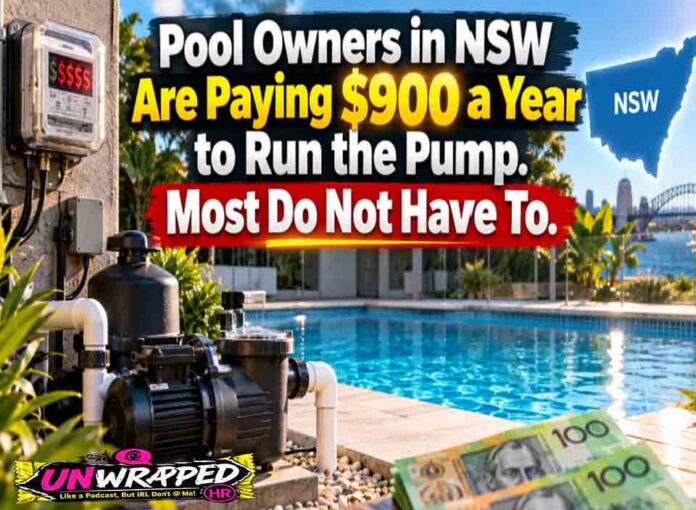
New South Wales has around 350,000 backyard pools, and most of them are run by a single speed pump that was fitted when the pool was built. Those pumps are the quiet reason so many pool owners get a shock on the summer power bill. The state’s Energy Savings Scheme now pays most of the cost of replacing them, but the rebate is one of the least known of the household energy incentives, partly because it never arrives as a payment. Here is how it works in practice.
What the rebate is
The Energy Savings Scheme is the NSW program behind the better known hot water and air conditioning incentives. It works by paying accredited providers for verified energy savings, and the provider passes that value to the householder as a discount on the installed price. For pool pumps, the eligible upgrade is replacing an existing single speed pump with a high efficiency variable speed pump of at least a certain energy rating. The installer does the paperwork; the customer sees a lower price.
What you actually pay
The retail picture first: a good variable speed pool pump costs $990 to $1,890 to buy, and pool shops typically charge $1,500 to $2,500 installed. With the scheme discount applied through an accredited provider, the going rate for a NSW pool pump replacement with the rebate is $899 installed for a 6 star 2.0 horsepower variable speed pump across Sydney, the Central Coast, Newcastle, the Hunter and Wollongong to Jervis Bay, and $1,049 for the rest of the state. That price includes the pump, installation, programming for the pool and filter, removal of the old pump and GST. A minimum three year warranty applies, five years on the Madimack unit most commonly fitted.
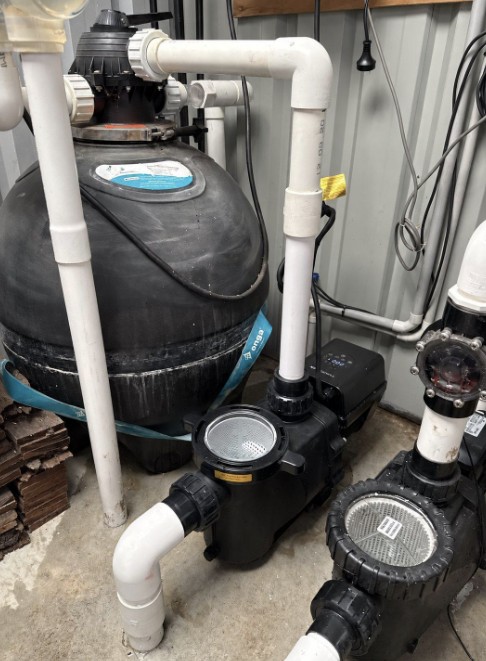
A variable speed pool pump plumbed into the existing filter, installed by Efficient Energy Group under the NSW pool pump rebate.
What you save
A 1.5 horsepower single speed pump running seven hours a day uses about 2,800 kilowatt hours a year, which is around $900 at Sydney prices. A variable speed pump on the same pool, programmed to run slow for most of the day, uses a fraction of that; the typical figure is about $190 a year. Savings land between $500 and $1,100 a year depending on pool size, so the $899 outlay comes back in roughly 15 months and the pump then runs for a decade or more. It is also far quieter, because it spends most of its time at low speed.
Who qualifies
- The property is in NSW and has an existing pool pump being replaced. New pools and first pumps do not qualify.
- The work is done by a provider accredited under the Energy Savings Scheme, who confirms eligibility before the install.
- You can supply three photos of the current pump and a recent power bill. The bill is used only for the meter number and address.
- Owner occupiers qualify directly; tenants need the owner’s agreement; strata pools go through the owners corporation.
If you are not sure whether your address qualifies, Energy Rebate Check runs a free postcode checker that shows which NSW energy rebates apply to a home, including the pool pump upgrade, before anyone books a visit.
Some councils add their own rebate on top. Randwick refunds 50 per cent up to $250 on pumps installed in the previous 12 months, and Ku-ring-gai pays $250 on pumps bought after 1 July 2026 with pre approval. Those are claimed from the council after the install, separately from the state scheme.
How the process runs
Send the photos and bill, get a fixed quote, and the installer books a date, usually within seven business days of accepting. The install itself takes an hour or two: old pump out, new pump plumbed and wired, programmed to a slow daily schedule with a short high speed run for the skimmer and filter. You are shown the schedule before they leave. The eligibility steps and current pricing are set out on Efficient Energy Group’s pool pump replacement page.
Things to watch
Any provider quoting the rebate must be accredited under the scheme, not just a pool shop that has heard of it. The discount should be shown on the quote, not promised as a later refund. A pump that is still single speed after the install, or a variable speed pump left running flat out, produces none of the saving, which is why the programming step matters more than the badge on the pump. And if your current pump has started tripping the breaker or leaking at the seal, a repair call out in NSW runs $80 to $150, which is money better put towards the replacement.