


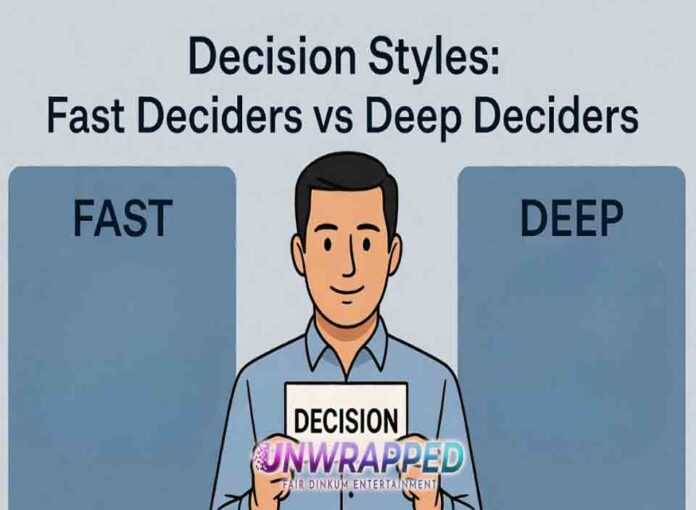
Every workplace, family, and relationship contains an invisible tension that rarely gets named: some people decide quickly, while others decide carefully. One moves with speed and confidence; the other pauses, weighs options, and digs deeper. Too often, these differences are misread as competence versus hesitation—or recklessness versus overthinking.
In reality, fast deciders and deep deciders represent two equally valid cognitive strategies, shaped by biology, experience, and context. Understanding how these decision styles work—and when each one shines—can dramatically reduce friction, improve outcomes, and change how people judge themselves and others.
What Are Decision Styles?
Decision style refers to how people gather information, process uncertainty, and commit to action. Psychologists generally agree that decision-making exists on a spectrum rather than in rigid categories.
At opposite ends of that spectrum sit two common patterns:
Fast Deciders – prioritize speed, momentum, and adaptability
Deep Deciders – prioritize accuracy, meaning, and long-term impact
Neither style is inherently better. Problems arise when one style is treated as the default.
See Also: Why Some People Need Money More Than Meaning (and That’s Fine)
Fast Deciders: Built for Momentum
Fast deciders tend to move with urgency and confidence. They process information quickly, tolerate uncertainty, and believe that action itself creates clarity.
Core traits of fast deciders:
Rapid pattern recognition
High comfort with ambiguity
Strong bias toward action
Willingness to adjust after deciding
Research notes that fast decision-makers are particularly effective in volatile environments where waiting carries its own risks.
Fast deciders often thrive in:
Startups and crisis situations
Leadership roles requiring quick calls
Environments with reversible decisions
Their strength is momentum. They keep systems moving when paralysis would be more dangerous than imperfection.
The Hidden Cost of Speed
However, speed can come with trade-offs.
Fast deciders may:
Miss subtle risks or emotional dynamics
Underestimate long-term consequences
Struggle with decisions involving people rather than systems
Behavioral research shows that rapid decisions are more vulnerable to cognitive bias when stakes are high and feedback is delayed.
Speed works best when errors are affordable.

Deep Deciders: Built for Depth
Deep deciders move differently. They pause, reflect, and examine multiple layers before committing. To outsiders, this can look like hesitation. Internally, it is a process of meaning-making and risk containment.
Core traits of deep deciders:
Strong need for contextual understanding
High sensitivity to downstream effects
Preference for irreversible decisions to be “right”
Discomfort with incomplete information
Psychological studies explain that reflective thinkers engage more deliberate neural pathways associated with long-term planning.
Deep deciders often excel in:
Ethical or people-centered decisions
Strategic planning
Complex, irreversible choices
Their strength is precision.
The Hidden Cost of Depth
Depth also carries risk.
Deep deciders may:
Experience decision fatigue
Delay action past the optimal window
Absorb unnecessary stress from uncertainty
Research shows that prolonged uncertainty increases anxiety and cognitive load. For deep deciders, the cost is often emotional rather than practical.
Depth works best when decisions truly matter long-term.
Why These Styles Clash So Easily
Fast and deep deciders often frustrate each other because they optimize for different threats.
Fast deciders fear stagnation and missed opportunity
Deep deciders fear regret and unintended harm
Neither fear is irrational. They are responses to different internal risk calculations.
Organizational research shows that mixed decision styles outperform homogeneous teams—when the differences are respected.
Conflict arises not from difference, but from moralizing those differences.
Decision Style Is Not Intelligence
One of the most damaging myths is that faster decisions equal sharper minds—or that slower decisions equal deeper ones.
Cognitive science research demonstrates that both intuitive and deliberative reasoning involve complex intelligence, just activated differently.
Decision speed reflects:
Nervous system sensitivity
Past consequences of mistakes
Environmental conditioning
It does not measure competence.
Choosing the Right Style for the Situation
High-performing individuals often learn to borrow from the opposite style when needed.
When fast decisions work best:
Low-risk, reversible choices
Time-sensitive situations
Exploratory or experimental phases
When deep decisions work best:
High-stakes, irreversible choices
Ethical or relational consequences
Long-term strategic planning
The most effective decision-makers are not fast or deep by identity—they are contextually fluent.
People Also Love: Why Some People Need Meaning More Than Money
Call to Action
If this article clarified your own decision style—or helped you understand someone else’s—share it. Subscribe for more psychology-based insights on how people think, choose, and collaborate differently.
Conclusion
Fast deciders keep the world moving. Deep deciders keep it from breaking. Both styles exist because both are necessary.
When speed and depth stop competing and start complementing each other, decisions improve—not just in quality, but in trust. The real advantage lies not in choosing one style, but in recognizing when each one is doing exactly what it was designed to do.
Another Must-Read: Why Some People Need Deadlines to Start