



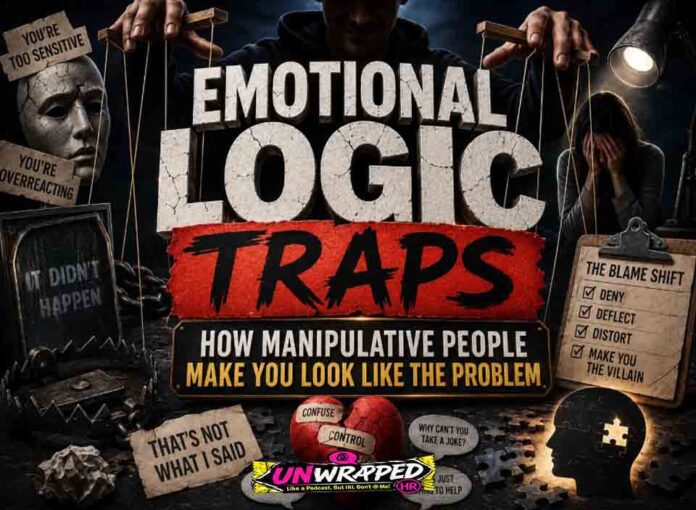
This is the classic snaky setup.
Step one: they poke you.
Maybe subtly. Maybe with a little insult. Maybe with a patronising tone. Maybe with a fake question. Maybe with a “joke.” Maybe by ignoring something obvious.
Step two: you react.
Maybe you get tense. Maybe you explain. Maybe you raise your voice slightly. Maybe your face changes. Maybe you sound irritated.
Step three: they point at your reaction.
“Wow, calm down.”
“Why are you getting so angry?”
“You’re being really defensive.”
“I can’t even talk to you.”
Now the original poke disappears, and your reaction becomes the crime scene.
That is the move.
They want to be the calm judge while you become the emotional defendant.
Page Contents
ToggleHow to spot it
Here are the signs.
1. They describe your emotional state as if it is a fact
“You’re angry.”
“You’re upset.”
“You’re triggered.”
“You’re jealous.”
“You’re insecure.”
“You’re bitter.”
They are not asking. They are assigning.
A normal person might say:
“Are you okay? You seem upset.”
A manipulative person says:
“You’re upset because you know I’m right.”
That second version is not care. It is control.
2. Denying it somehow proves it
This is the Kafka trap.
“You’re defensive.”
“No, I’m not.”
“See? You’re defending yourself.”
No fair answer is allowed.
If you deny it, guilty.
If you explain, guilty.
If you get annoyed, guilty.
If you go quiet, guilty.
The only winning move is to reject the frame.
“That’s circular. My denial is not evidence. Address the point.”
3. They move from the issue to your tone
You say:
“You lied about what happened.”
They say:
“I don’t like your tone.”
Your tone may or may not be perfect. But notice the move.
The subject changed from their action to your delivery.
Useful response:
“I’ll keep my tone steady. Now answer the point.”
That gives them no easy escape. You’ve acknowledged the tone issue without letting them use it as a trapdoor.
4. They act wounded by being questioned
You ask a reasonable question.
They say:
“Wow. So now I’m the bad guy?”
That is not an answer. That is a role reversal.
They are trying to become the victim of your attempt to clarify reality.
Response:
“You’re not the bad guy for being asked a question. I’m asking you to answer it.”
5. They use “concern” as a weapon
“I’m worried about you.”
“You don’t seem okay.”
“You need help.”
“This reaction isn’t normal.”
Sometimes concern is real. But fake concern has a smell: it appears exactly when you stop complying.
Response:
“Don’t pathologise me. Address what happened.”
The brutal list
1. “Calm down.”
The game:
They position themselves as the calm adult and you as the unstable child.
Why it works:
Even if you were calm, now you feel patronised. If you react to being patronised, they say, “See?”
What they are really doing:
“Before your point can be valid, you must perform calmness to my satisfaction.”
Clean response:
“I’m calm enough to discuss this. Respond to what I said.”
Sharper response:
“Telling someone to calm down is not an argument.”
Brutal response:
“You’re using ‘calm down’ to avoid the point.”
2. “You seem angry.”
The game:
They make your emotional state the topic.
The trap:
If you say, “I’m not angry,” you sound defensive. If you say, “Yes, I am,” they dismiss you as emotional.
Clean response:
“Maybe I am. The point still stands.”
This is powerful because it refuses the bait. You are not trying to prove you are emotionless.
Sharper:
“My mood is not the subject. The issue is what happened.”
3. “Why are you getting defensive?”
The game:
They accuse you of guilt without directly saying what you did wrong.
The trap:
Any answer looks like more defence.
Response:
“That’s a loaded question. What specific thing are you accusing me of?”
Or:
“Explaining myself is not the same as being defensive.”
Brutal:
“You’re calling my response defensive because you don’t want to answer it.”
4. “You’re overreacting.”
The game:
They make themselves the judge of what level of reaction you are allowed to have.
The hidden message:
“Your response is too big, therefore the issue is too small.”
Response:
“You don’t have to agree with my reaction. You still need to address the issue.”
Sharper:
“Calling it an overreaction doesn’t make the original problem disappear.”
5. “You’re too sensitive.”
The game:
They convert their disrespect into your weakness.
What it really means:
“I want to say whatever I want without dealing with your response.”
Response:
“Maybe I am sensitive. You were still rude.”
That one is excellent because it does not accept the false choice. You can be sensitive and they can still be wrong.
Sharper:
“Sensitivity is not the issue. Respect is.”
6. “I was only joking.”
The game:
They insult you, then hide behind humour.
The trap:
If you object, you “can’t take a joke.” If you laugh, they got away with it.
Response:
“A joke at my expense is still a choice.”
Or:
“Explain the joke.”
That one is lethal. If the joke was just cruelty in a costume, making them explain it drains the fun out of it.
Brutal:
“It became a joke only when you got challenged.”
7. “Can’t you take a joke?”
The game:
They make your boundary look like a personality defect.
Response:
“I can take a joke. I don’t have to take disrespect.”
Sharper:
“The problem isn’t humour. The problem is using humour as cover.”
8. “No offence, but…”
The game:
They try to pre-forgive themselves before saying something offensive.
Response:
“Saying ‘no offence’ doesn’t make it harmless.”
Or:
“Then say it in a way that doesn’t need that warning.”
9. “With all due respect…”
The game:
A formal costume for disrespect.
Usually means:
“I’m about to be rude, but I want credit for being civil.”
Response:
“Then keep it respectful.”
Simple. No essay.
10. “I’m just being honest.”
The game:
They confuse honesty with permission to be cruel.
Truth:
Honesty is about accuracy. Cruelty is about delivery, timing, and intention.
Response:
“Honesty doesn’t require disrespect.”
Sharper:
“You’re not being honest. You’re being unfiltered and calling it a virtue.”
11. “I’m only trying to help.”
The game:
They make you look ungrateful for rejecting interference, criticism, or control.
Response:
“Help respects consent. I didn’t ask for that.”
Or:
“If it’s help, it should be useful to me, not just satisfying for you to say.”
12. “I’m saying this because I care.”
The game:
They use care as emotional body armour.
It implies:
“Because my intention is good, you’re not allowed to object to my method.”
Response:
“Care doesn’t cancel out impact.”
Sharper:
“If you care, you can hear how it landed.”
13. “You’re twisting my words.”
The game:
They said something dodgy, you noticed, and now they accuse you of distortion.
Sometimes people genuinely get misunderstood. But the snaky version appears when they refuse to clarify plainly.
Response:
“Then clarify what you meant without attacking my interpretation.”
Or:
“I’m responding to what you said. If you meant something else, say that clearly.”
14. “That’s not what I meant.”
The game:
This can be legitimate. But it becomes a trap when they use it to erase what they actually said.
Response:
“Okay. What did you mean?”
Then be quiet.
If they cannot give a clean alternative meaning, they were hiding.
Sharper:
“Intent noted. Now let’s deal with what was actually said.”
15. “You misunderstood me.”
The game:
They put the entire burden on your comprehension.
Response:
“Maybe. Then explain it clearly.”
Sharper:
“Misunderstanding is possible. So is poor communication. Clarify it.”
16. “You’re taking it the wrong way.”
The game:
They make your interpretation the problem instead of their wording or behaviour.
Response:
“Then tell me the right way to take it.”
Again, silence after this is powerful.
17. “You always take things the wrong way.”
The game:
They turn one issue into a character flaw.
This is a globalising move: always, never, every time, this is what you do.
Response:
“Stay with this specific situation.”
Or:
“We’re not discussing ‘always.’ We’re discussing what just happened.”
18. “Here we go again.”
The game:
They make your concern sound like a boring repeated performance.
It says:
“Your issue is not worth hearing because I’ve heard your tone before.”
Response:
“Yes, here we are again because it still hasn’t been addressed.”
Brutal and clean.
19. “I can’t say anything around you.”
The game:
They convert your boundary into their oppression.
What it means:
“If I can’t say things without consequences, I’m being silenced.”
Response:
“You can say what you want. I can respond.”
Sharper:
“You’re not being silenced. You’re being disagreed with.”
20. “So I’m not allowed to have an opinion?”
The game:
They confuse having an opinion with being immune from challenge.
Response:
“You’re allowed to have an opinion. I’m allowed to question it.”
Sharper:
“Freedom to speak is not freedom from response.”
21. “Wow, so now I’m the bad guy?”
The game:
Victim reversal.
Instead of answering for what they did, they dramatise being held accountable.
Response:
“This isn’t about making you the bad guy. It’s about addressing what happened.”
Sharper:
“Being asked to take responsibility is not persecution.”
22. “I guess I just can’t do anything right.”
The game:
Self-pity as a smoke bomb.
They turn your specific complaint into their global despair, forcing you to comfort them.
Response:
“That’s not what I said. I’m talking about this one thing.”
Brutal:
“I’m not going to comfort you out of accountability.”
23. “Fine, I’m just a terrible person then.”
The game:
Emotional hostage-taking.
They exaggerate your criticism so you’ll rush to reassure them.
Response:
“I didn’t say that. I’m asking you to take responsibility for a specific action.”
Sharper:
“Turning this into self-pity avoids the issue.”
24. “You’re making me feel bad.”
The game:
They make your boundary responsible for their discomfort.
Truth:
You can care about someone’s feelings without becoming responsible for protecting them from the consequences of their actions.
Response:
“I understand this feels bad. That doesn’t mean I caused the problem.”
Or:
“Feeling bad is not the same as being wronged.”
That one hits.
25. “After everything I’ve done for you…”
The game:
Debt collection.
They use past kindness to buy immunity from present accountability.
Response:
“I appreciate what you’ve done. It doesn’t cancel this issue.”
Sharper:
“Good history doesn’t erase bad behaviour.”
26. “You’re ungrateful.”
The game:
They frame your boundary as betrayal.
Response:
“Gratitude doesn’t mean silence.”
Or:
“I can be grateful and still say no.”
27. “You’ve changed.”
The game:
They are grieving the version of you that was easier to control.
Sometimes “you’ve changed” means:
“You used to tolerate this.”
Response:
“Yes. I have.”
That is often enough.
Sharper:
“I’m not easier to pressure anymore. That may feel like change.”
28. “I miss the old you.”
The game:
Nostalgia as manipulation.
Translation:
“I preferred you before the boundaries.”
Response:
“The old me tolerated things I don’t tolerate now.”
Simple. Devastating.
29. “Be the bigger person.”
The game:
They ask you to absorb unfairness so everyone else can stay comfortable.
Response:
“Being the bigger person doesn’t mean being the bin.”
Or cleaner:
“Being mature includes having boundaries.”
30. “Let it go.”
The game:
They want the benefits of forgiveness without repair.
Response:
“Letting it go comes after it’s addressed, not instead of addressing it.”
Sharper:
“You don’t get to decide when someone else is finished with your behaviour.”
31. “You’re holding a grudge.”
The game:
They rebrand memory as malice.
Sometimes you are not holding a grudge. You are recognising a pattern.
Response:
“Remembering a pattern is not the same as holding a grudge.”
Excellent line.
32. “Why are you bringing up the past?”
The game:
They want every incident judged in isolation so the pattern never becomes visible.
Response:
“Because the pattern matters.”
Or:
“If it keeps happening, it’s not just the past.”
33. “That was ages ago.”
The game:
They use time as a substitute for repair.
Response:
“Time passing is not the same as accountability.”
34. “I already said sorry.”
The game:
They treat apology as a receipt that entitles them to silence.
Response:
“An apology is a start. Changed behaviour is the point.”
Sharper:
“If the apology ended the issue, the behaviour wouldn’t still be happening.”
35. “I’m sorry you feel that way.”
The game:
The fake apology.
It sounds like an apology but apologises for your feelings, not their behaviour.
Response:
“That’s not an apology for what you did.”
Or:
“I’m not asking you to apologise for my feelings. I’m asking you to address your action.”
36. “I’m sorry, but…”
The game:
The apology that immediately defends itself.
Response:
“Everything after ‘but’ is the part you actually mean.”
Or less sharp:
“Can you apologise without explaining it away?”
37. “You’re making a big deal out of nothing.”
The game:
Minimisation.
They shrink the action and enlarge your reaction.
Response:
“It may be nothing to you. It isn’t nothing to me.”
Sharper:
“If it’s so small, it should be easy to address.”
That one is useful because it turns their minimization back on them.
See Also: Why You Feel “Flat” After a Big Goal
38. “Nobody else has a problem with me.”
The game:
Invisible jury.
They bring in an imaginary crowd to outvote you.
Response:
“I’m not speaking for everybody else. I’m speaking for me.”
Sharper:
“Other people’s silence doesn’t invalidate my point.”
39. “Everyone thinks you’re difficult.”
The game:
Triangulation.
They use unnamed people to make you feel surrounded.
Response:
“Who is everyone?”
If they won’t name names, say:
“Then don’t use invisible people as evidence.”
Brutal:
“If they have an issue, they can speak for themselves.”
40. “You’re difficult.”
The game:
They label you difficult because you are no longer convenient.
Response:
“If having boundaries makes me difficult, I’ll live with that.”
Sharper:
“Difficult often means hard to manipulate.”
Use that carefully, but it is true in many cases.
41. “You’re high-maintenance.”
The game:
They shame you for having needs or standards.
Response:
“Standards are not high-maintenance just because they inconvenience you.”
42. “You’re selfish.”
The game:
They treat your refusal to self-sacrifice as moral failure.
Response:
“Not giving you what you want is not automatically selfish.”
Or:
“I’m allowed to consider myself too.”
43. “You only care about yourself.”
The game:
Extreme moral accusation.
It pressures you to overgive just to prove you are not selfish.
Response:
“I’m not going to overextend myself to disprove an accusation.”
That is a grown-up line.
44. “If you cared, you would…”
The game:
Love as a lever.
They make compliance the proof of care.
Response:
“Care does not mean automatic agreement.”
Sharper:
“Don’t turn care into a contract where I must obey.”
45. “I would do it for you.”
The game:
Hypothetical guilt.
They claim imaginary generosity to pressure real compliance.
Response:
“Maybe you would. I’m still allowed to say no.”
46. “You owe me.”
The game:
Relationship as ledger.
Response:
“If something was a gift, it wasn’t a loan.”
Or:
“If there are expectations attached, say them clearly upfront.”
47. “You’re being negative.”
The game:
They use positivity to shut down criticism.
Response:
“Naming a problem is not negativity.”
Sharper:
“Pretending there’s no problem is not positivity.”
48. “Don’t bring drama.”
The game:
The person causing chaos accuses the person naming it of creating drama.
Response:
“Drama is the behaviour, not the conversation about it.”
Excellent line.
49. “Why are you making this awkward?”
The game:
They make the discomfort of accountability your fault.
Response:
“I didn’t make it awkward by naming it.”
Sharper:
“The awkward part is what happened, not me pointing at it.”
50. “Can we not do this here?”
The game:
Sometimes valid. But often it is used to avoid accountability in front of people they performed for.
Response:
“Fine. Then we will discuss it privately after.”
Key: do not let “not here” become “not ever.”
51. “I don’t want to argue.”
The game:
They say something provocative, then declare the conversation closed.
Response:
“Then don’t argue. Answer the question.”
Or:
“You don’t get to take a shot and then hide behind peace.”
52. “I’m just trying to keep the peace.”
The game:
Peacekeeping that always requires you to swallow the issue.
Response:
“Peace without honesty is just silence.”
Sharper:
“You’re asking me to keep the peace by carrying the discomfort alone.”
53. “Let’s be adults.”
The game:
They imply you are childish for objecting.
Response:
“Adults address issues directly.”
Or:
“Agreed. So let’s address the actual issue.”
54. “You need to grow up.”
The game:
Shame attack disguised as maturity advice.
Response:
“Insulting me doesn’t make your point stronger.”
55. “I thought you were more mature than this.”
The game:
They try to make you earn their approval by backing down.
Response:
“Maturity is not the same as silence.”
56. “You’re acting crazy.”
The game:
Pathologising.
They try to make your reaction seem irrational or unstable.
Response:
“Don’t insult me. Address the point.”
Sharper:
“Calling me crazy is not an argument.”
57. “You need help.”
The game:
They turn disagreement into diagnosis.
Response:
“Don’t use therapy language as a weapon.”
Or:
“If you’re concerned, speak respectfully. If you’re insulting me, own it.”
58. “You’re triggered.”
The game:
They use psychological language to belittle your response.
Response:
“Maybe I’m reacting because something happened. Address that.”
Sharper:
“Calling me triggered doesn’t make you right.”
59. “You’re projecting.”
The game:
They avoid your point by claiming it reveals your inner issues.
Response:
“Maybe. Now respond to the actual claim.”
Or:
“That’s speculation about me, not an answer.”
60. “You’re insecure.”
The game:
They invent a weakness that explains away your objection.
Response:
“You don’t need to diagnose me to answer the point.”
Sharper:
“Even if I were insecure, that wouldn’t make your behaviour okay.”
That line is strong because it refuses the false dependency.
61. “You’re jealous.”
The game:
They reduce your concern to envy.
Response:
“That’s a convenient story. It doesn’t answer what I said.”
62. “You’re bitter.”
The game:
They rebrand experience as resentment.
Response:
“Calling me bitter doesn’t disprove the pattern.”
63. “You’re just trying to control me.”
The game:
Boundary inversion.
You set a limit. They call it control.
Truth:
A boundary says:
“Here is what I will do.”
Control says:
“Here is what you must do.”
Response:
“I’m not controlling you. I’m telling you what I will and won’t accept.”
64. “So now I have to walk on eggshells?”
The game:
They frame basic respect as impossible oppression.
Response:
“No. You just have to be considerate.”
Sharper:
“If respect feels like eggshells, that says something.”
65. “That’s just how I am.”
The game:
They present bad behaviour as identity.
Response:
“Then this is just how I respond to it.”
Or:
“Being ‘how you are’ doesn’t exempt you from consequences.”
66. “You know what I’m like.”
The game:
Advance excuse.
They expect you to adjust around their behaviour instead of them taking responsibility for it.
Response:
“Yes, and that’s why I’m setting the boundary clearly.”
67. “You should know me by now.”
The game:
They expect your familiarity with their flaws to become tolerance.
Response:
“Knowing you doesn’t mean accepting everything.”
68. “You made me do it.”
The game:
Responsibility dump.
They make their action your fault.
Response:
“You chose your response.”
Sharper:
“My behaviour is mine. Yours is yours.”
69. “I only lied because I knew how you’d react.”
The game:
They justify betrayal by blaming your future reaction.
Response:
“My possible reaction didn’t make you lie.”
Brutal:
“You don’t get to blame me for the lie and then use the lie as proof I’m hard to tell the truth to.”
70. “See? This is why I didn’t tell you.”
The game:
They use your reaction to bad news as justification for hiding it.
Response:
“You don’t get credit for predicting that I’d react to being mistreated.”
71. “I didn’t tell you because I didn’t want to hurt you.”
The game:
They disguise avoidance as protection.
Response:
“That protected you from the conversation. It didn’t protect me.”
Very strong.
72. “You’re attacking me.”
The game:
They recode criticism as violence.
Response:
“I’m criticising an action. That is not an attack.”
Sharper:
“Disagreement is not attack.”
73. “Stop lecturing me.”
The game:
They call your explanation a lecture so they don’t have to hear it.
Response:
“Then answer directly and I won’t need to explain it again.”
74. “You always have to be right.”
The game:
They avoid whether you are right by attacking your desire to be right.
Response:
“Wanting accuracy isn’t the same as needing dominance.”
Or:
“If I’m wrong, show me where.”
75. “You think you’re perfect?”
The game:
Deflection.
They try to make your flaws the topic.
Response:
“No. And my imperfections don’t erase this issue.”
Sharper:
“We can discuss me after we finish discussing this.”
76. “You do it too.”
The game:
Counter-accusation.
Sometimes relevant, often evasive.
Response:
“If I’ve done it, we can discuss that too. Right now we’re discussing this instance.”
77. “What about when you…”
The game:
Whataboutism.
They dodge the current issue by opening another file.
Response:
“That may be a separate issue. It doesn’t answer this one.”
78. “You’re making this about you.”
The game:
You describe how their action affected you, and they shame you for having a perspective.
Response:
“I’m allowed to talk about how your behaviour affected me.”
79. “You always play the victim.”
The game:
They try to make any claim of harm look manipulative.
Response:
“Naming harm is not playing victim.”
Sharper:
“Calling it victimhood is a way to avoid responsibility.”
80. “You love drama.”
The game:
They attack your motives so they don’t have to address your evidence.
Response:
“If I loved drama, I’d keep this vague. I’m being specific.”
81. “You’re reading too much into it.”
The game:
Ambiguity protection.
They say something with an edge, then retreat into “you imagined it.”
Response:
“Then make it clear.”
Or:
“If there’s nothing behind it, you should have no problem saying it plainly.”
82. “It was just a comment.”
The game:
They minimise impact by shrinking the category.
Response:
“Comments still have meaning.”
83. “You’re making assumptions.”
The game:
Sometimes fair. But often used when you are drawing an obvious conclusion from repeated behaviour.
Response:
“Then correct the assumption with a clear explanation.”
84. “I never said that.”
The game:
Literalism.
They avoid the implication by focusing only on exact wording.
Response:
“You didn’t use those exact words. That was the implication.”
Or:
“Let’s not hide behind wording. What was the message?”
85. “Technically…”
The game:
Technical truth used to dodge moral truth.
Example:
“I didn’t lie. I just didn’t tell you.”
Response:
“Technical accuracy doesn’t change the deception.”
86. “You’re putting words in my mouth.”
The game:
They avoid owning the natural meaning of what they said.
Response:
“Then put your own words on it clearly.”
87. “I don’t remember that.”
The game:
Could be true. But repeated convenient amnesia is a fog machine.
Response:
“You may not remember. I do. The issue still needs addressing.”
Sharper:
“Your lack of memory doesn’t erase the impact.”
88. “That never happened.”
The game:
Flat denial.
If you know it happened, do not get dragged into begging them to accept reality.
Response:
“We remember it differently. I’m making decisions based on what I experienced.”
This is powerful because it moves from argument to boundary.
89. “You’re gaslighting me.”
The game:
Weaponised therapy language.
Real gaslighting is serious: it means manipulating someone into doubting their reality. But some people use the word to mean “you disagree with me.”
Response:
“Disagreeing with your version is not gaslighting. Let’s stay with the facts.”
90. “That’s your truth.”
The game:
They relativise facts into vibes.
Response:
“There may be different perspectives. There are also facts.”
91. “Agree to disagree.”
The game:
Sometimes healthy. But sometimes used to prematurely close a conversation where accountability is needed.
Response:
“We can disagree about opinions. We still need to address behaviour.”
92. “Why can’t you just move on?”
The game:
They want closure without repair.
Response:
“Because moving on without change just repeats the same cycle.”
93. “You’re punishing me.”
The game:
You set a consequence. They call it punishment.
Response:
“A consequence is not punishment. It’s me choosing what I stay available for.”
94. “You’re giving me the silent treatment.”
The game:
Sometimes silence is manipulative. But sometimes distance is self-protection.
Response:
“I’m taking space because the conversation wasn’t respectful.”
Important distinction:
Silent treatment is used to control someone.
Taking space is used to regulate yourself.
Another Must-Read: The Psychology of “Don’t Get Ahead of Yourself”
95. “Fine. Whatever.”
The game:
Contempt in disguise.
It pretends to end the conversation while leaving emotional poison in the room.
Response:
“That doesn’t sound resolved. We can pause, but I’m not pretending this is handled.”
96. “Okay, believe what you want.”
The game:
They refuse accountability while implying you are unreasonable.
Response:
“I will. And I’ll act accordingly.”
That is cold and clean.
97. “I’m not mad, I’m disappointed.”
The game:
Parent-child frame.
They put themselves above you morally.
Response:
“You’re allowed to be disappointed. I’m still allowed to disagree.”
98. “You should be ashamed.”
The game:
Shame attack.
Response:
“Shame isn’t an argument.”
99. “You’re embarrassing yourself.”
The game:
Social control.
They try to make you self-conscious so you stop speaking.
Response:
“I’m comfortable with what I’m saying.”
100. “You must be fun at parties.”
The game:
Mockery used to punish seriousness.
Response:
“Mocking me doesn’t answer the point.”
The deeper games they are playing
Game 1: Tone court
They put your tone on trial.
You came to discuss facts. They drag you into proving you are calm enough to be heard.
Their move:
“Your tone invalidates your point.”
Your counter:
“My tone can be improved, but the point still needs answering.”
This is the balanced version. You are not pretending tone never matters. You are refusing to let tone erase content.
Game 2: The invisible jury
They speak as if an audience has already judged you.
“Everyone thinks…”
“People are saying…”
“Nobody else has this issue…”
The purpose is to make you feel outnumbered.
Counter:
“Speak for yourself.”
Or:
“If someone has something to say, they can say it directly.”
Game 3: The fake therapist
They diagnose you instead of answering you.
“You’re triggered.”
“You’re projecting.”
“You’re insecure.”
“You need help.”
The purpose is to move from:
“What happened?”
to:
“What is wrong with you?”
Counter:
“Don’t diagnose me. Respond to the issue.”
Game 4: The saint costume
They act kind while being cutting.
“I’m only trying to help.”
“I’m worried about you.”
“I say this with love.”
“I just want peace.”
The purpose is to make themselves look morally clean while putting pressure on you.
Counter:
“If this is care, it needs to be respectful.”
Game 5: The role swap
They do something questionable. You respond. Suddenly they are the victim.
“I can’t say anything.”
“You’re attacking me.”
“So I’m the bad guy?”
“You’re making me feel awful.”
The purpose is to make you comfort them instead of hold the line.
Counter:
“I’m not attacking you. I’m asking you to take responsibility.”
Game 6: The burden shift
They make you prove you are not angry, insecure, jealous, selfish, bitter, dramatic, or crazy.
The purpose is to exhaust you.
Counter:
“I’m not going to prove I’m reasonable before you answer a reasonable point.”
That is one of the best lines in the whole topic.
Game 7: Plausible deniability
They say something with an edge, but leave themselves an escape hatch.
“I was joking.”
“You took it wrong.”
“I didn’t mean it like that.”
“It was just a comment.”
The purpose is to let them stab with a rubber knife: enough to hurt, soft enough to deny.
Counter:
“Then say what you mean plainly.”
Game 8: The maturity leash
They use maturity language to get submission.
“Be the bigger person.”
“Let’s be adults.”
“Grow up.”
“I expected better from you.”
The purpose is to make backing down look noble.
Counter:
“Maturity includes directness and boundaries.”
The cleanest way to handle these
Use this formula:
1. Name the frame
“You’re making this about my tone.”
2. Refuse the label
“I’m not debating whether I’m angry.”
3. Return to the issue
“The issue is that you said X and then denied it.”
4. Set the boundary
“If you keep labelling me instead of answering, I’m ending the conversation.”
Full version:
“You’re making this about my tone instead of what happened. I’m not debating whether I’m angry. The issue is that you said X. Are you willing to address that directly?”
That is clean, strong, and hard to twist.
The best one-liners
Use these when you feel the trap forming.
“I reject the premise.”
“That’s a label, not an answer.”
“Don’t narrate my emotions. Address my point.”
“My reaction is not the original issue.”
“You’re trying to make me defend myself instead of answering the question.”
“I’m not going into tone court.”
“You can dislike my delivery and still answer the point.”
“That’s a character comment, not a response.”
“You’re turning accountability into an attack.”
“I’m not responsible for managing your discomfort with this conversation.”
“If you need a calmer tone, fine. If you need no accountability, no.”
“We can pause. We are not burying it.”
“Speak plainly. What are you accusing me of?”
“That question comes with a built-in accusation.”
“I’m not going to over-explain myself to escape a label you chose.”
“You’re allowed to feel that way. I’m allowed to hold my boundary.”
“I’m not accepting that frame.”
That last one is huge.
“I’m not accepting that frame.”
Because that is the whole thing. They are trying to put a frame around reality where they are reasonable and you are the problem.
The most important distinction
Not everyone who says one of these phrases is manipulating you.
Sometimes someone says:
“Calm down.”
because you genuinely are shouting.
Sometimes someone says:
“You seem angry.”
because they are honestly trying to check in.
Sometimes someone says:
“That hurt me.”
because it did.
The difference is what happens next.
A sincere person can handle clarification.
You say:
“I hear you. I’m frustrated, but I want to stay on the actual issue.”
A sincere person says:
“Okay. Fair. Let’s talk about it.”
A game-player says:
“See? You’re still doing it.”
That is how you know.
The test is simple:
Do they use your response to understand you, or to convict you?
If they use it to understand, it is probably clumsy communication.
If they use it to convict, it is a trap.
The thing you learned the hard way
When you were younger and more responsive, you probably felt this automatic pull:
“Oh no, they think I’m angry.”
“Oh no, I’ve upset them.”
“Oh no, I need to explain.”
“Oh no, I need to prove I’m good.”
That makes you easy to frame.
Not because you’re weak. Because you had a conscience and they found the handle.
The upgrade is this:
You can care about someone’s feelings without accepting responsibility for their framing.
That is the line.
You are responsible for:
your words,
your actions,
your choices,
your repair when you genuinely mess up,
your boundaries,
your self-control.
You are not responsible for:
their interpretation,
their discomfort with accountability,
their need to be seen as innocent,
their mood after you say no,
their story about what your reaction “means.”
That is where freedom starts.
The nuclear detector question
When you suspect someone is playing this game, ask yourself:
“Are they trying to resolve the issue, or are they trying to win the position of calm reasonable person?”
Because that is the whole scam.
Some people do not want truth.
They want the aesthetic of reasonableness.
They want to look calm, measured, concerned, mature, and above it all — while quietly needling, dodging, minimising, or controlling.
Once you see it, you cannot unsee it.
And the best takedown is not exploding.
The best takedown is staying precise:
“You’re not responding to what I said. You’re commenting on my reaction. I’m happy to continue if we discuss the actual issue. Otherwise, we’re done here.”
That is the cleanest light you can shine on the whole thing.
The main personalities that do this
1. The image-protector
This person needs to look like the good, calm, reasonable one.
Their favourite moves:
“I’m only trying to help.”
“I’m worried about you.”
“Why are you being so hostile?”
“I don’t want drama.”
The game: they want to behave badly while keeping a clean public image.
They are often very good at sounding mature. They use soft voice, concerned face, careful wording. But the actual effect is: you end up looking unstable while they look saintly.
What they fear most:
Being exposed as less kind than they pretend to be.
Spot them by this: they care more about how the situation looks than what actually happened.
2. The covert-aggressive needler
This is the snaky one.
They don’t punch directly. They poke, hint, mock, imply, smirk, make “jokes,” then act shocked when you react.
Their favourite moves:
“Wow, I was only joking.”
“You’re so sensitive.”
“Can’t say anything around you.”
“You took that the wrong way.”
The game: they want the pleasure of aggression without the accountability of aggression.
They throw little emotional stones, then hide their hands.
What they fear most:
Being forced to plainly own what they meant.
Best detector question:
“What did you mean by that?”
They hate that question because it removes the fog.
3. The fragile ego person
This person cannot handle being wrong, criticised, questioned, corrected, or even mildly challenged.
Their favourite moves:
“So I’m the bad guy?”
“I guess I can’t do anything right.”
“You always have to be right.”
“You’re attacking me.”
The game: they turn accountability into emotional injury.
So instead of dealing with the issue, you end up comforting them.
What they fear most:
Shame.
They experience normal accountability as humiliation, so they dodge it by making you feel cruel.
Spot them by this: any specific criticism becomes a huge identity crisis.
You say:
“That comment was rude.”
They hear:
“You are a worthless monster.”
Then suddenly you’re managing their collapse.
4. The controller
This person wants to control the emotional rules of the room.
Their favourite moves:
“Lower your tone.”
“Don’t speak to me like that.”
“Calm down first.”
“We’ll talk when you can be reasonable.”
The game: they decide when your point is admissible.
They may not even care whether you’re right. They care whether they can make you submit to their frame first.
What they fear most:
Losing authority.
Spot them by this: they set rules for your communication that they do not follow themselves.
They interrupt, provoke, dismiss, accuse — but the moment you push back, suddenly they become the referee.
5. The professional victim
This person uses hurt as leverage.
Their favourite moves:
“You’re making me feel bad.”
“You’ve really upset me.”
“I can’t believe you’d say that to me.”
“After everything I’ve done for you…”
The game: their pain becomes your responsibility.
This one is dangerous if you grew up feeling responsible for other people’s emotions, because they know exactly where the handle is.
What they fear most:
Losing emotional control over you.
Spot them by this: their feelings always outrank the facts.
You bring up what they did.
They bring up how your bringing it up made them feel.
Now you’re the offender.
6. The “nice” manipulator
This person uses politeness as camouflage.
They are not openly nasty. They are warm, smiling, helpful, reasonable. But there is always a little hook in it.
Their favourite moves:
“I’m saying this with love.”
“You know I care about you.”
“I just want what’s best for you.”
“Don’t take this the wrong way.”
The game: they make control sound like care.
What they fear most:
You noticing the difference between kindness and control.
Spot them by this: their “help” usually makes you smaller, more doubtful, more dependent, or more apologetic.
Real help leaves you clearer.
Fake help leaves you indebted or destabilised.
7. The conflict-avoidant dodger
This one may not be malicious. But they still create traps.
They hate uncomfortable conversations, so they try to shut the whole thing down.
Their favourite moves:
“Can we not do this?”
“I don’t want to argue.”
“Why can’t we just move on?”
“Let’s not make this a big thing.”
The game: peace over truth.
They may genuinely want calm, but their version of calm often means you swallowing the issue.
What they fear most:
Spot them by this: every serious conversation is “too much,” “bad timing,” or “not worth it.”
With these people, the trap is softer. They may not be trying to dominate you. But the result is still: your concern gets buried.
8. The status player
This person treats every disagreement like a dominance contest.
Their favourite moves:
“You’re embarrassing yourself.”
“Grow up.”
“You sound ridiculous.”
“Everyone can see what you’re doing.”
The game: make you self-conscious so you back down.
They want the upper hand, not understanding.
What they fear most:
Looking weak.
Spot them by this: they use mockery more than reasoning.
They do not answer the point. They try to make you feel socially unsafe for making it.
9. The therapy-language weaponiser
This is increasingly common.
They know words like boundaries, trauma, projection, gaslighting, triggered, narcissist, unsafe, emotional labour — but they use them as weapons, not tools.
Their favourite moves:
“You’re projecting.”
“You’re triggered.”
“You’re gaslighting me.”
“You’re violating my boundaries.”
The game: use psychological language to win moral authority.
What they fear most:
Plain facts.
Spot them by this: the language sounds sophisticated, but somehow it always makes them innocent and you defective.
Healthy therapy language increases clarity.
Weaponised therapy language creates fog.
10. The emotionally immature person
This person may not be calculating. They just cannot separate feelings from facts.
If they feel accused, then to them you attacked them.
If they feel bad, then you harmed them.
If they feel uncomfortable, then you are being unfair.
Their favourite moves:
“You made me feel this way.”
“You’re being mean.”
“I don’t like your energy.”
“You’re ruining the mood.”
The game: feelings become reality.
What they fear most:
Self-reflection.
Spot them by this: they cannot say, “I feel hurt, but maybe you still have a point.”
That sentence is emotional adulthood. Some people simply cannot do it.
The shared pattern
Different characters, same basic move:
They shift from behaviour to identity.
You say:
“That thing you did was not okay.”
They respond:
“Why are you angry?”
“Why are you attacking me?”
“Why are you so sensitive?”
“Why do you always make problems?”
Now the issue is no longer their behaviour.
The issue is your supposed defect.
That is the whole trick.
The easiest way to spot them
Watch what happens when you stay specific.
Say:
“I’m not discussing my personality. I’m discussing this specific thing you said.”
A decent person may be uncomfortable, but they can come back to the point.
A game-player will hate it.
They will escalate with:
“See, you’re doing it again.”
“This is impossible.”
“You always have to make things difficult.”
“I can’t talk to you.”
That tells you a lot.
Because the goal was never resolution. The goal was to get you back into the role they assigned you.
The deepest tell
These people often rely on one trait in you:
conscientiousness.
They rely on the fact that you don’t want to be unfair, cruel, selfish, dramatic, or unreasonable.
So they accuse you of exactly those things.
That way, you start working hard to prove you’re not bad.
And while you’re proving you’re not bad, they avoid proving they were right.
That’s the scam.
The upgrade is exactly what you described:
I’ll take responsibility for what I control. I will not take responsibility for your framing, your discomfort, or your attempt to make me the emotional defendant.