


What if some of the traits you think are simply part of your personality were originally built to help you survive?
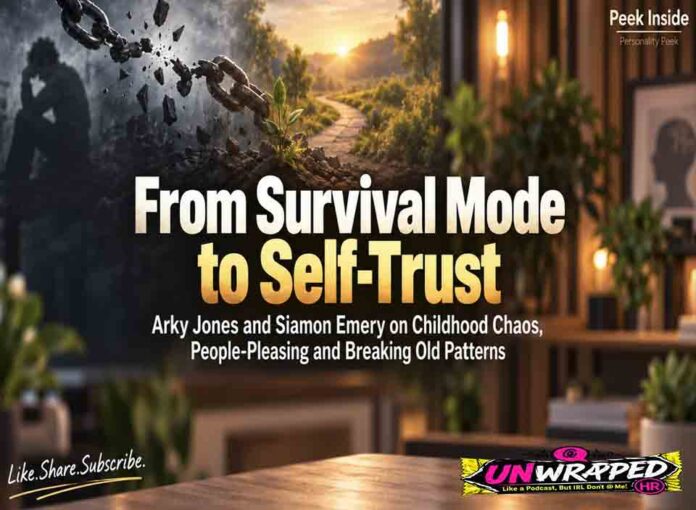
In this episode of Peek Inside, Arky Jones speaks with Siamon Emery about growing up in a deeply unstable environment and the way those early experiences shaped his relationships, behaviour and sense of safety later in life.
Siamon describes a childhood marked by addiction, inconsistency and constantly shifting circumstances. With little sense of dependable stability around him, he says he learned early to manage other people, read situations carefully and become whatever version of himself seemed most likely to keep him safe. Over time, that developed into people-pleasing, hypervigilance and a strong need for control.
When Survival Strategies Follow You Into Adult Relationships
Arky spends much of the conversation exploring a difficult question: what happens when behaviours that once protected you continue long after the original danger has gone?
Siamon explains that his early relationships repeatedly brought those patterns to the surface. He describes becoming deeply attached, struggling with trust and looking to partners to provide the sense of safety that had been missing in childhood.
Even after years of self-reflection, counselling, meditation and studying different approaches to personal growth, he says the same broad relationship patterns continued to repeat. Eventually, around the age of 40, Siamon reached a point where blaming circumstances or other people no longer felt sufficient.
He describes looking at himself and deciding to take fuller ownership of his part in the pattern.
Arky frames this as a shift from an external to an internal locus of control: recognising what can actually be changed while letting go of what cannot.
Why Understanding the Pattern Was Not Enough
One of the more interesting parts of the discussion is Siamon’s admission that intellectual understanding alone did not change the outcome.
He had spent years analysing his past and understanding why certain behaviours existed. What changed, he says, was beginning to explore body-based approaches and the idea that safety is not only something we think about but something we experience physically.
Siamon talks about studying somatic approaches, yoga and meditation, and describes developing a simple framework around feeling either safe or unsafe. In his experience, when he felt unsafe, he automatically moved towards control, prediction and people-management. When he learned to recognise moments in which he was actually safe, those behaviours became less necessary.
Arky challenges and expands this by asking about hormones, stress responses and the relationship between psychological experience and the body. Siamon then discusses his own understanding of stress physiology, cortisol and nervous-system regulation, while presenting these ideas as part of the framework he has developed through his studies and personal experience.
Building Boundaries and Learning to Be Enough Without Managing Everyone Else
Today, Siamon says one of the biggest changes in his life is his ability to say no.
Rather than automatically taking responsibility for other people’s emotions or trying to control situations before they become uncomfortable, he describes becoming more comfortable with limits, disappointment and uncertainty.
He also talks about being content on his own and feeling less dependent on external markers of success or approval. For him, self-trust is less about becoming completely fearless and more about believing he can handle what happens next without constantly trying to pre-empt it.
Arky keeps the conversation grounded by pointing out how easy it can be to fall back into old behaviours during stress. Siamon agrees, noting that long-standing patterns can remain powerful even after years of awareness.
The episode ultimately becomes a conversation about how survival strategies can become personality patterns, how those patterns affect adult relationships and what it means to build a greater sense of emotional safety from within.
Watch the full conversation on Peek Inside: