



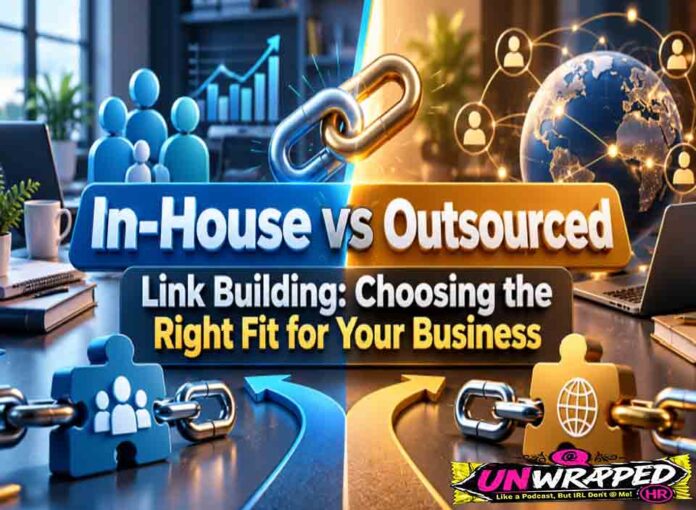
For Australian businesses, deciding between in-house vs outsourced link building is less about finding a universal winner and more about matching the work to your team’s skills, time and priorities. A local health clinic, food brand and software company may all want stronger online visibility, but they will not necessarily need the same people or process to earn relevant links.
Link building involves earning links from other websites to your own. Those links can help people discover useful information and provide search engines with context about a business. But results depend on relevance and editorial quality, not simply the number of links acquired. A rushed campaign built around irrelevant placements can waste money and create reputational risks.
What your team needs to manage
Effective link building is rarely just sending emails. It can involve researching suitable publications, creating material worth citing, pitching editors, checking websites, and tracking outreach and results. Someone also needs to review proposed placements and ensure claims are accurate.
That last step matters particularly in health. A clinic or wellness business should check that any content about treatments, services or outcomes is responsible and consistent with its professional obligations. A link is not useful if it appears beside misleading claims or on a site that does not make sense for the business.
Before choosing a model, estimate how many hours the work will take each month and identify who will approve content. If no one internally can give the project regular attention, a nominally low-cost in-house approach may still be expensive in missed priorities and inconsistent execution.
When in-house makes sense
An internal team can be a strong choice when the business has people with the right skills and enough time to use them. Staff understand the products, customer questions and brand voice, and they can coordinate link building with public relations, content and other marketing activity.
In-house work also gives the business direct oversight of outreach and publisher selection. That can be valuable for organisations in sensitive sectors, or those with strict approval processes. The trade-off is the cost of hiring, training and retaining experienced people, along with the time needed to build relationships with publishers.
It is worth being realistic about capacity. If link building is assigned to someone who already handles several marketing functions, outreach may become sporadic. A clear plan, suitable tools and protected work hours are more important than simply assigning the task to an existing employee.
Freelancer, agency or marketplace?
A freelancer may suit a business that needs a particular skill or a defined amount of support. For example, an experienced outreach specialist might help with prospect research and pitching, while an editor or writer develops supporting content. The business can keep strategy and approvals in-house without hiring a permanent employee.
An agency can offer a broader team and established processes, which may help when a campaign requires strategy, content and outreach at scale. It can also mean less day-to-day coordination for the client. However, the scope, reporting, communication and actual publisher-selection process should be clear before signing an agreement.
A marketplace is another way to find individual specialists for discrete tasks. Businesses can compare relevant profiles and commission work without building a full internal team. The model requires careful briefing and review: a marketplace does not remove the need to assess experience, agree on deliverables and check completed work.
A useful overview of the trade-offs is this guide to outsourcing link building in 2026, which compares in-house teams, freelancers, agencies and marketplaces.
Choose by task, not just provider
Outsourcing does not have to mean handing over the whole campaign. A business might retain strategy and final approvals while bringing in help for research, writing or outreach. This division works best when responsibilities are explicit: who chooses target sites, who contacts them, who approves any proposed content, and who reports on outcomes?
The same principle applies to other marketing work. A restaurant or packaged-food business may need high-quality images as well as search outreach. A freelance food and drink photographer can create images for menus, product pages or editorial pitches, while the business retains control over the brief and how the images are used. Osdire is one marketplace where businesses can browse freelance services across categories including photography and marketing.
For any outsourced task, agree on the deliverable, timeline, revision process and price in advance. Ask to see work relevant to your sector, and make sure you have the rights needed to use any finished content or images. For link building, request transparent reporting on the sites approached and placements secured, rather than relying on vague promises about rankings.
A practical way to decide
Start with a small, measurable scope. Set a budget and choose a limited set of activities, such as researching relevant publications or producing a piece of expert-led content. Review the quality of the work, how well the provider communicates and whether the process fits your team before expanding it.
In-house teams offer knowledge and control; freelancers offer focused expertise; agencies can provide capacity across several disciplines; marketplaces can help locate specialists for specific jobs. The right arrangement may combine more than one. What matters is maintaining sound editorial judgement, realistic expectations and a process that your business can sustain.