


There’s no shortage of systems designed to help us understand ourselves and the people around us. Personality models, psychology, philosophy and self-development frameworks all approach the same basic problem from different directions:
Human beings are complicated.
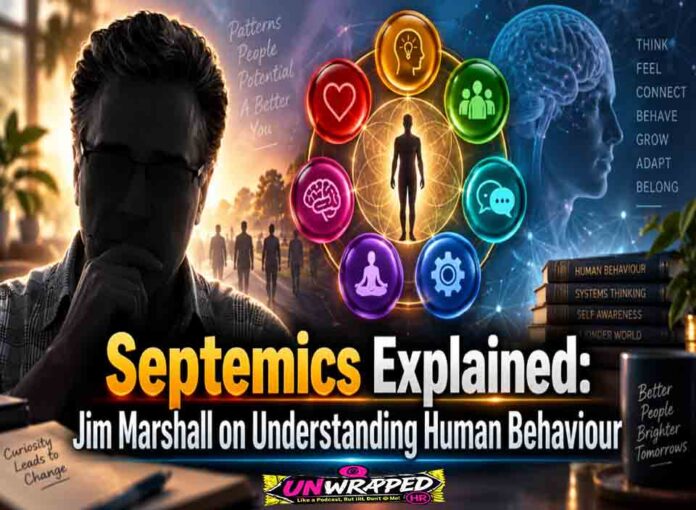
In this episode of Peek Inside, I sat down with Jim Marshall, author of Septemics: Hierarchies of Human Phenomena, to explore a system he calls Septemics.
Marshall describes Septemics as a “philosophical science” based around 35 different scales, with each scale containing seven hierarchical levels. These scales cover different aspects of human experience and are intended to provide a framework for analysing problems, relationships and behaviour.
It’s an ambitious idea — and one that led us into some interesting territory.
What Is Septemics?
According to Marshall, Septemics wasn’t originally created as a theoretical system.
He says it emerged from decades of working directly with people in human development. During that work, Marshall began noticing recurring patterns in his clients and recording his observations.
Over time, he believed those patterns formed recognisable levels. What began as observations eventually developed into the 35 seven-level scales that form the basis of Septemics today.
Marshall later published those ideas in Septemics: Hierarchies of Human Phenomena.
But an obvious question follows.
Can Human Behaviour Really Be Put on a Scale?
People aren’t static.
We can behave differently around our parents, partners, friends, colleagues and complete strangers. Our behaviour is influenced by experience, circumstances and the information available to us at a particular moment.
So during our conversation, I wanted to explore whether a structured system like Septemics risks doing exactly what many personality frameworks are criticised for doing:
Putting complicated people into boxes.
Marshall argues that this isn’t the intention of Septemics.
In fact, he specifically warns against simply telling another person where you believe they sit on one of his scales. Instead, he sees Septemics as a tool people can examine and apply, allowing them to reach their own conclusions and insights.
What About Personal Bias?
This became one of my favourite parts of the conversation.
Whenever we analyse another person, we’re working with incomplete information.
Someone might behave one way with us and completely differently with somebody else. We don’t know every experience they’ve had, what they’re thinking or what else might be happening in their life.
So how do we protect ourselves against our own biases when trying to map another person’s behaviour?
Marshall takes a strong position here.
He argues that the underlying Septemics scales represent natural phenomena and compares their reliability to principles found in mathematics and physics.
That’s a big claim.
And it’s one of the reasons the conversation becomes interesting.
You don’t necessarily have to accept a framework completely to find value in examining the questions behind it.
How Well Do We Really Understand Other People?
Perhaps the bigger question raised by Septemics isn’t whether every person can be accurately placed somewhere on 35 different scales.
It’s how good we actually are at understanding people in the first place.
Every day we make decisions about who we trust, who we work with, who we form relationships with and whose advice we listen to.
We’re already building mental models of other people.
Usually without even realising we’re doing it.
Septemics offers one particular framework for making that process more structured. Marshall believes those scales can help people better understand themselves, their relationships and the behaviour of people around them.
Whether you ultimately agree with his conclusions is something you’ll have to decide for yourself.
But it’s certainly an unusual idea — and one worth exploring.
In this episode of Peek Inside, Jim Marshall explains Septemics, where the system came from, how its 35 seven-level scales are intended to work, and why he believes they can provide a practical framework for understanding human behaviour.
Watch the full Jim Marshall interview on Peek Inside:
See Also: Chris Komor on Climate Change, AI Data Centres and Colorado’s Future