

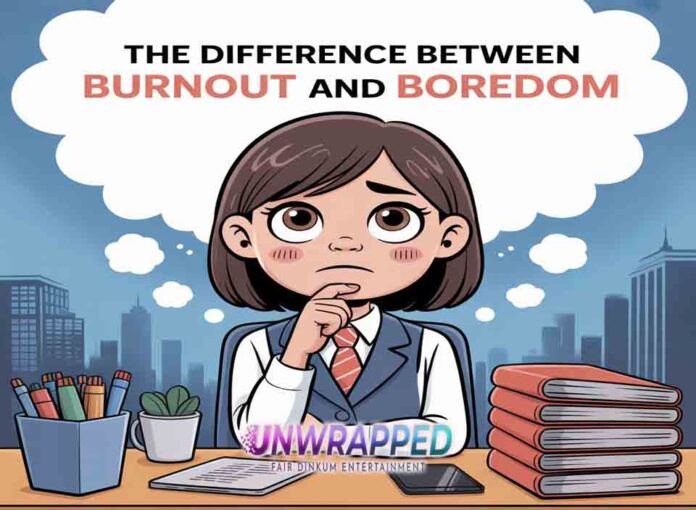
Feeling flat, unmotivated, and disengaged has become so common that many people label it quickly and move on. Some assume they are burned out. Others think they are just bored. In reality, burnout and boredom are not the same psychological state, even though they can look similar on the surface.
Misidentifying the two leads to the wrong solutions—rest when stimulation is needed, or novelty when recovery is required. Understanding the difference matters, not just for productivity, but for mental health, relationships, and long-term wellbeing.
Burnout is a depletion problem. Boredom is a meaning problem. Treating one like the other keeps people stuck.
Why Burnout and Boredom Get Confused
Both Reduce Motivation
Burnout and boredom both reduce drive, focus, and enthusiasm. Tasks feel heavier. Time moves slowly. Engagement drops. From the outside, both look like laziness or apathy—labels that miss the underlying cause.
Both Create Emotional Numbness
In both states, people may feel emotionally muted. Excitement is blunted. Irritation increases. The nervous system pulls back—but for very different reasons.
What Burnout Actually Is
Burnout Is Nervous System Exhaustion
Burnout occurs when stress outweighs recovery for too long. Burnout is characterized by:
emotional exhaustion
reduced professional efficacy
mental distance or cynicism
This is not a motivation failure. It is a capacity failure.
Burnout Feels Like “I Can’t”
People experiencing burnout often want to care but feel unable to. Even enjoyable tasks feel draining. Rest doesn’t immediately restore energy. The body and brain are stuck in prolonged survival mode.
Research shows burnout alters stress hormones, sleep quality, attention, and emotional regulation.
What Boredom Actually Is
Boredom Is Understimulation, Not Exhaustion
Boredom happens when attention has nowhere meaningful to go. The brain is underused, not overused. There is energy available—but nowhere engaging to place it.
Boredom as a signal that current activities lack purpose, challenge, or relevance.
Boredom Feels Like “Why Am I Here?”
Boredom often shows up as restlessness, irritation, or low-level dissatisfaction. Unlike burnout, people may still have energy—but feel disconnected, uninspired, or mentally itchy.
Key Differences at a Glance
Burnout
caused by too much demand
nervous system is depleted
rest feels necessary but insufficient
cynicism and withdrawal increase
even fun feels tiring
Boredom
caused by too little meaning or challenge
nervous system is underused
rest feels empty or frustrating
restlessness and irritation increase
novelty temporarily helps
See Also: Why Some People Need Isolation to Recover
How the Body Responds Differently
Burnout Triggers Shutdown
Burnout pushes the nervous system toward conservation. The body limits output to protect itself. Motivation drops because energy is genuinely low.
Insights show chronic stress reshapes how the brain processes effort and reward.
Boredom Triggers Agitation
Boredom does the opposite. The system wants engagement. That’s why bored people often scroll, snack, pick fights, or seek stimulation. The energy is there—it’s just misdirected.
Why the Wrong Fix Makes Things Worse
Treating Burnout Like Boredom
Adding novelty, pressure, or “just push through” strategies to burnout worsens symptoms. It increases exhaustion and accelerates emotional collapse.
Treating Boredom Like Burnout
Excessive rest, withdrawal, or disengagement deepens boredom. The person may start to feel flat, disconnected, or purposeless—not because they need rest, but because they need meaning.
Work Is Where Confusion Peaks
Burnout at Work
Burnout at work often comes from:
chronic workload imbalance
lack of control
unclear expectations
emotional labour without recovery
The solution involves boundaries, recovery time, workload redesign, and sometimes systemic change.
Boredom at Work
Workplace boredom often comes from:
repetitive tasks
underutilized skills
lack of autonomy
absence of challenge
Here, the solution is growth, learning, responsibility, or creative engagement—not rest alone.
Emotional Signals That Help Tell Them Apart
Signs It’s Burnout
persistent fatigue
brain fog
emotional detachment
resentment toward demands
recovery takes a long time
Signs It’s Boredom
restlessness
irritability without exhaustion
craving novelty
distraction-seeking
improvement with stimulation
Why Modern Life Creates Both
Digital overload, blurred work boundaries, and constant availability push people toward burnout. At the same time, repetitive work, passive entertainment, and reduced challenge increase boredom.
Modern environments can paradoxically overstimulate attention while under-stimulating meaning.
People Also Love: Why Stress Makes Some People Clean the House
How to Respond More Accurately
If It’s Burnout
prioritize sleep and nervous system recovery
reduce demand before adding novelty
reintroduce pleasure slowly
restore safety before stimulation
If It’s Boredom
increase challenge intentionally
seek learning or mastery
change context or role
engage socially or creatively
The key question is not “How do I feel?” but “What is my system lacking right now?”
Call to Action
If this article clarified something you’ve been mislabelling, share it with someone who might be stuck applying the wrong fix. Understanding whether the issue is burnout or boredom can change careers, relationships, and mental health trajectories. Subscribe or comment to explore more psychology explained in human terms.
Conclusion
Burnout and boredom are not two words for the same feeling. One signals depletion; the other signals disconnection. One needs recovery; the other needs meaning.
When people learn to tell the difference, they stop blaming themselves—and start responding accurately. That clarity alone can be the first step toward feeling human again.
Another Must-Read: Why Some People Need Company to Recover