



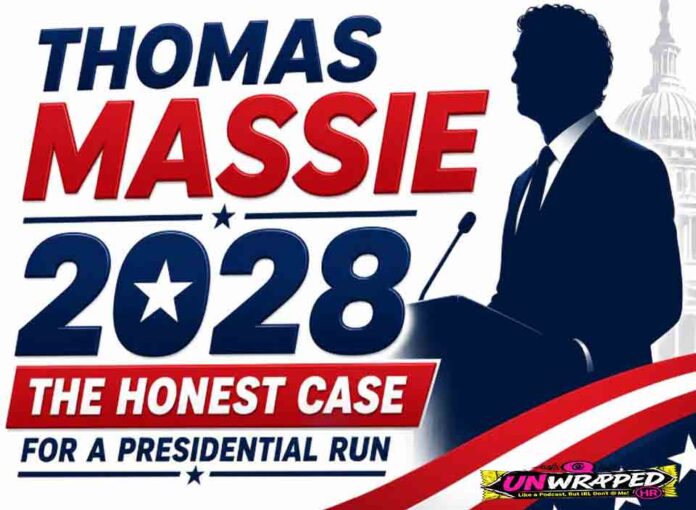
Thomas Massie 2028: The Strongest Honest Case for a Presidential Run
Thomas Massie should run for president in 2028 because America does not need another carefully packaged politician pretending to be independent. It needs a candidate who has already proven he is willing to lose power rather than surrender his judgment.
That is the core case for a Thomas Massie 2028 presidential run. Not that it would be easy. Not that he is currently the frontrunner. Not that every voter will agree with every vote he has ever cast. The case is stronger than that: Massie is one of the rare national Republicans whose public brand, voting record, biography, and political wounds all tell the same story. He believes Washington has too much power, spends too much money, wages too many undeclared wars, hides too much from the public, and punishes too many people for refusing to clap on command.
As of June 2026, Massie has not announced a presidential campaign. After losing his 2026 Republican House primary, he filed paperwork for a 2028 House race and said he had not made a final decision about which office, if any, he would seek; the FEC page lists him as a Republican House candidate in Kentucky’s 4th District and shows a statement of candidacy filed May 25, 2026.
But the timing matters. Massie’s filing came after a nationally watched primary defeat to Trump-backed Ed Gallrein, a race Reuters reported Gallrein won 54.9% to 45.1% with 99% counted. Reuters also reported the contest drew about $32 million in ad spending, making it the most expensive U.S. House primary in history.
That defeat should not end the Massie story. It should begin the presidential one.
See Also: Can Trump Use Bitcoin to Pay Off the US National Debt?
The Republican Party Needs a Test, Not Just a Coronation
The 2028 Republican primary already has obvious establishment lanes. A May 2026 Emerson College poll found Vice President JD Vance at 36% and Secretary of State Marco Rubio at 35% among likely Republican primary voters, with Ron DeSantis and Nikki Haley far behind at 5% each and 15% undecided.
That is a formidable field. It is also a narrow one. A party that claims to believe in “America First,” limited government, fiscal responsibility, and constitutional authority should have at least one serious candidate willing to define those words against power, not just against Democrats.
Massie’s candidacy would ask the question the GOP has avoided for years: Does “America First” mean loyalty to the Constitution, or loyalty to whoever currently controls the party machinery?
That question is not theoretical. AP reported that Massie lost after pushing for the release of the Jeffrey Epstein files, criticizing the war in Iran, and voting against President Trump’s signature tax legislation.
In other words, Massie did not lose because he became a liberal. He lost because he stayed consistent in a party increasingly built around loyalty tests.
That is exactly why he should run.
Who Is Thomas Massie?
Massie’s biography is almost impossibly well-suited for a populist, constitutional, anti-establishment campaign. He is not a cable-news creation. He is not a think-tank résumé in a suit. He is an engineer, inventor, entrepreneur, farmer, former county official, and congressman.
His official House biography says he entered Congress in November 2012 after serving as Lewis County Judge Executive. It also says he earned a bachelor’s degree in electrical engineering and a master’s degree in mechanical engineering from MIT, invented touch-based computer-interface technology, founded SensAble Technologies, raised more than $32 million in venture capital, created 70 jobs, and obtained 29 patents.
That matters. A 2028 president will face artificial intelligence, surveillance technology, supply-chain insecurity, energy constraints, monetary instability, cyber conflict, and a federal bureaucracy that often cannot distinguish innovation from a compliance problem. A candidate who has actually built technology, hired people, raised capital, and dealt with real-world engineering constraints brings something useful to the table.
The Lemelson-MIT program describes Massie’s PHANToM haptic interface as a system that allowed users to “feel” the shape, texture, and weight of virtual objects, with potential uses in design and surgery training.
That is not a gimmick. It is a serious difference between Massie and the average national politician. Most presidential candidates talk about innovation. Massie has lived it.
The Case in One Sentence
The strongest case for Thomas Massie in 2028 is this: he is the candidate for voters who believe the federal government should be smaller, more transparent, less militarized, less indebted, less intrusive, and more accountable to the Constitution than to party bosses.
That is a real lane. It cuts across factions. It appeals to libertarian Republicans, constitutional conservatives, anti-war voters, small-government conservatives, privacy advocates, debt hawks, small farmers, independent-minded populists, and Americans exhausted by politicians who campaign as rebels and govern as rubber stamps.
Massie is often called “Mr. No.” Reuters noted the nickname came after years of opposing bills from both parties and reported that by 2014 he had voted against roughly one-third of measures that came up in his first year.
His opponents see that as a liability. A smart 2028 campaign would turn it into the point.
Washington needs more “no.” No to trillion-dollar bills nobody read. No to undeclared wars. No to surveillance backdoors. No to using emergencies as excuses for permanent power. No to borrowing today and sending the invoice to people who are not old enough to vote yet.
But Massie cannot run only as “Mr. No.” To win nationally, he would need to show what he says yes to: sound money, local food, real privacy, constitutional war powers, honest budgeting, open records, industrial freedom, energy abundance, free speech, and a Congress that works for citizens rather than leadership offices.
Fiscal Sanity Is the Opening
A Massie 2028 campaign should begin with the national debt because almost nobody else wants to speak honestly about it.
Republicans have spent years calling themselves fiscal conservatives while supporting spending packages that explode deficits. Democrats have often treated every spending objection as cruelty. Both parties have trained voters to believe fiscal restraint means someone else’s benefits get cut while their own promises stay untouched.
Massie has the credibility to challenge that lie.
CBO estimated that H.R. 1, the One Big Beautiful Bill Act as passed by the House in 2025, would increase deficits by $2.4 trillion over the 2025–2034 period before macroeconomic or debt-service effects; CBO also estimated that debt-service costs would add $551 billion, increasing the cumulative deficit effect to $3.0 trillion.
That is the kind of number a serious conservative presidential candidate should be willing to say out loud. Massie was one of only two House Republicans to vote against Trump’s major tax-and-spending package, a move Reuters identified as one of the issues that intensified his clash with Trump.
A Massie campaign could make the simplest, hardest argument in American politics: borrowing is taxation without the honesty. Debt is not free. Inflation is not an accident. Interest payments are not a rounding error. A country that cannot control spending cannot control its future.
That message will make donors uncomfortable. Good. That is how voters know it is real.
War Powers: America First Must Mean Congress Decides
Massie’s foreign-policy case is both his biggest opportunity and one of his biggest risks.
In June 2025, Massie and Democratic Rep. Ro Khanna introduced a bipartisan War Powers Resolution to prohibit U.S. Armed Forces from unauthorized hostilities in Iran. Massie’s office said the resolution was designed to stop unauthorized involvement, and Massie argued that Congress has the sole power to declare war.
That position is not isolationism. It is constitutionalism.
There is a difference between being weak and being lawful. There is a difference between abandoning national defense and insisting that the people’s representatives debate and authorize war. There is a difference between defending America and treating every foreign conflict as an automatic U.S. obligation.
A Massie campaign should say this plainly: America should be strong enough to defend itself, wise enough to avoid unnecessary wars, and constitutional enough to require Congress to vote before Americans are sent into combat.
The political opening is real. Emerson’s May 2026 national poll found voters opposed U.S. military intervention in Cuba that year by 57% to 23%, while the economy was the top issue at 41%.
That does not mean voters agree with Massie on every foreign-policy question. Many will not. But it does mean a candidate who connects peace, constitutional authority, debt, and national interest could find more support than Washington assumes.
Transparency Is a Populist Issue, and Massie Has Receipts
The Epstein files fight is one of the clearest examples of why Massie’s independence matters.
In July 2025, Massie announced the bipartisan Epstein Files Transparency Act with Rep. Ro Khanna, saying the bill would force a House vote on releasing the government’s files related to Jeffrey Epstein.
In January 2026, Khanna and Massie asked a federal judge to appoint a special master to compel the Department of Justice to release the full Epstein files, arguing that DOJ had failed to comply with the law and that millions of files were being kept from the public.
This is the kind of issue where Massie’s brand becomes powerful. He was not protecting a party. He was not protecting an administration. He was not protecting institutional comfort. He was asking for disclosure.
A 2028 campaign could use that as the foundation for a broader transparency agenda: release records, audit agencies, end secret-law culture, stop hiding behind overclassification, protect whistleblowers, and make the federal government prove why information should be withheld instead of forcing citizens to beg for what should already be public.
That is not left or right. That is anti-corruption.
Civil Liberties in the Surveillance Age
Massie also has a long record on surveillance and privacy, a subject that should become central in 2028.
Years before today’s AI-surveillance panic became fashionable, Massie worked on amendments aimed at shutting “backdoor” access to Americans’ private data and blocking the NSA and CIA from requiring backdoors in products. His office described one amendment as prohibiting warrantless searches of government databases for information about U.S. citizens and another as prohibiting intelligence agencies from forcing product backdoors.
That issue has aged well.
The next president will inherit federal agencies with access to enormous amounts of data, increasingly powerful artificial intelligence tools, public-private censorship pressure points, and a national-security bureaucracy that often treats civil liberties as obstacles. Massie can credibly argue that the Bill of Rights must apply in the digital world, not just in civics textbooks.
A strong Massie campaign would make privacy a kitchen-table issue: your phone, your bank records, your medical data, your online speech, your location history, your children’s digital records. The government should need a warrant. Companies should not be quietly deputized as surveillance partners. And no president should be trusted with powers that would terrify voters if the other party held them.
Sound Money, the Fed, and Inflation
Massie is also one of the few national Republicans willing to take on the Federal Reserve directly.
In March 2025, he introduced H.R. 1846, the Federal Reserve Board Abolition Act, which his office said would abolish the Federal Reserve Board of Governors and Federal Reserve banks and repeal the 1913 Federal Reserve Act; the same release also noted he introduced H.R. 24 to audit the Federal Reserve.
That position will be controversial. It should be argued carefully. A presidential campaign cannot simply shout “End the Fed” and call that monetary policy. But Massie has an opening here because millions of Americans already believe the economy is rigged for politically connected banks, asset holders, and insiders while ordinary workers get punished by inflation.
Massie’s best framing would be practical, not slogan-driven: the country needs honest money, transparent monetary policy, real limits on debt monetization, and a financial system that does not quietly transfer wealth from savers and wage earners to asset owners and government borrowers.
Even voters who are not ready to abolish the Fed may be ready to audit it, restrain it, and ask why unelected central bankers hold so much power over American life.
The Food Freedom Candidate
Massie has another underrated advantage: he can talk about food, farming, and decentralization without sounding like a consultant.
His PRIME Act is designed to help small farms and ranches sell locally raised and processed meat. In April 2026, Massie’s office announced a PRIME Act pilot program had been included in a House-passed Farm Bill, saying it would allow certain custom-exempt slaughter facilities, under state programs and labeling rules, to sell meat directly to consumers within the state.
Rep. Chellie Pingree’s office described the PRIME Act as bipartisan legislation from Pingree and Massie to make it easier for small farms and ranches to serve consumers, giving states freedom to permit intrastate distribution of custom-slaughtered meat.
That issue is bigger than meat processing. It is about whether Americans can buy from local producers, whether small farmers can survive federal compliance burdens, whether supply chains should be centralized to the point of fragility, and whether health freedom includes knowing where your food comes from.
Massie lives the issue. His official bio says he lives on a cattle farm in Kentucky, and his office’s PRIME Act release says he raises cattle on an off-grid farm in northeast Kentucky.
A presidential candidate who can connect food freedom, small farms, health, anti-monopoly policy, and local resilience has a message that reaches far beyond typical Republican primary audiences.
The Second Amendment Without Apology
Massie would also enter a Republican primary with unquestioned credibility on gun rights. In 2016, his office announced he would chair the revived Congressional Second Amendment Caucus.
That does not make him unique in a GOP primary. Many Republicans support the Second Amendment. What makes Massie different is that he places gun rights inside a larger philosophy: the citizen comes before the state, rights come before permission, and federal power should be limited even when politicians claim safety as justification.
That framing matters because voters can sense when politicians treat the Second Amendment as a campaign prop. Massie treats it as part of the constitutional architecture.
The Coalition Massie Could Build
A Massie 2028 campaign would not look like a normal Republican campaign. That is its advantage.
His coalition would include constitutional conservatives who are tired of performative conservatism. It would include libertarian-leaning Republicans who felt orphaned after the Ron Paul movement faded from presidential politics. It would include anti-war America First voters who believe the slogan should actually mean fewer foreign entanglements. It would include small farmers and food-freedom activists. It would include privacy advocates, Bitcoin and sound-money voters, pro-Second Amendment voters, homeschoolers, small-business owners, and independents who distrust both parties.
It could even attract selective support from civil-liberties Democrats and anti-corruption independents, especially on surveillance, war powers, and transparency.
This coalition would not agree on everything. It would be messy. But the best political movements usually are. The unifying principle would be simple: decentralize power.
That is the word Massie should build around. Washington has too much power. Central banks have too much power. party leadership has too much power. intelligence agencies have too much power. bureaucracies have too much power. corporate-government partnerships have too much power. Presidents have too much unilateral war power. The answer is not to hand that power to better people. The answer is to reduce it.
The Primary Loss Is Not a Disqualifier
Massie’s critics will say the obvious: he just lost a House primary, so how can he win a presidential primary?
It is a fair question. The honest answer is that he would start as an underdog.
But losing a primary under the circumstances Massie faced is not the same thing as being rejected as irrelevant. Reuters described his race as a test of Trump’s power to punish critics, reported the extraordinary spending against him, and noted his clashes with Trump over the Epstein files, Iran, aid to Israel, and Trump’s tax-and-spending package.
The Guardian reported that after the loss, Massie said, “They couldn’t buy my vote in 14 years, so they bought this seat.”
That is not a concession line. That is a presidential slogan.
A campaign could build around it: The Vote They Couldn’t Buy.
Massie’s loss tells voters something important. He had a price for power, and he refused to pay it. In a political culture where nearly everyone claims to be independent until independence costs them something, that is rare.
AP also reported that after Massie’s concession speech, supporters chanted “2028!” and “President!” and Massie replied, “You’ve made a compelling argument. We’ll talk about it later.”
They should talk about it now.
The Honest Weaknesses
The case for Massie is strongest when it does not pretend the weaknesses are small.
First, he has no national campaign machine. Presidential politics is brutal. It requires money, staff, ballot access, state operations, debate preparation, donor discipline, media strategy, and relentless travel. Massie’s authenticity will not substitute for organization.
Second, he has to overcome the “Mr. No” problem. A president cannot only be the person who stops bad ideas. He must also define good ones, hire competent people, manage crises, and persuade a country bigger than one congressional district.
Third, foreign policy could hurt him. Many voters who agree that Congress should authorize war will still worry about his broader posture toward alliances. In December 2025, Massie introduced legislation to remove the United States from NATO, a position that would demand a serious, detailed national-security defense in a presidential race.
Fourth, he lost his own primary. That cannot be spun away. It proves he would need to broaden his appeal, sharpen his message, and build a coalition beyond his existing base.
Fifth, he has cast votes that opponents will weaponize. Some were principled constitutional votes. Some will be easy to demagogue. His campaign would need a rapid-response operation that explains not just what he voted, but why.
Those weaknesses are real. They are also manageable if Massie runs as a serious candidate rather than a protest candidate.
What a Winning Massie Platform Should Sound Like
A Thomas Massie 2028 presidential campaign should be built around ten clear promises:
Restore constitutional war powers. No more major military action without congressional authorization.
Stop bankrupting the country. No tax cuts, spending increases, or emergency packages without honest deficit accounting.
Audit the Fed and restore sound money. End the culture of monetary secrecy and make inflation a central campaign issue.
Defend privacy and civil liberties. No warrantless searches of Americans’ data. No surveillance backdoors. No public-private censorship laundering.
Release government records by default. Epstein files, intelligence abuses, pandemic records, agency communications, and other public-interest documents should not be hidden to protect powerful people.
Protect the Second Amendment. Treat the right to keep and bear arms as a constitutional right, not a temporary license from the administrative state.
Champion local food and small farms. Break federal barriers that make it harder for consumers to buy directly from trusted local producers.
Bring engineering discipline to government. A government that cannot pass an audit, secure its systems, or build infrastructure on time should not be trusted with unlimited money.
Decentralize power. Push decisions back to states, localities, families, entrepreneurs, farmers, and citizens wherever constitutionally possible.
End the loyalty-test presidency. The president is not a king, party boss, or national therapist. He is an executive bound by law.
That platform would not please everyone. That is the point. It would be coherent.
Why Massie Should Run Even If He Does Not Win
A Massie candidacy would be worth it even if he began as a long shot because presidential primaries are not only about winning delegates. They are about forcing debates.
Ron Paul did not win the presidency, but he changed the conversation on the Fed, war, civil liberties, and debt. Barry Goldwater lost in a landslide but helped define modern conservatism. Pat Buchanan did not become president, but he exposed trade and foreign-policy fractures that later reshaped the GOP.
Massie could force the 2028 Republican field to answer questions they would rather avoid:
Will you reduce spending, or just rearrange it?
Will you require Congress to vote on war, or keep letting presidents improvise?
Will you audit the Fed?
Will you oppose surveillance when your own party controls the agencies?
Will you release files that embarrass powerful people?
Will you say no to donors?
Will you defend “America First” as a constitutional doctrine instead of a branding exercise?
Those questions are valuable. The country needs them asked on a debate stage.
The Final Case: Run, Thomas Massie
Thomas Massie should run for president in 2028 because his candidacy would clarify what the Republican Party actually believes after Trump.
If the GOP believes in constitutional government, Massie belongs on the stage. If it believes in fiscal responsibility, Massie belongs on the stage. If it believes in America First restraint, Massie belongs on the stage. If it believes in transparency, civil liberties, sound money, small farms, gun rights, and reducing federal power, Massie belongs on the stage.
And if the party does not believe those things anymore, Massie should run to make that clear too.
He should not run as a spoiler. He should not run as a vanity candidate. He should not run just to settle scores after a primary loss. He should run as a serious constitutional conservative with a builder’s background, a farmer’s suspicion of bureaucracy, an engineer’s hatred of broken systems, and a voting record that proves he is willing to be unpopular when the Constitution is on the line.
The slogan is already there:
Thomas Massie 2028: The Vote They Couldn’t Buy.
FAQ
Is Thomas Massie running for president in 2028?
Thomas Massie has not announced a 2028 presidential campaign. After losing his 2026 House primary, he filed FEC paperwork for a 2028 House race and said he had not made a final decision about which office, if any, he would seek.
Why do supporters want Thomas Massie to run for president?
Supporters see Massie as a consistent constitutional conservative focused on fiscal restraint, war powers, civil liberties, transparency, food freedom, gun rights, and limiting federal power. His biography as an MIT-trained engineer, inventor, entrepreneur, farmer, and former county official also gives him a different profile from most national politicians.
Could Thomas Massie win the 2028 Republican nomination?
It would be difficult. Early polling shows JD Vance and Marco Rubio as the top Republican contenders, and Massie would begin without the national machinery of better-known candidates. But he could occupy a distinct constitutional, anti-war, anti-debt, anti-surveillance lane that no major candidate currently owns.
What are Thomas Massie’s biggest weaknesses as a presidential candidate?
His biggest weaknesses are his 2026 primary loss, limited national campaign infrastructure, the “Mr. No” image, controversial foreign-policy positions, and the need to explain votes that opponents will portray as extreme or unserious. Reuters and AP both framed his primary loss as a major example of Trump’s power inside the GOP.
What would a Thomas Massie 2028 campaign be about?
A serious Massie campaign would likely focus on constitutional war powers, spending and debt, Federal Reserve transparency, privacy, anti-surveillance reforms, government transparency, food freedom, Second Amendment rights, and decentralizing federal power. His recent work on the Epstein Files Transparency Act, the Iran War Powers Resolution, the PRIME Act, and Federal Reserve legislation gives him a ready-made platform.