


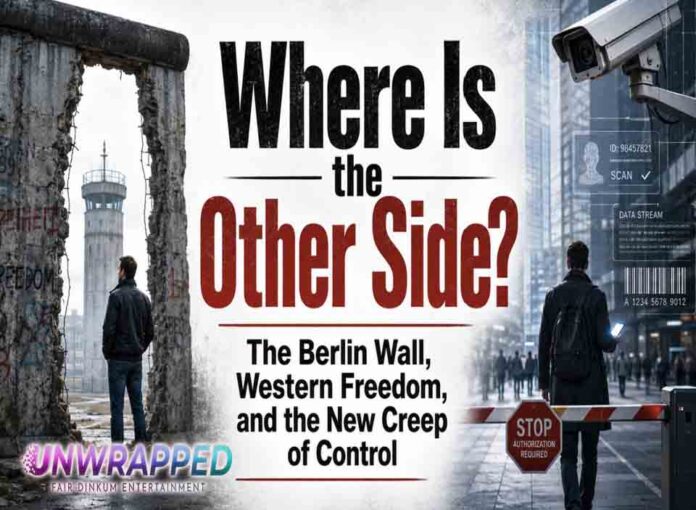
There is a comforting lesson freedom-loving people like to draw from East Germany.
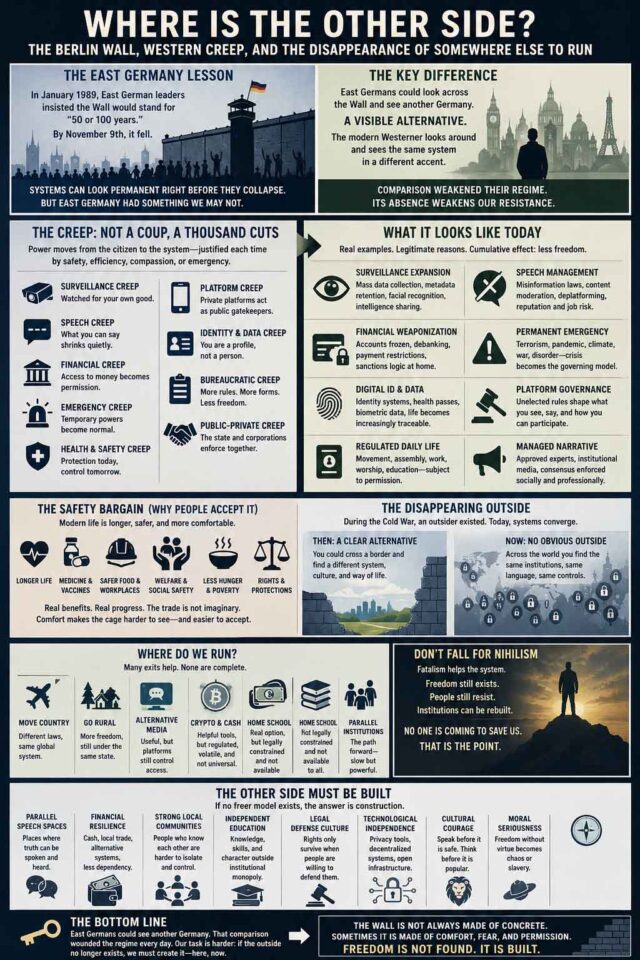
They say: look at the Berlin Wall. Look at the confidence of the regime. Look at the speeches, the ceremonies, the slogans, the officials insisting history was on their side. In January 1989, East German leader Erich Honecker said the Wall would still be standing in “50 or 100 years.” By November 1989, it was open. The system that looked permanent was suddenly exposed as fragile.
That lesson is true. It is important. It is a good antidote to despair.
But it is not the whole lesson.
East Germany did not exist in a vacuum. It had West Germany beside it. Same language. Same people. Same national memory. Same devastated twentieth century. But two different systems. One watched, restricted, and managed its people. The other was freer, richer, more open, and visibly more desirable. Before the Berlin Wall was built, around 2.5 million East Germans fled from East to West Germany between 1949 and 1961. The Wall itself was an admission: people had compared the systems and chosen the other side.
That is the missing half of the analogy.
The East German could look across the Wall and see another Germany.
The modern Westerner who senses the creep of control faces a different and more unsettling question:
Where is the other side now?
The East German Lesson Is True — But Incomplete
The fall of East Germany proves that regimes can look strongest shortly before they fail.
That matters. Power often performs confidence when it is most afraid. Officials rarely announce that legitimacy is collapsing. They celebrate. They issue statements. They condemn pessimists. They pretend permanence is proof of strength.
Then suddenly, the spell breaks.
So yes, East Germany teaches us not to be nihilistic. It teaches us that even a heavily policed system can decay from within. It teaches us that fear can evaporate quickly once enough people realise other people are no longer afraid.
But East Germany also teaches us something else:
comparison matters.
The regime had to compete with a visible alternative. It could tell its people that socialism was superior, but West Germany existed. It could say the East was building a better future, but West German shops, wages, cars, media, and freedoms contradicted the claim. It could call the Wall an anti-fascist protection barrier, but everyone knew which direction people were trying to escape.
West Germany was not merely a country. It was a mirror.
And that mirror wounded the regime every day.
The deeper lesson is not only that oppressive systems can fall. It is that systems are weaker when people can see a real alternative.
The Modern Problem: What If There Is No Clear Outside?
This is where the East Germany analogy becomes less comforting.
In the Cold War, the dissident imagination had geography. East meant one thing. West meant another. The prisoner could point somewhere and say, “There. That is where life is different.”
Today, the problem is more blurred.
A person in Britain, Canada, Australia, Germany, France, Ireland, the United States, or New Zealand may still live in a broadly free society compared with openly authoritarian states. That should be said clearly. The modern West is not East Germany. We do not live under a Soviet-style one-party system. People are not generally shot for crossing borders. Elections, courts, private property, independent media, protest movements, and civil society still exist.
But that is exactly why the danger is different.
The new creep does not usually arrive with tanks. It arrives through safety policies, digital platforms, banking rules, emergency powers, online speech regulation, surveillance systems, anti-extremism frameworks, health protocols, and bureaucratic language. It does not usually say, “You have no rights.” It says, “Your rights must now be balanced against safety, harm, risk, misinformation, security, inclusion, emergency, and public order.”
And because many Western countries use similar language, similar institutions, similar platforms, similar financial systems, and similar legal justifications, the citizen begins to feel something East Germans did not feel in the same way:
Maybe there is no West Germany left to run to.
That does not mean every country is equally unfree. They are not. Some countries still protect civil liberties better than others. But the old contrast is weaker. There is no obvious rival civilisation model standing next door and humiliating the system by existing.
The old question was:
How do we get across the Wall?
The modern question is:
What if the wall has become the operating system?
What Is “The Creep”?
The creep is not a coup.
A coup is dramatic. It announces itself. It has uniforms, arrests, decrees, and a moment people can point to.
The creep is quieter.
The creep is the gradual transfer of power from the person to the system, justified each time by safety, efficiency, compassion, emergency, or protection.
It is not one law. It is not one party. It is not one bad leader. It is the accumulation.
It looks like this:
The state wants more data because terrorism is real.
Platforms moderate more speech because harm is real.
Banks monitor transactions because fraud, extremism, and money laundering are real.
Governments use emergency powers because crises are real.
Institutions regulate behaviour because risk is real.
Public health authorities restrict movement because disease is real.
Online safety laws expand because children really do need protection.
That is what makes the creep powerful. It does not usually begin with fake problems. It begins with real ones.
The question is not whether safety matters. Of course it does.
The question is whether safety becomes the permanent moral excuse for reducing the zone of ordinary human freedom.
The State That Watches for Your Own Good
After 9/11, Western states expanded surveillance and counterterrorism powers. In the United States, the Department of Justice described the Patriot Act as giving law enforcement new tools to detect and prevent terrorism, including broader surveillance powers for terrorism-related crimes.
That context matters. Terrorism was not imaginary. Governments had a duty to respond.
But emergency powers tend to create machinery. And machinery rarely dismantles itself.
Once a state builds systems for collecting, retaining, searching, analysing, and sharing information, those systems become part of normal administration. They are justified by one threat, then adapted to another. Terrorism becomes extremism. Extremism becomes misinformation. Misinformation becomes public disorder. Public disorder becomes risk. Risk becomes governance.
Australia, for example, requires telecommunications companies to retain certain telecommunications data for at least two years, with the government saying access to that data is central to serious criminal and national security investigations.
The United Kingdom has also developed legal frameworks around bulk personal datasets. Official guidance describes a bulk personal dataset as a large set of personal data where most individuals included are not, and are unlikely to become, of interest to the intelligence services.
Again, the point is not that every use is illegitimate. The point is cumulative.
A free society once treated privacy as the default. Increasingly, it treats traceability as the default.
The citizen is told he is not a suspect. He is merely a data point waiting to become relevant.
The Managed Mouth
Old censorship was simpler.
A government banned a newspaper. A dissident was arrested. A book was prohibited. A speech was shut down.
Modern speech control often works differently.
It is less likely to say:
“You may not say this.”
It is more likely to say:
“You may say it, but you may lose your account, your reach, your job, your reputation, your payment processor, your professional licence, or your place in polite society.”
This is a major difference.
Modern speech is governed not only by states, but by platforms, employers, advertisers, banks, regulators, NGOs, academic institutions, media campaigns, and social pressure. A person may technically have legal free speech, yet still feel that only a narrow range of opinions can be expressed without serious consequences.
Online safety laws show the dilemma clearly. The UK’s Online Safety Act is framed around protecting users, especially children, and the government says mis- and disinformation are captured where they are illegal or harmful to children.
The EU’s Digital Services Act says it strengthens fundamental rights online and requires platforms to minimise risks from illegal and harmful content, including risks to children and young people.
These are not trivial goals. Child protection, fraud prevention, and incitement to violence are real concerns.
But the danger is that “harm” becomes elastic. Once institutions claim responsibility for managing harmful information, the boundary between protecting people and managing public opinion becomes unstable.
A society does not need to jail every dissident if it can make ordinary people afraid to sound like one.
The Financial Chokepoint
The strongest modern form of control may not be censorship.
It may be financial access.
In a cashless, banked, app-based, platform-dependent society, money is not just money. It is participation. If you cannot bank, receive payments, use platforms, insure yourself, travel, rent, or transact, you are not merely inconvenienced. You are pushed toward civil nonexistence.
Canada’s 2022 use of emergency powers during the convoy protests is one of the clearest examples of why this matters. The Canadian government announced temporary measures requiring financial service providers to cease services where they suspected accounts were being used to further illegal blockades, and stated that accounts could be frozen or suspended without a court order.
People can debate the convoy. They can debate the emergency. They can debate the legality, necessity, or proportionality of the response.
But the precedent matters beyond that one event.
The old state had to arrest you.
The new system may only need to make you financially nonfunctional.
This is a major shift in the architecture of control. The state does not always need to ban a movement if banks, platforms, insurers, crowdfunding sites, and payment processors can make participation too costly.
In the future, exile may not mean being sent away. It may mean being left exactly where you are, unable to transact.
Emergency as a Form of Government
Emergencies are sometimes real.
Wars happen. Terror attacks happen. Pandemics happen. Riots happen. Financial crashes happen. Cyberattacks happen. Natural disasters happen.
A serious argument about freedom must admit this. Only a fool says the state should never act in crisis.
But the danger is that emergency becomes a style of government.
The pattern is familiar:
A crisis arrives.
Officials say temporary powers are necessary.
The public accepts restrictions.
Institutions adapt.
The crisis passes.
Some powers remain.
A new crisis arrives.
The process repeats.
During the COVID-19 pandemic, Freedom House warned that democracy and human rights had deteriorated in many countries and that emergency measures introduced during the crisis could have lasting effects.
The pandemic was real. The tradeoffs were real. But so was the revelation.
Modern societies discovered how quickly movement, assembly, work, worship, protest, education, and speech could be restricted under emergency logic. Some restrictions may have been justified. Some may not have been. But all of them trained populations to accept a new relationship between citizen and state.
The emergency may end.
The precedent rarely does.
The Safety Bargain
This argument becomes dishonest if it pretends modern life is only decline.
It is not.
The modern West has achieved extraordinary things. People live longer. Children are safer. Food is safer. Workplaces are safer. Medical care is better. Infant mortality has fallen. Welfare systems exist. Consumer protections exist. Civil rights have expanded. Many forms of open brutality that were once normal are now unacceptable.
Globally, life expectancy rose from around 32 years in 1900 to 71 years by 2021, according to Our World in Data. Improvements in living standards, nutrition, sanitation, antibiotics, vaccines, and healthcare have transformed human life.
The world has also made major progress against hunger over the last 50 years, even though recent progress has stagnated and hunger remains a serious global problem.
So the argument is not:
“Everything is worse.”
The argument is sharper:
We are safer, richer, healthier, and more managed.
That is the bargain.
And because the benefits are real, the bargain is seductive.
People do not accept control only because they are weak. They accept it because control often arrives attached to something they genuinely want: safety, health, stability, convenience, protection, lower risk, less chaos.
The cage is harder to see when it has heating, medicine, insurance, and Wi-Fi.
Comfort as Compliance
East Germany had a legitimacy problem because the failure was visible.
Shortages were visible. Travel restrictions were visible. The secret police were feared. The propaganda was wooden. The comparison with West Germany was obvious.
Modern control in the West is often more sophisticated because it does not always make life visibly miserable.
It can make life comfortable.
A comfortable population is not necessarily a free population. Comfort can soften resistance. People who have mortgages, subscriptions, pensions, careers, reputations, insurance policies, social media accounts, and children in institutional systems are easier to discipline because they have more to lose.
The modern citizen may not ask:
“Will I be arrested?”
He may ask:
“Will I lose my job?”
“Will my bank close my account?”
“Will my account be banned?”
“Will my children suffer?”
“Will my friends think I am dangerous?”
“Will I become unemployable?”
That is softer than old tyranny. But softer does not always mean weaker.
The most stable cage is not the one that hurts.
It is the one people are afraid to leave.
Another Must-Read: Gad Saad’s “Suicidal Empathy”: The Selective Empathy Problem
The Disappearing Outside
This is the heart of the matter.
East Germans had West Germany.
Soviet citizens had the West.
People living under communist regimes could imagine another system. They could hear about it. Watch it. Smuggle it in. Defect to it. Dream of it.
But what happens when the West itself becomes uncertain about freedom?
Freedom House reported that global freedom declined for the 20th consecutive year in 2025, with 54 countries experiencing deterioration in political rights and civil liberties while only 35 improved.
V-Dem’s 2026 Democracy Report says democracy in Western Europe and North America has reached its lowest level in over 50 years, largely due to deterioration in the United States, and reports that only 7 percent of the world’s population lives in liberal democracies.
These findings should not be used carelessly. Different democracy indices have different methods and assumptions. They are not sacred texts.
But they do support the broader mood: freedom is not simply expanding. In many places, it is under pressure.
And if the pressure is not isolated to one failed regime, the psychology changes.
The East German could say:
“There is another Germany.”
The modern Westerner asks:
“Where is the other West?”
That question is not nihilism. It is the right question.
Because the systems now shaping life are not only national. They are also digital, financial, corporate, legal, cultural, and transnational.
You can move country and still use the same phones, the same app stores, the same payment networks, the same social platforms, the same airport systems, the same compliance language, the same institutional vocabulary, the same elite consensus, and the same managerial view of human beings as risks to be administered.
There are still freer and less free countries.
But there may no longer be a simple “other side” in the Cold War sense.
The wall is not always made of concrete.
Sometimes it is made of accounts, permissions, policies, reputational scores, payment access, platform rules, digital IDs, professional codes, and safety language.
False Exits
People still try to escape.
Some move country. That can help. Laws differ. Cultures differ. Tax systems differ. Speech climates differ. Some places are genuinely freer than others.
Some go rural. That can help too. More space, more practical independence, less social pressure, stronger local community.
Some use alternative media. Useful, but still often dependent on hosting, app stores, search visibility, payment processors, and legal vulnerability.
Some use cryptocurrency or cash. Useful in certain ways, but not a complete social order.
Some homeschool. Powerful for those who can do it, but not available to everyone and still legally constrained.
Some build local networks. That may be the most serious answer, but it is slow, unglamorous, and hard.
These exits are not fake.
They are just smaller than the cage.
That is the problem.
The modern person may be able to reduce dependence, but not fully escape the surrounding system. The task becomes less about finding untouched territory and more about building zones of independence inside managed societies.
Why the West Is Not Finished
This is where the argument must avoid despair.
The West is not dead.
That matters.
Courts still sometimes restrain governments. Elections still sometimes remove leaders. Journalists still expose abuses. Civil liberties groups still win cases. Citizens still protest. Public backlash still changes policy. Some countries remain significantly freer than others. Technology can empower individuals as well as control them.
That is why nihilism is wrong.
But optimism should not become laziness.
The shallow optimist says:
“East Germany fell, so don’t worry. These things always correct themselves.”
The serious answer is:
“East Germany fell partly because people could see and desire another system. If the modern West lacks that visible outside, then correction may require deliberate construction, not passive hope.”
Fatalism helps the creep.
But so does naïve optimism.
The right attitude is neither despair nor comfort. It is responsibility.
No one is coming to save us.
That is not the bad news.
That is the point.
The Other Side Must Be Built
If there is no obvious West Germany left to run to, then the answer is not to sit around mourning its absence.
The answer is to build visible alternatives.
Not fantasies. Not slogans. Not online rage. Real alternatives.
That means building institutions, habits, communities, and technologies that make freer life visible again.
It means parallel speech spaces where difficult truths can be spoken without instant social or financial punishment.
It means financial resilience: cash, local trade, alternative payment systems, and less dependence on single points of failure.
It means strong families and local communities, because isolated individuals are easier to manage.
It means independent education, not because every school is evil, but because no society should outsource the formation of the next generation entirely to bureaucratic systems.
It means legal defence culture, because rights survive only when people are willing to defend them.
It means technological independence: privacy tools, open-source systems, decentralised infrastructure, and a refusal to make convenience the highest good.
It means cultural courage: people willing to speak before it is safe.
And it means moral seriousness. Freedom cannot survive if it means only appetite, consumption, and personal preference. A society of people who only want comfort will eventually accept management. Freedom requires citizens who value responsibility more than ease.
The new “other side” may not be a country.
It may be a network.
A culture.
A set of institutions.
A way of life.
A refusal.
A construction project.
If there is no other side to run to, then the work is to make one.
Conclusion: The Wall Is Not Always Made of Concrete
The fall of the Berlin Wall should still give people hope.
It proves that systems can look permanent and then suddenly fail. It proves that official confidence can be hollow. It proves that fear can break. It proves that history is not over just because institutions say it is.
But East Germany also teaches a harder lesson.
The Wall fell in a world where the other side was visible.
West Germany existed. It embarrassed the lie. It gave people a comparison, a destination, and a model.
The modern West faces a different danger. Not the exact return of East Germany. Not the old Soviet form. Not necessarily dictatorship in its twentieth-century uniform.
The danger is softer, richer, more networked, more legalistic, more comfortable, and more difficult to name.
It is the slow narrowing of life by systems that promise safety.
It is surveillance for protection.
Speech management for harmony.
Financial control for security.
Emergency powers for stability.
Digital identity for convenience.
Platform governance for safety.
Bureaucracy for fairness.
Compliance for the common good.
Every step may have a reason. Every policy may have defenders. Every expansion may appear limited. But the cumulative effect may still be less freedom.
The East German asked:
“How do I get over the Wall?”
The modern Westerner asks:
“Where is the other side?”
That is the question we cannot avoid.
And if the answer is that no one is coming, then the conclusion is not despair.
It is duty.
Freedom is not found automatically. It is not delivered by history. It is not guaranteed by the word “democracy.” It is not preserved by comfort, nostalgia, or slogans.
Freedom must be made visible.
If there is no West Germany left to point to, then we have to build the comparison ourselves.
See Also: Is the UK in Managed Decline Since 1984? The Honest Fact-Based Case