

Personality content is everywhere—types, traits, archetypes, codes, colors, letters. Some frameworks promise instant clarity by telling people what they are. Others offer sliders, continua, and dimensions that show where someone falls. Both approaches feel useful, yet they often spark confusion, debate, or even identity anxiety.
The difference between types and spectrums is not just academic. It shapes how people understand themselves, judge others, build teams, and interpret personal growth. One approach tells a story that feels human and relatable. The other provides a map that shows range, movement, and nuance. Understanding how—and when—each works prevents personality tools from becoming boxes instead of guides.
What Personality “Types” Actually Do
Types organize people into distinct categories. Introvert or extrovert. Planner or improviser. Thinker or feeler. The appeal is obvious: types simplify complexity.
Types function like stories. They offer:
A central character (“This is how you operate”)
A coherent narrative (“This explains your past choices”)
A sense of belonging (“Others like you exist”)
Psychologists often note that humans are natural storytellers. People understand themselves best through narrative identity—connecting traits into meaningful arcs rather than isolated data points.
Types work because they answer emotional questions quickly:
Why am I like this?
Why do I clash with certain people?
Where do I fit?
Another Must-Read: Why Two People Can Share a Trait for Totally Different Reasons
Where Types Start to Break Down
The problem with types isn’t accuracy—it’s overreach.
Most type systems draw hard borders around soft realities. Someone who is labeled “conflict-avoidant” may actually be:
Assertive at work but passive at home
Calm in familiar situations but reactive under stress
Changing over time due to context or growth
Behavioral science research highlights that personality traits fluctuate across situations far more than people expect. Types freeze motion. Humans rarely stay still.
When types are treated as identities instead of tools, they can:
Limit perceived growth (“That’s just how I am”)
Create false opposites (“We’re incompatible types”)
Mask situational factors (stress, safety, culture)
What Personality Spectrums Do Differently
Spectrums replace categories with ranges.
Instead of asking which one, spectrums ask:
How much?
Under what conditions?
Compared to what baseline?
Examples include:
Introversion ↔ Extroversion
Structure ↔ Flexibility
Emotional sensitivity ↔ Emotional distance
Spectrums function like maps. They show:
Position (where someone usually operates)
Distance (how far traits can stretch)
Terrain (what’s easy vs. draining)
Almost entirely on spectrums because human behavior clusters—but rarely divides cleanly.
Why Spectrums Feel Less “Relatable” at First
Spectrums are accurate, but accuracy doesn’t always feel comforting.
Unlike types, spectrums:
Don’t offer instant identity
Don’t tell a clear story
Require interpretation
This is why spectrums feel analytical rather than emotional. They explain how traits vary but not always what that means in daily life.
Cognitive psychology research explains that people prefer meaning before precision. Stories come before maps. Emotion comes before measurement.
Types Create Meaning, Spectrums Create Precision
The real difference is not which system is “better,” but what each is built to do.
Types excel at:
Self-recognition
Communication shortcuts
Group identity and language
Early-stage self-discovery
Spectrums excel at:
Accuracy
Growth tracking
Context sensitivity
Reducing stereotypes
In leadership and organizational psychology, spectrum-based thinking leads to better team design, while type-based language improves quick alignment and morale.
Why Mixing the Two Causes Confusion
Problems arise when types are mistaken for spectrums—or spectrums are treated like types.
Examples:
Treating an “introvert” label as permanent rather than contextual
Assuming someone at one end of a spectrum cannot operate elsewhere
Using type language to justify behavior instead of examining conditions
This confusion fuels criticism of personality systems as “pseudo-science,” even though the issue is usually misuse, not the framework itself.
How Growth Looks Different in Each Model
In type-based thinking, growth often looks like:
Becoming a “healthier version” of the type
Balancing weaknesses with strengths
Learning coping strategies
In spectrum-based thinking, growth looks like:
Expanding range
Increasing flexibility
Choosing responses instead of defaulting
Neuroscience research supports the spectrum view: nervous systems adapt based on safety, stress, and repetition—not fixed identity.
Why the Brain Likes Stories but Needs Maps
Stories help people start. Maps help people navigate.
Types give emotional traction. Spectrums give directional accuracy.
This mirrors how people learn in other domains:
Stories explain history; maps explain geography
Diagnoses explain symptoms; charts track recovery
Labels start conversations; data guides decisions
Neither replaces the other.
People Also Love: How to Read Personality Content Without Falling for Confirmation Bias
The Most Effective Way to Use Both
The strongest personality models combine the two approaches.
A practical framework:
Start with a type to create recognition and language
Layer in spectrums to restore nuance and movement
Revisit context to see when traits shift
Track range, not category loyalty
This approach aligns with evidence-based personality coaching methods.
Call to Action
If this article helped clarify how personality frameworks actually work, share it with someone navigating self-discovery, team dynamics, or personality content overload. Subscribe for future articles that cut through labels without losing meaning.
Conclusion
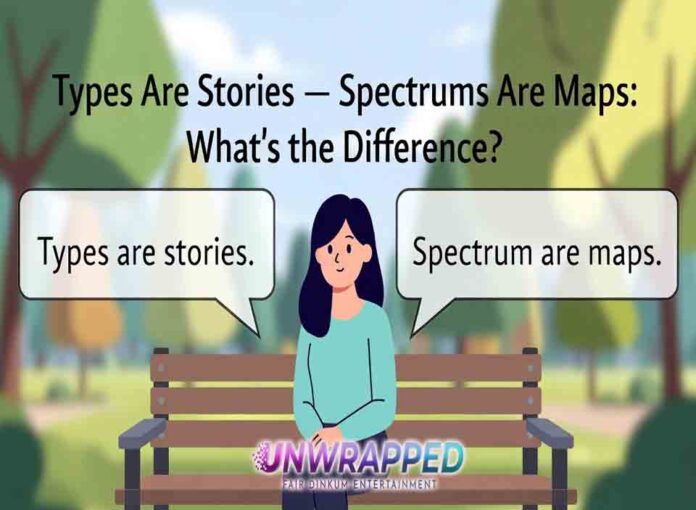
Types are stories. Spectrums are maps.
Stories help people feel seen. Maps help people move wisely. When personality tools are used as narratives and navigation aids, they become powerful without becoming limiting. The goal isn’t to choose one—it’s to know when each is doing its job.
Understanding the difference turns personality frameworks from labels into lenses.