


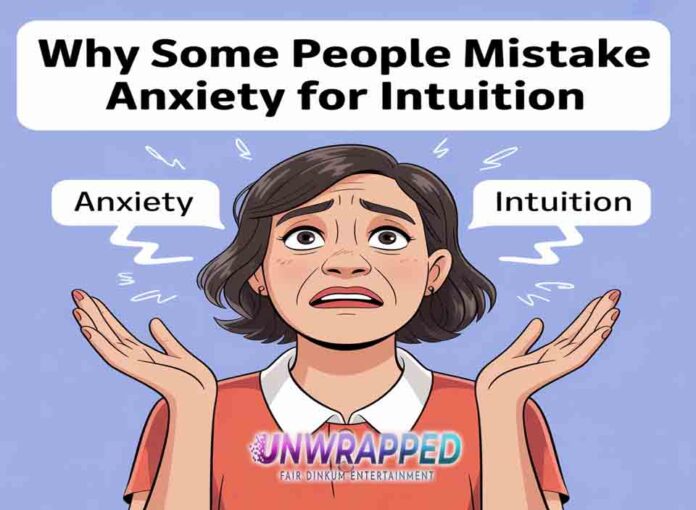
Many people describe anxiety as a gut feeling. It arrives suddenly, carries urgency, and feels protective—almost wise. Because intuition is also fast, nonverbal, and body-based, the two are easily confused. Over time, anxious thoughts can begin to feel like insight, guidance, or even foresight.
Psychology tells a different story. Anxiety and intuition come from different mental systems, serve different purposes, and lead to very different outcomes. Understanding why they are often mistaken for each other explains chronic overthinking, avoidance disguised as wisdom, and the difficulty many people have trusting their own decisions.
What Intuition Actually Is
Intuition is not fear. It is pattern recognition.
Intuition is the brain’s ability to draw on past experience, subtle cues, and contextual knowledge without conscious reasoning. It is quiet, efficient, and proportional to the situation.
True intuition tends to feel:
Calm but clear
Neutral rather than urgent
Grounded rather than frantic
Informative without being overwhelming
Intuition offers direction, not alarm.
See Also: When “Easygoing” Is Actually Avoidance
What Anxiety Actually Is
Anxiety is a threat-detection system.
Research from Harvard Health Publishing explains that anxiety activates the stress response, preparing the body for danger by increasing vigilance, heart rate, and mental scanning. Its job is not accuracy—it is survival.
Anxiety often feels:
Urgent and loud
Repetitive and circular
Catastrophic in tone
Focused on worst-case scenarios
Its goal is protection, not clarity.
Why Anxiety Feels Like Intuition
Both anxiety and intuition:
Appear suddenly
Bypass conscious thought
Are felt in the body
Feel convincing
Because neither arrives through deliberate reasoning, the brain labels both as inner knowing. People under chronic stress are especially likely to interpret anxiety as intuition because stress amplifies internal signals.
The confusion comes from how the signal arrives—not what it represents.
The Nervous System Explains the Confusion
Anxiety and intuition operate best under opposite conditions.
Anxiety dominates when the nervous system is highly activated. In this state, the brain prioritizes speed over nuance. Signals feel intense because intensity ensures attention.
Intuition, by contrast, requires:
Relative calm
Emotional regulation
Cognitive flexibility
When the nervous system is overstimulated, anxiety drowns out intuition—but still masquerades as insight.
Why Anxious People Trust Anxiety More
Anxiety is self-reinforcing.
When people avoid a feared situation and nothing bad happens, the brain credits the avoidance. This reinforces the belief that anxiety was “right.”
Over time:
Anxiety feels predictive
Avoidance feels wise
Calm feels risky
Relief is mistaken for accuracy.
Anxiety Is Loud; Intuition Is Subtle
Volume matters.
Intuitive signals are usually subtle. They do not escalate when questioned. Anxiety, however, becomes louder the more it is examined.
Key differences:
Anxiety insists
Intuition suggests
Anxiety pressures
Intuition allows space
Urgency is a hallmark of fear, not intuition.
How Culture Encourages the Mix-Up
Modern self-help culture often romanticizes anxiety as instinct. Phrases like “trust your gut” or “listen to your fear” blur an important psychological line.
While intuition deserves respect, research consistently shows that fear-based decision-making leads to poorer outcomes. Anxiety narrows focus; intuition integrates context.
Rear feels intelligent because it is fast—but speed is not the same as wisdom.

Anxiety Generalizes; Intuition Stays Specific
Another key difference is scope.
Intuition:
Relates to a specific situation
Does not spread rapidly
Fades once acknowledged
Anxiety:
Jumps between scenarios
Creates chains of “what ifs”
Expands rather than resolves
Cognitive psychology research shows that anxiety broadens perceived threat, while intuition sharpens relevance.
Emotional Tone Reveals the Source
The emotional quality of a thought is often more revealing than its content.
Anxiety feels constricting
Intuition feels clarifying
Anxiety creates tension
Intuition creates orientation
If a “gut feeling” increases panic, rigidity, or mental noise, it is far more likely anxiety than intuition.
Why Anxiety Feels Responsible
Anxiety presents itself as careful thinking.
It warns, plans, and anticipates. This can feel mature or conscientious. Intuition, by contrast, may suggest rest, patience, or restraint—which can feel passive or irresponsible.
Anxiety-driven decisions often feel responsible in the moment but produce long-term dissatisfaction.
Caution is not the same as wisdom.
When Intuition Is Most Reliable
Intuition becomes clearer under certain conditions:
Adequate emotional regulation
Relevant experience
Low urgency
Psychological safety
Intuitive accuracy improves when people are calm enough to process nuance.
Clarity emerges after anxiety settles—not during it.
How to Tell the Difference in the Moment
A practical distinction helps:
Anxiety asks: “What if something goes wrong?”
Intuition asks: “What fits here?”
Another clue:
Anxiety escalates when questioned
Intuition remains steady or fades
Time tends to quiet intuition, not amplify it.
People Also Love: When “Strong” Is Actually Numb
Why Intuition Often Appears After the Fact
Many people notice that clarity arrives after anxiety subsides.
This is not coincidence. Calming the nervous system restores access to integrative thinking. Intuition becomes audible when fear steps back.
Calm is not avoidance—it is access.
Call to Action
If inner signals often feel loud, urgent, and overwhelming, curiosity—not self-judgment—is the next step. Readers are encouraged to notice how decisions change when urgency is paused and calm is allowed to return.
Share this article with someone navigating overthinking or chronic worry, or subscribe for more psychology-based insights into emotion, intuition, and self-trust.
Conclusion
Anxiety and intuition may feel similar, but they speak different languages. Anxiety is fast, protective, and loud. Intuition is quiet, contextual, and grounded. Confusing the two leads to avoidance that feels like wisdom and fear that masquerades as insight.
When calm returns, intuition becomes easier to hear—and far more reliable to follow.
Another Must-Read: The Difference Between Confidence and Certainty