


In almost every workplace, family gathering, friendship circle, or online discussion, there is usually someone who seems unable to let a disagreement go. They will argue over details, defend their position relentlessly, and often appear more concerned with being right than reaching understanding.
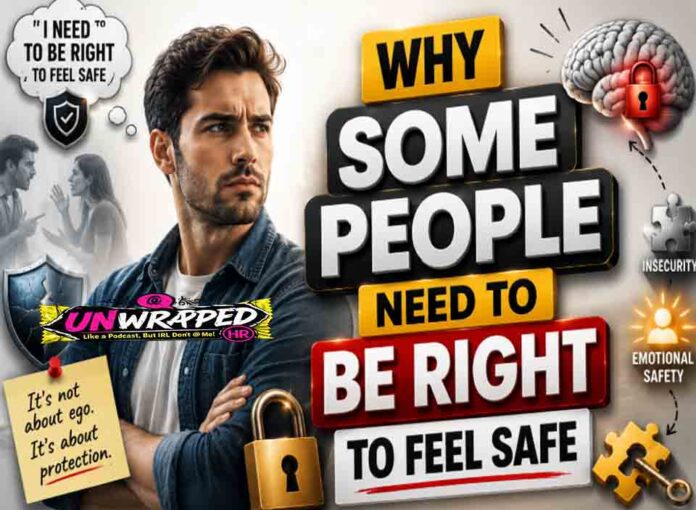
At first glance, this behavior can seem arrogant, stubborn, or controlling. But psychology suggests something more complicated may be happening beneath the surface. For many people, being right is not simply about winning an argument. It is about feeling secure, competent, respected, and emotionally safe.
Understanding this connection can completely change the way people view conflict, communication, and personality.
The Hidden Emotional Need Behind Being Right
Most people assume arguments are about facts.
Often, they are about feelings.
When someone strongly identifies with their opinions, beliefs, or expertise, disagreement can feel like more than a challenge to an idea. It can feel like a challenge to their identity.
People naturally protect aspects of themselves that contribute to self-worth and psychological stability.
For some individuals, being correct provides reassurance that:
- They are competent
- They are intelligent
- They are respected
- They are in control
- They can trust their judgment
Without realizing it, correctness becomes emotional security.
Why Uncertainty Feels Threatening
Not everyone experiences uncertainty the same way.
Some people are comfortable with ambiguity.
Others find it deeply uncomfortable.
For those in the second group, uncertainty can create significant stress because it introduces unpredictability.
What Happens Internally?
When uncertainty increases, people may experience:
- Anxiety
- Mental discomfort
- Self-doubt
- Fear of making mistakes
- Fear of losing control
Being right becomes a way to reduce those uncomfortable feelings.
Instead of sitting with uncertainty, they seek certainty.
Instead of exploring possibilities, they seek confirmation.
Childhood Experiences Often Play a Role
Many personality patterns develop long before adulthood.
Children who receive praise primarily for being correct, intelligent, or successful may learn to associate mistakes with rejection or disappointment.
Over time, they begin to connect self-worth with accuracy.
Common Messages That Shape This Pattern
- “Don’t make mistakes.”
- “You should know better.”
- “Only correct answers matter.”
- “Failure is unacceptable.”
These experiences can create adults who feel uncomfortable admitting they are wrong because mistakes trigger old emotional responses.
Perfectionism and defensiveness often share roots in fear of judgment.
Another Must-Read: Why You Get Defensive With the People You Love Most
The Difference Between Confidence and Needing to Be Right
People often confuse confidence with certainty.
They are not the same thing.
Confident People
- Can change their minds
- Welcome new information
- Ask questions
- Admit mistakes
- Remain curious
People Who Need to Be Right
- Resist opposing views
- Feel threatened by disagreement
- Defend positions aggressively
- Interpret challenges personally
- Struggle to admit uncertainty
The distinction is important.
True confidence can tolerate being wrong.
Insecurity often cannot.
Why Smart People Sometimes Become More Defensive
An interesting psychological paradox exists.
Highly intelligent people can become especially attached to being right.
The issue is not intelligence itself.
The issue is identity.
When intelligence becomes someone’s primary source of self-worth, disagreement may feel like a direct attack on what makes them valuable.
The smarter someone becomes, the better they may become at defending their position.
Not necessarily examining it.
How Relationships Suffer When Being Right Becomes a Priority
Relationships thrive on understanding.
They struggle when conversations become competitions.
Common Relationship Problems
When someone constantly needs to be right:
- Partners stop sharing openly
- Conversations become debates
- Small disagreements escalate quickly
- Emotional intimacy decreases
- Resentment builds
The goal of communication shifts from connection to victory.
Unfortunately, winning the argument often means losing the relationship moment.
The Brain Loves Certainty
Neuroscience provides another explanation.
The human brain naturally prefers predictability.
Uncertainty requires more mental energy.
Certainty feels efficient.
This tendency helps explain why people often seek information that confirms existing beliefs.
Researchers call this confirmation bias.
People unconsciously look for evidence supporting what they already think while ignoring contradictory information.
This pattern affects everyone to some degree.
The difference lies in how strongly someone depends on certainty for emotional comfort.
See Also: 7 Unusual Human Personality Facts That Were Discovered by Accident
Signs Someone Uses Being Right as Emotional Protection
Not everyone who argues frequently has this pattern.
However, several signs often appear together:
Difficulty Saying “I Was Wrong”
Even minor mistakes feel surprisingly difficult to admit.
Constant Fact-Checking
The need to prove accuracy becomes more important than the discussion itself.
Defensiveness During Feedback
Constructive criticism feels personal.
Overexplaining
Every disagreement becomes a lengthy defense.
Anxiety Around Mistakes
Errors create disproportionate emotional discomfort.
These behaviors are often less about ego and more about emotional safety.
How to Become More Comfortable Being Wrong
Growth begins with awareness.
Separate Identity From Opinion
An opinion can be wrong without making the person wrong.
This distinction reduces defensiveness dramatically.
Practice Curiosity
Replace:
“I need to prove my point.”
With:
“What can I learn here?”
Normalize Mistakes
Mistakes are information.
They are not evidence of failure.
Focus on Understanding
The goal of communication should not always be agreement.
Sometimes understanding is enough.
Learn to Tolerate Uncertainty
One of the healthiest psychological skills is the ability to say:
“I don’t know.”
Without feeling threatened.
Why Psychological Safety Matters
People who feel secure generally become less attached to being right.
When self-worth is stable, disagreement loses its emotional danger.
They can:
- Explore ideas openly
- Change opinions freely
- Admit mistakes quickly
- Learn without embarrassment
Psychological safety creates intellectual flexibility.
Flexibility creates growth.
Conclusion
The need to be right is rarely about facts alone. For many people, it serves as a shield against uncertainty, self-doubt, criticism, or emotional discomfort. What appears to be stubbornness on the surface is often a deeper attempt to maintain security and stability.
Understanding this pattern creates more compassion—for others and for ourselves. The strongest personalities are not necessarily the ones who are always right. They are often the ones secure enough to learn, adapt, and occasionally say, “I was wrong.”
Call to Action
Have you ever noticed yourself becoming defensive when someone challenges your opinion?
Share your thoughts in the comments and explore the deeper personality patterns that influence how you handle disagreement, uncertainty, stress, and communication.