


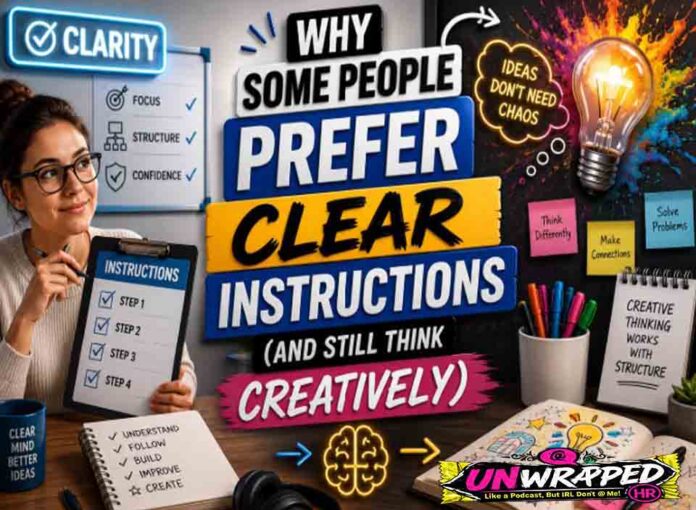
Creativity is often imagined as chaotic, spontaneous, and completely unstructured. Popular culture tends to celebrate the “free spirit” who ignores rules and invents ideas out of thin air. But real life is far more nuanced. Some of the most imaginative people actually thrive when expectations are clear, systems are organized, and instructions are easy to follow.
That combination may sound contradictory at first. How can someone crave structure while still being deeply creative? Yet psychologists, educators, designers, engineers, writers, and innovators have recognized this pattern for years. Many people think best when their mental energy is not wasted decoding confusion. Clear instructions create mental space for experimentation, problem-solving, and original thinking.
Research from institutions like the American Psychological Association and insights from cognitive science suggest that creativity does not always come from disorder. In many cases, creativity grows stronger inside supportive frameworks that reduce stress and cognitive overload.
The result is a personality style that values clarity without losing imagination — practical thinkers who still create bold ideas.
Why Clear Instructions Feel Mentally Safer
The human brain naturally seeks predictability. When instructions are vague, the brain spends extra energy trying to interpret hidden expectations, possible mistakes, or social consequences. For some personalities, that uncertainty becomes mentally exhausting.
Clear guidance helps reduce:
- Decision fatigue
- Anxiety about mistakes
- Overthinking
- Cognitive overload
- Fear of misunderstanding expectations
This does not mean the person lacks intelligence or originality. In fact, structured thinkers are often highly observant and strategic. They simply prefer knowing the boundaries before exploring possibilities inside them.
A software developer, for example, may prefer a detailed project outline before building something innovative. A graphic designer may want brand guidelines before experimenting visually. A musician may learn scales and structure before improvising creatively.
Structure becomes the foundation, not the limitation.
Creativity Is Not the Opposite of Structure
One of the biggest myths about creativity is that it only exists in completely unrestricted environments. In reality, many creative systems are built around frameworks.
Writers use outlines.
Architects follow engineering principles.
Filmmakers use scripts.
Musicians follow rhythm and timing.
Artists study composition and technique.
Even improvisation relies on learned structure first.
According to research shared by Harvard Business Review, constraints can actually improve innovation because they force the brain to solve problems more efficiently. When everything is unlimited, people often become overwhelmed instead of inspired.
This explains why some personalities become more creative when instructions are clear. Their minds stop focusing on uncertainty and start focusing on possibilities.
The Psychology Behind Instruction-Oriented Thinkers
People who prefer clear instructions often share several psychological tendencies:
High Conscientiousness
Conscientious personalities value organization, accuracy, preparation, and reliability. Studies connected to the Big Five personality framework consistently show that conscientious individuals often perform well in structured environments while still demonstrating strong creative output.
Pattern Recognition
Many instruction-oriented thinkers are excellent at spotting systems, patterns, and improvements. Once they understand the “rules,” they naturally begin optimizing or reinventing them.
Fear of Miscommunication
Some people dislike vague expectations because they want to avoid unnecessary conflict or failure. Clear communication helps them feel secure enough to focus creatively instead of defensively.
Mental Efficiency
Certain personalities simply think more effectively when information is organized logically. Clarity reduces mental clutter.
Why Structured Thinkers Are Often Misunderstood
Unfortunately, society sometimes stereotypes people who prefer instructions as rigid, boring, or uncreative. That assumption misses the bigger picture.
Many highly creative individuals are actually systems thinkers. They enjoy:
- Refining processes
- Improving ideas
- Building frameworks
- Solving practical problems
- Turning concepts into reality
The difference is that their creativity often appears more intentional than chaotic.
Instead of random inspiration, their imagination operates through precision and strategy.
A person who carefully plans every detail of a business launch can still be deeply creative. Someone who color-codes projects may also write brilliant stories or invent original solutions. Creativity has many personalities.
See Also: Why Some People Hate Being Managed (Even When the Boss Is Good)
The Hidden Stress of Ambiguity
For some people, unclear instructions create emotional tension that others may never notice.
When expectations feel uncertain, the brain starts asking:
- “What if this is wrong?”
- “What are they actually asking for?”
- “Am I missing something important?”
- “What if I misunderstand the goal?”
This constant mental scanning drains energy that could otherwise be used creatively.
That is why clarity often unlocks better performance. Once uncertainty disappears, curiosity and innovation become easier to access.
In workplaces, schools, and relationships, communication quality dramatically affects how different personality types perform.
Creative People Who Love Systems
Many successful creators throughout history balanced imagination with structure.
Examples include:
- Filmmakers using storyboarding systems
- Musicians practicing repetitive scales daily
- Designers following visual hierarchy principles
- Scientists conducting structured experiments
- Authors using chapter outlines
Even companies known for innovation rely heavily on organized systems behind the scenes.
According to insights from McKinsey & Company, innovative organizations often combine creativity with operational clarity rather than relying on chaos alone.
The idea that structure kills creativity is mostly a misconception.
Different Personalities Create Differently
Not everyone approaches creativity the same way.
Some personalities brainstorm freely first and organize later. Others need structure before ideas begin flowing naturally. Neither approach is wrong.
Common creative styles include:
The Free Explorer
Thrives in open-ended environments and spontaneous experimentation.
The Structured Innovator
Prefers clear goals, systems, and expectations before creating.
The Emotional Creator
Uses feelings, intuition, and connection as creative fuel.
The Analytical Builder
Combines logic, precision, and strategic thinking to generate ideas.
Understanding these differences helps reduce unnecessary judgment between personality types.
How to Support Creative Structured Thinkers
Managers, teachers, friends, and collaborators can often unlock stronger creativity simply by improving communication.
Helpful approaches include:
- Giving clear expectations
- Breaking projects into steps
- Defining goals early
- Allowing flexibility within structure
- Reducing unnecessary ambiguity
- Encouraging experimentation after clarity is established
This balance helps instruction-oriented personalities feel mentally safe enough to innovate confidently.
Why Self-Awareness Matters More Than Labels
The goal is not to place people into rigid personality boxes. The goal is awareness.
Once someone understands how their mind works, they stop comparing themselves unfairly to others. They recognize that preferring clarity does not make them less imaginative. It simply means their creativity operates differently.
Some minds create through chaos.
Others create through clarity.
Both are valid.
Understanding personal thinking patterns can improve relationships, work performance, communication, emotional regulation, and confidence.
Call-to-Action
Do you think more creatively when instructions are clear — or when everything is open-ended?
Share this article with someone who has been misunderstood as “too structured” to be creative. Their mind may simply work differently.
For deeper personality insights, emotional patterns, and behavioral tendencies, explore the FREE quiz from Personality Peek and discover how your personality influences the way you think, create, and communicate.
Conclusion
The idea that creative people must reject structure is outdated. Many imaginative minds actually perform best when expectations are organized, goals are clear, and communication feels predictable. Structure does not always limit creativity — sometimes it protects it.
People who prefer clear instructions are not less original. In many cases, they are highly strategic thinkers whose creativity becomes stronger once confusion is removed. Understanding that difference creates healthier workplaces, stronger relationships, and greater self-awareness for everyone involved.