


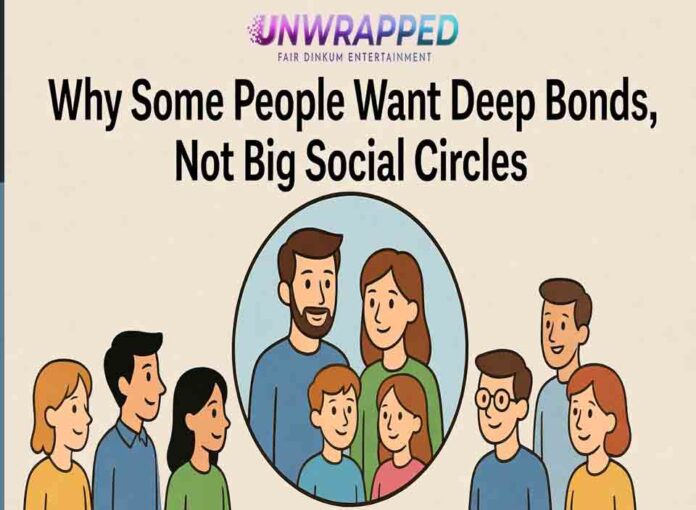
In a culture that often celebrates popularity, networking, and constant social activity, there is a quieter preference that rarely gets the spotlight. Some people are not interested in knowing everyone. They are interested in knowing someone—deeply. While others thrive on broad connections, these individuals invest their time, emotion, and attention into a small number of meaningful relationships.
This preference is not antisocial, elitist, or emotionally limited. It reflects a different way of relating to others—one rooted in depth over breadth. Understanding why some people want deep bonds rather than big social circles reveals how attachment, energy, values, and biology shape human connection in profoundly different ways.
Page Contents
ToggleDepth and Breadth Are Different Social Strategies
Human beings are wired for connection, but not all connections serve the same purpose. Social scientists often distinguish between bonding (deep, emotionally rich relationships) and bridging (wide, loose networks).
People who prioritize deep bonds focus on:
emotional safety
mutual understanding
long-term trust
People who prefer large circles often value:
access to opportunities
variety of perspectives
social stimulation
Neither approach is superior. They are simply optimized for different outcomes. Individuals differ widely in how they experience fulfillment through relationships.
Emotional Energy Is Finite
One of the most practical reasons people choose depth over breadth is energy.
Deep bonds require:
presence
vulnerability
emotional availability
Maintaining many relationships at that level would be exhausting. For people who process emotions intensely, spreading connection too thin can feel draining rather than enriching.
Psychologists often note that some individuals recover energy through solitude or depth rather than stimulation. A smaller circle allows them to show up fully without burnout.
Trust Takes Time—and Some People Respect That
Deep-bond-oriented individuals tend to treat trust as something built slowly, not assumed quickly.
They value:
consistency over charisma
honesty over performance
reliability over novelty
This makes large social circles feel inefficient. Casual connections may be pleasant, but they do not offer the emotional return these individuals seek.
Sociological research frequently references the idea that trust density matters more than network size. A handful of deeply trusted relationships often provides more psychological safety than dozens of surface-level ones.
See Also: Why Some People Are Natural Pattern-Spotters
Attachment Style Shapes Social Preference
Attachment theory helps explain why some people gravitate toward depth.
Those with secure or reflective attachment styles often prefer fewer, stronger bonds because:
intimacy feels regulating
emotional openness feels meaningful
stability feels nourishing
Meanwhile, people with more avoidant or novelty-seeking tendencies may prefer wider networks with less emotional intensity.
Educational resources emphasize that attachment styles influence not just romance, but friendship patterns, community involvement, and social pacing.
Big Social Circles Can Feel Performative
For people oriented toward depth, large social environments often feel scripted.
They may experience:
pressure to be “on”
conversations that stay surface-level
relationships that revolve around roles rather than authenticity
This does not mean they dislike people. It means they dislike performing connection instead of living it.
Depth-oriented individuals often want conversations that move beyond updates and opinions into values, fears, contradictions, and growth. These exchanges are difficult to sustain across large groups.
The Hidden Strengths of Deep-Bond Seekers
People who prioritize depth often bring unique strengths to relationships and communities:
Emotional attunement – they notice subtle shifts and unspoken needs
Consistency – they show up over time, not just in moments
Meaning-making – they help others process experiences deeply
While they may not be the most socially visible, they are often the ones people rely on when things truly matter.
When Depth Becomes Isolation
Depth has limits, too. If selectivity turns into avoidance, or if fear of surface interaction blocks new connections, loneliness can creep in.
Healthy depth-oriented people still allow:
gradual entry points
evolving levels of closeness
light connections that may deepen later
As noted in mental health guidance from Mind, balance—not extremity—supports long-term social well-being.
People Also Love: Why Some People Assume the Best (and Get Burnt)
Call to Action
If this article gets to you, share it with someone who values a small circle and deep trust. Readers are encouraged to comment with their own experiences of choosing depth over breadth. Subscribe for future articles that explore human behavior with nuance, warmth, and psychological insight.
Ending Thoughts
Wanting deep bonds instead of big social circles is not a rejection of people—it is a commitment to meaning. For these individuals, connection is not about visibility or volume, but about presence, trust, and emotional truth.
In a world that often measures social success by numbers, depth-oriented people quietly redefine richness. They remind us that intimacy does not scale—but it does endure. Sometimes, one real bond is worth more than a hundred casual ones.
Another Must-Read: Why Some People Assume the Worst (and Get It Right)