



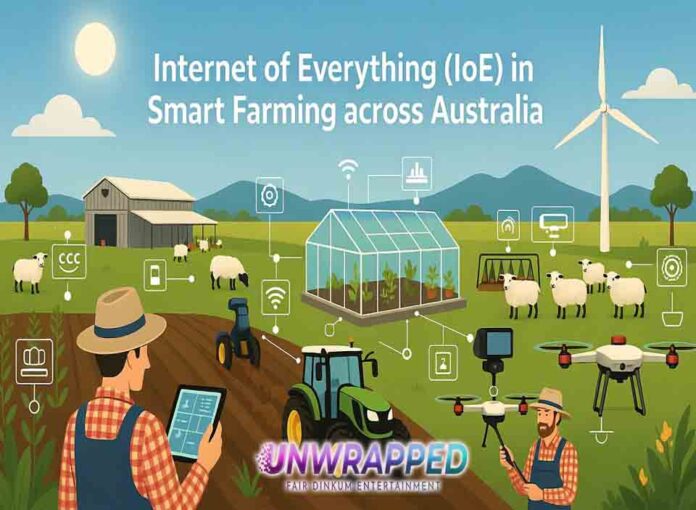
Australian agriculture is undergoing one of its most significant transformations since mechanization. Faced with climate volatility, water scarcity, labor shortages, and global market pressure, farmers are increasingly turning to connected technologies to stay competitive and resilient. At the center of this shift is the Internet of Everything (IoE)—a broader evolution of the Internet of Things that connects not just devices, but people, data, processes, and systems into a single intelligent farming ecosystem.
Across Australia’s vast and diverse agricultural landscape—from cattle stations in Queensland to vineyards in South Australia and grain farms in Western Australia—IoE-powered smart farming is no longer experimental. It is becoming a practical, measurable way to improve yields, reduce waste, protect the environment, and make better decisions in real time. This article explores how IoE is reshaping Australian agriculture, the technologies involved, real-world use cases, challenges, and what the future holds for smart farming nationwide.
What Is the Internet of Everything (IoE)?
Beyond IoT: A Smarter Agricultural Network
While the Internet of Things (IoT) focuses on connected devices such as sensors and machinery, the Internet of Everything (IoE) goes further. IoE integrates:
Things – sensors, drones, machinery, wearables
Data – weather, soil, crop health, livestock metrics
People – farmers, agronomists, supply chain partners
Processes – automated workflows, alerts, predictive models
IoE creates value by turning raw data into actionable insight—something particularly powerful in agriculture, where timing and accuracy are critical.
See Also: How to Quiet a Squeaky Bed Frame Without Tools
Why IoE Matters for Australian Agriculture
Farming in One of the World’s Toughest Environments
Australia’s agricultural sector operates under unique conditions: vast distances, variable rainfall, extreme weather events, and fragile ecosystems. Traditional farming methods often rely on historical averages and manual observation, which are no longer sufficient.
Data-driven farming improves productivity while reducing environmental impact—exactly where IoE excels.
Key benefits of IoE for Australian farmers include:
Real-time decision-making
Reduced input costs (water, fertilizer, fuel)
Improved animal welfare
Greater climate resilience
Core IoE Technologies Powering Smart Farming in Australia
Smart Sensors and Edge Devices
Soil moisture probes, nutrient sensors, weather stations, and livestock trackers form the foundation of IoE in agriculture. These devices collect continuous data, even in remote locations.
Organisations like AgriFutures Australia highlight how sensor-based monitoring allows farmers to respond precisely rather than reactively—watering only when needed and fertilising only where required.
Connectivity: From LoRaWAN to Satellite IoE
Connectivity is a major challenge in rural Australia. To overcome this, smart farming increasingly relies on:
LoRaWAN networks for low-power, long-range sensor communication
Private LTE/5G on large farms
Satellite IoE, supported by initiatives like NBN Sky Muster and emerging low-earth-orbit satellite services
Improved rural connectivity is a key enabler of digital agriculture.
Data Platforms and AI Analytics
IoE platforms aggregate data from multiple sources—sensors, machinery, weather forecasts, and historical records—into unified dashboards. AI models then analyze patterns and predict outcomes.
Predictive analytics can forecast yield, detect disease early, and optimize harvest timing, reducing both risk and waste.
Smart Farming Use Cases Across Australia
Precision Crop Management
IoE enables site-specific farming, where every part of a paddock is managed differently based on real conditions.
Examples include:
Variable-rate irrigation guided by soil moisture data
Targeted fertiliser application using nutrient maps
Early disease detection through multispectral imaging
These practices align with findings on improving farm efficiency while protecting natural resources.
Another Must-Read: Cheapest Cities to Live in Australia 2026 for Students & New Migrants
Livestock Monitoring and Welfare
In Australia’s extensive grazing systems, IoE is transforming livestock management.
Smart ear tags, collars, and walk-over weigh systems track:
Animal location and movement
Weight gain and health indicators
Water usage and grazing patterns
Projects show that connected livestock systems reduce losses, improve welfare outcomes, and support more sustainable grazing.
Smart Irrigation and Water Management
Water is one of Australia’s most precious resources. IoE-based irrigation systems combine weather forecasts, evapotranspiration data, and soil sensors to deliver water only when and where it is needed.
Data-led irrigation can significantly reduce water use without compromising yield—a critical advantage in drought-prone regions.
Call to Action: Building Australia’s Smart Farming Future
IoE is not just about technology—it’s about empowering farmers with better information and control. Producers, agribusinesses, policymakers, and researchers all play a role in accelerating adoption.
Readers are encouraged to share this article, engage in conversations about digital agriculture, and explore IoE solutions suited to their region and enterprise. The future of Australian farming depends on informed, connected decisions made today.
Wrapping Up
The Internet of Everything is reshaping smart farming across Australia, turning data into one of agriculture’s most valuable inputs. By connecting devices, people, and processes, IoE enables farmers to respond faster, farm more precisely, and operate more sustainably—despite the challenges of climate and scale.
While barriers remain, the momentum is clear. With continued investment in connectivity, education, and farmer-led innovation, IoE will play a central role in ensuring Australian agriculture remains productive, resilient, and globally competitive for decades to come.
People Also Love: 15 Best Side Hustle Ideas for Students in Australia in 2026