



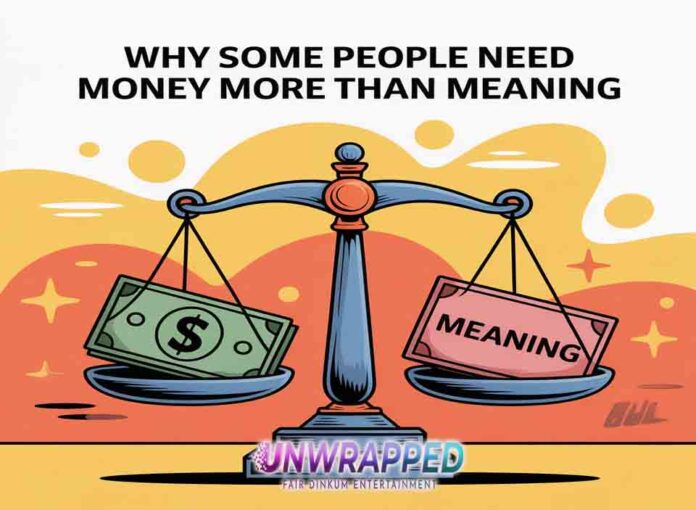
Modern conversations about work and fulfillment often carry a quiet moral judgment: that seeking “meaning” is enlightened, while prioritizing money is shallow. Social media glorifies purpose-driven careers, passion projects, and mission-led work—sometimes overlooking a simpler truth. For many people, money is not a secondary motivator. It is the foundation that makes life workable, stable, and psychologically safe.
This article explores why some people genuinely need money more than meaning, why this preference is rooted in psychology and lived reality—not greed—and why treating it as inferior creates unnecessary shame, bad career advice, and unrealistic expectations.
Money Is Not Just Motivation—It’s Regulation
Money doesn’t merely motivate behavior; it regulates stress, cognition, and decision-making.
Financial insecurity increases cognitive load, reduces working memory, and amplifies emotional reactivity. For people under economic pressure, money isn’t about luxury—it’s about mental bandwidth.
When income stabilizes:
Anxiety drops
Planning improves
Emotional regulation strengthens
For these individuals, money creates the conditions in which meaning can exist later.
Maslow Wasn’t Wrong—Just Misused
The popular version of Maslow’s hierarchy suggests people should “move past” money toward self-actualization. But Maslow himself emphasized that unmet basic needs dominate attention.
Safety and physiological needs don’t disappear just because society celebrates purpose. If rent, healthcare, food, or debt are unstable, meaning feels abstract.
For people who grew up with:
Financial instability
Caregiving responsibilities
Systemic barriers
money represents safety, dignity, and choice—not emptiness.
See Also: Why Some People Hate Feedback (Even When It’s Kind)
Why Meaning-First Advice Often Backfires
“Follow your passion” advice assumes a safety net. Without one, it can be harmful.
Economic precarity disproportionately affects decision-making freedom. When people are told they should prioritize meaning while lacking stability, they often experience:
Shame for practical choices
Chronic stress from risk exposure
Burnout from overextension
Choosing money is often an adaptive, intelligent response to real constraints.
Some Nervous Systems Prioritize Predictability
From a neurobiological perspective, people vary in how their nervous systems respond to uncertainty.
Unpredictability heightens stress responses in certain individuals. For these people, stable income:
Lowers baseline anxiety
Improves sleep and focus
Supports emotional regulation
Meaning-driven but unstable work may actually decrease well-being for them.

Money Can Be a Form of Care
In many cultures and families, money equals responsibility.
Financial contribution is often a primary way people express care for family and community. For these individuals:
Earning well = protecting others
Stability = love in action
Income = reliability
In this context, choosing money is not selfish—it is relational.
Identity Shapes What Feels Rewarding
Not everyone experiences work as identity expression. Some experience it as instrumental—a means to support life outside work.
People differ in how central work is to their identity. Those who are:
Family-centered
Life-outside-work oriented
Security-driven
often find fulfillment through what money enables, not what work symbolizes.
The Myth That Money and Meaning Must Compete
A common misconception is that prioritizing money means rejecting meaning. In reality, timing matters.
Financial security is strongly correlated with life satisfaction up to a stability threshold. Once stability is achieved, people often explore meaning later—on their own terms.
Money-first doesn’t mean meaning-never.
Why Shaming Money Priorities Is Harmful
When society elevates meaning and downplays money, it creates invisible hierarchies:
“Purpose-driven” becomes morally superior
Financial focus becomes suspect
Practical choices get pathologized
This framing ignores structural realities like cost of living, healthcare access, caregiving, and inequality. Economic security is a key determinant of mental health.
Money isn’t shallow when it’s protecting health.
People Also Love: Why Some People Need Deadlines to Start
Call to Action
If this article helped reframe how you—or someone you know—thinks about money and meaning, share it. Subscribe for more psychology-backed insights that challenge simplistic narratives about work, success, and fulfillment.
Conclusion
Some people are energized by purpose first. Others need stability before anything else. Neither path is superior—they are responses to different nervous systems, histories, responsibilities, and realities.
Choosing money can be wise, ethical, and self-aware. It can be about safety, care, regulation, and freedom. Recognizing this allows people to make choices without shame—and helps workplaces and cultures support motivation as it actually exists, not as it’s idealized.
Another Must-Read: Why Some People Need Meaning More Than Money