

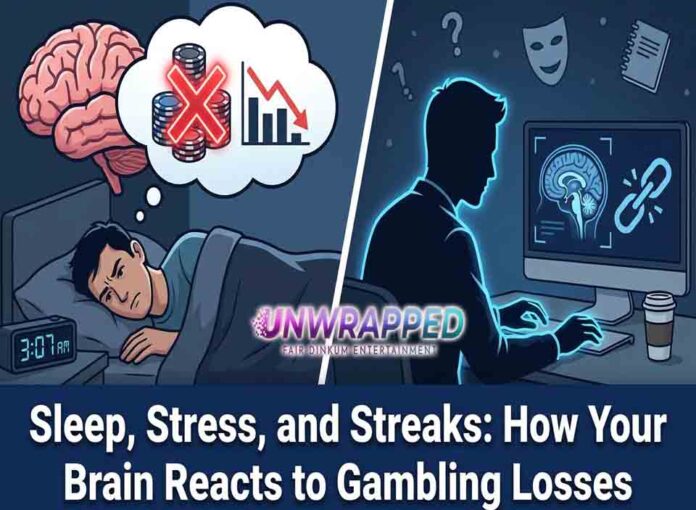
Gambling losses don’t just affect a bank account—they affect the brain. What looks like a simple financial setback often triggers a chain reaction involving stress, sleep disruption, and behavioral loops that are difficult to break. The brain doesn’t process gambling losses the same way it processes everyday decisions. It treats them as emotionally charged events tied to reward, risk, and recovery.
In 2026, with online platforms making gambling more accessible than ever, understanding this psychological response has become increasingly important. Why do people keep playing after losing? Why does sleep suffer? And why do losing streaks feel so hard to walk away from? The answers lie in how the brain interprets loss, uncertainty, and the possibility of a comeback.
The Brain’s Reward System Doesn’t Shut Off After a Loss
At the core of gambling behavior is the brain’s reward system. When a person wins, dopamine is released, reinforcing the behavior. But what’s less obvious is that dopamine doesn’t disappear after a loss.
Anticipation—not just winning—drives dopamine release.
This means:
- The possibility of winning still feels rewarding
- Losses don’t immediately reduce motivation
- The brain stays engaged in the cycle
Instead of stopping after a loss, the brain often becomes more focused on the next attempt.
Why Losing Streaks Feel Harder Than They Should
A losing streak isn’t just a series of outcomes—it’s a psychological pattern.
The brain struggles with randomness. It looks for meaning where none exists. This leads to:
- Belief that a win is “due”
- Increased confidence after repeated losses
- Continued play despite negative outcomes
This is often referred to as the “gambler’s fallacy”.
The result is a distorted sense of probability, where losses don’t signal stopping—they signal persistence.
People Also Love: Under-18 Esports Betting Loopholes—How Regulators Are Clamping Down
Stress Response Intensifies Decision-Making Errors
Losses trigger stress, and stress changes how decisions are made.
When stress levels rise:
- The brain shifts toward short-term thinking
- Risk assessment becomes less accurate
- Emotional decisions override logical ones
Stress reduces the brain’s ability to process complex information.
In gambling contexts, this leads to:
- Chasing losses
- Increasing bet sizes
- Ignoring long-term consequences
Stress doesn’t encourage caution—it often amplifies risk.
Sleep Disruption After Gambling Losses
Sleep is one of the first systems affected.
After a loss, people often experience:
- Racing thoughts
- Mental replay of decisions
- Difficulty switching off
The brain remains in an activated state, trying to “resolve” the situation.
This creates a loop:
- Loss → stress → poor sleep → reduced cognitive control → more impulsive decisions
Sleep loss doesn’t just affect energy—it affects judgment.
Why the Brain Focuses More on Losses Than Wins
Losses carry more emotional weight than gains.
This is known as loss aversion, a concept explored in behavioral economics research.
In practical terms:
- Losing $100 feels worse than winning $100 feels good
- Negative outcomes are remembered more strongly
- The brain prioritizes “fixing” the loss
This explains why people often continue gambling—not for excitement, but for recovery.

The Illusion of Control Keeps the Cycle Going
Many gambling environments create a sense of influence:
- Choosing numbers
- Timing decisions
- Adjusting strategies
Even when outcomes are random, these actions create the feeling of control.
The brain interprets this as:
- “I can change the outcome”
- “I just need to adjust my approach”
This illusion strengthens persistence, even when evidence suggests otherwise.
Emotional Regulation Becomes the Hidden Driver
Over time, gambling shifts from entertainment to emotional regulation.
People begin to use it to:
- Escape stress
- Distract from problems
- Regain a sense of control
This changes the purpose of the activity.
Instead of asking:
- “Is this logical?”
The brain asks:
- “Does this help me feel better right now?”
Short-term relief becomes the priority.
Breaking the Cycle Requires Awareness, Not Just Willpower
Stopping isn’t simply about discipline. It’s about understanding the pattern.
Key shifts include:
- Recognizing emotional triggers
- Separating outcomes from identity
- Interrupting automatic behavior
Even small actions help:
- Pausing before placing a bet
- Setting limits in advance
- Creating distance from the environment
Awareness introduces choice where there was previously impulse.
Call to Action
Understanding the brain changes how behavior is managed.
🧠 Pay attention to patterns, not just outcomes.
💭 Notice emotional triggers before acting.
🔁 Share this article with someone who could benefit from this insight.
Awareness is the first step toward control.
Conclusion
Gambling losses don’t operate in isolation. They activate a network of responses involving reward systems, stress reactions, and cognitive biases. What appears to be a simple decision to continue often reflects deeper neurological patterns.
Sleep disruption, emotional intensity, and distorted thinking all play a role in maintaining the cycle. Recognizing these elements doesn’t eliminate the behavior—but it makes it visible.
Once the pattern becomes clear, the response can change. The brain may be wired to react in certain ways, but awareness creates the space to choose differently. And in that space, long-term control becomes possible.
See Also: What Smart Players Do Differently in Online Casinos in 2026