

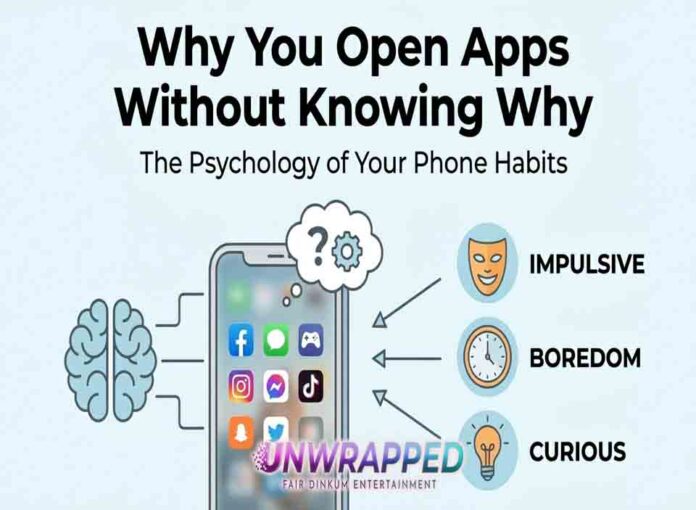
It happens almost automatically. A phone unlocks, a thumb taps an app, and suddenly minutes—or even hours—pass without a clear reason why it started. There’s no urgent notification, no specific goal, yet the behavior repeats daily. This isn’t random. It’s patterned.
In today’s digital environment, apps are designed to capture attention, but the deeper story lies in how the brain responds. Opening apps without thinking isn’t a lack of discipline—it’s the result of habit loops, emotional triggers, and neurological shortcuts working together. Understanding this behavior reveals not just how technology influences attention, but how people interact with their own impulses.
1. The Habit Loop Running in the Background
At the core of mindless app opening is a simple cycle: cue, action, reward.
A cue appears:
- A moment of boredom
- A pause between tasks
- A subtle emotional shift
The action follows:
- Unlocking the phone
- Opening a familiar app
The reward completes the loop:
- A quick dopamine hit
- New content
- Temporary distraction
Once this loop is established, it runs with minimal conscious effort.
Over time, the brain stops asking why—it simply executes the pattern.
2. Micro-Boredom Triggers Automatic Behavior
Most people don’t open apps during major events—they open them during micro-moments.
These include:
- Waiting in line
- Sitting between tasks
- Pausing during conversations
These small gaps feel uncomfortable, even if only for a second.
Instead of sitting in that space, the brain seeks stimulation. Apps provide instant relief.
The behavior isn’t about the app itself—it’s about filling the gap.
See Also: How to Quiet a Squeaky Bed Frame Without Tools
3. Dopamine Doesn’t Need a Big Reward
A common misconception is that dopamine requires something significant to activate.
In reality:
- Small, unpredictable rewards are more powerful
- Variable content creates anticipation
- Scrolling becomes self-reinforcing
Unpredictability increases engagement.
This is why:
- Refreshing feeds feels satisfying
- New notifications create urgency
- Endless scrolling becomes hard to stop
The brain is chasing possibility, not certainty.
4. Apps Are Designed to Remove Stopping Points
Older forms of media had natural endings. Apps don’t.
Features like:
- Infinite scroll
- Auto-play videos
- Continuous recommendations
…eliminate decision points.
Without a clear “stop” signal, the brain continues the behavior by default.
Platforms intentionally reduce friction to keep users engaged longer.
The result is not just usage—it’s prolonged immersion.
5. Emotional States Drive Unconscious Checking
App usage isn’t only triggered by boredom. Emotions play a major role.
Common triggers include:
- Stress → seeking distraction
- Loneliness → seeking connection
- Anxiety → seeking reassurance
Opening an app becomes a quick emotional adjustment tool.
The problem is:
- Relief is temporary
- The underlying feeling remains
This creates repeated checking without resolution.

6. Muscle Memory Turns Into Behavior
Over time, physical actions become automatic.
People:
- Unlock phones without thinking
- Tap the same app location instinctively
- Navigate screens without awareness
This is muscle memory.
The brain offloads the process to automatic systems, freeing up cognitive effort—but also reducing awareness.
The action feels intentional, but it’s often habitual.
7. The Illusion of “Just Checking”
Many interactions begin with a clear intention:
- Check one message
- Look at one notification
But quickly expand into:
- Multiple apps
- Extended scrolling
- Lost time
This happens because:
- Each action triggers another
- Each interaction offers new input
- The brain follows the path of least resistance
The original purpose gets replaced by continuous engagement.
8. Social Validation Keeps the Loop Alive
Apps are not just informational—they’re social.
Features like:
- Likes
- Comments
- Messages
…create feedback loops.
The brain interprets these as:
- Approval
- Connection
- Relevance
This reinforces the habit.
Even without new activity, the possibility of social validation keeps users checking.
9. Decision Fatigue Reduces Control
Throughout the day, decision-making capacity declines.
By evening:
- Self-control weakens
- Impulse increases
- Habits dominate
Opening apps becomes easier because:
- It requires no decision
- It provides immediate reward
- It avoids effort
This explains why mindless scrolling often increases later in the day.
10. Awareness Interrupts the Pattern
Breaking the cycle doesn’t require removing apps—it requires noticing the moment.
Simple interventions include:
- Pausing before opening an app
- Asking: “Why now?”
- Creating small delays
These actions reintroduce awareness into automatic behavior.
Even a one-second pause can disrupt the loop.
Call to Action
Awareness changes behavior.
📱 The next time an app opens automatically, pause.
🧠 Notice what triggered it.
🔁 Decide if it’s intentional or habitual.
Small awareness creates long-term control.
Conclusion
Opening apps without knowing why isn’t a flaw—it’s a function of how the brain interacts with modern technology. Habit loops, emotional triggers, and design systems work together to create automatic behavior.
The key isn’t to eliminate app usage, but to understand it. When people recognize the patterns behind their actions, they gain the ability to interrupt them. What once felt automatic becomes adjustable.
The goal isn’t to use less technology—it’s to use it more consciously. Because the difference between control and distraction often comes down to a single moment of awareness.
People Also Love: An Investigation into Why Phones Only Fall Screen-First Onto Concrete