

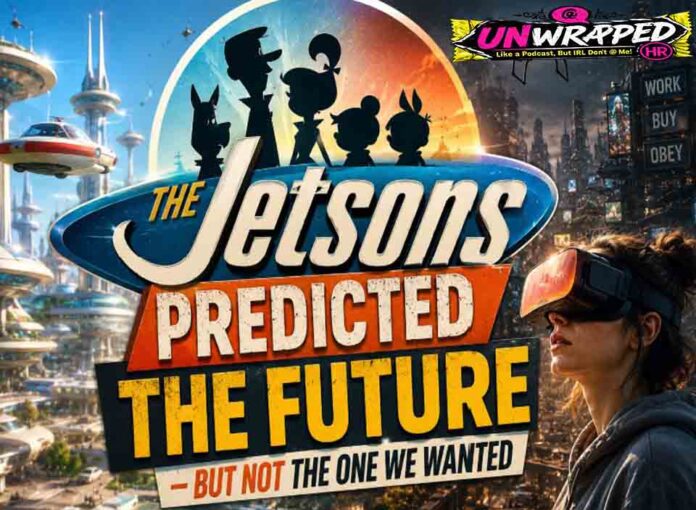
The joke was supposed to be the flying cars.
That was the shiny promise of The Jetsons: a world of bubble-domed vehicles, robot maids, instant meals, video calls, conveyor belts, moving walkways and homes floating high above the mess of ordinary life. It was the future as 1962 imagined it — sleek, clean, mechanical, optimistic and slightly ridiculous.
But more than sixty years later, the strange thing about The Jetsons is not how much it got wrong.
It is how much it got right.
Not perfectly. Not literally. We are not all commuting in flying cars. Most people do not have a wisecracking humanoid maid named Rosie. Our homes do not float above the clouds. Dinner does not reliably appear at the press of a button, unless you count ordering takeaway through an app while pretending that is not a cry for help.
But The Jetsons understood something deeper than gadgetry. It understood the emotional shape of the future.
The show predicted video calls, smartwatches, domestic robots, flat screens, automated homes, digital communication and machine-assisted work. That part is impressive enough. But its real accidental genius was darker: it predicted a world where technology makes everything more convenient while leaving people just as anxious, insecure, overmanaged, status-obsessed and spiritually exhausted as before.
In other words, The Jetsons did not just predict the future.
It predicted us.
What Was The Jetsons?
The Jetsons was an American animated sitcom created by Hanna-Barbera. It first aired in 1962 and followed the Jetson family: George, Jane, Judy, Elroy, their dog Astro and their robot maid Rosie.
The show was essentially the Space Age sibling of The Flintstones. One sitcom took the American nuclear family and dropped it into a comic Stone Age. The other launched that same family into a glittering future usually understood to be around 2062 — one hundred years ahead of the show’s original audience.
The original run was surprisingly short: only 24 episodes aired in the early 1960s. But the show lived on through reruns, later revivals, specials, comics and a permanent place in pop culture. Today, The Jetsons is less a cartoon than a cultural reference point. When people ask, “Where’s my flying car?” they are really asking why the future promised to them never arrived.
Except it did arrive.
Just not in the form they expected.
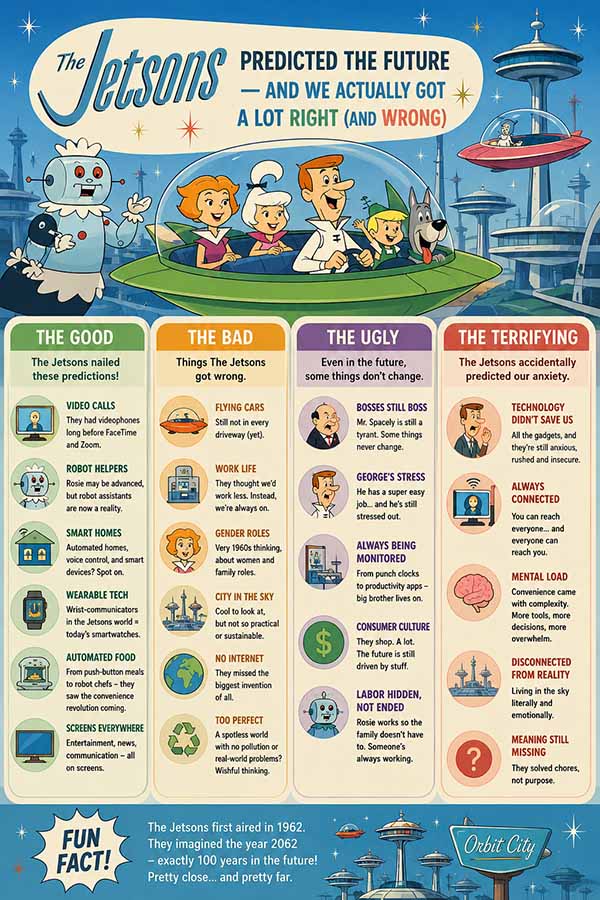
The Good: The Jetsons Got a Lot Right
The easiest way to praise The Jetsons is to list the technologies it seemed to predict. That list is real, and it is impressive.
1. Video Calls
The most famous Jetsons prediction is the videophone.
Characters regularly speak to each other through screens, whether for work, family or social life. In 1962, that still felt like science fiction for most households. Today, it is ordinary. FaceTime, Zoom, Microsoft Teams, WhatsApp video calls, Google Meet and every other screen-based calling tool have turned the videophone into daily life.
But the show did not just predict the device. It predicted the awkwardness.
Video calls are useful, yes. They connect families across continents. They make remote work possible. They bring doctors, teachers, colleagues and friends into the same digital room.
They also bring your face, your home, your bad lighting and your tired expression into other people’s screens whether you are emotionally ready or not.
One of the sharpest Jetsons jokes involves the anxiety of being seen before one is presentable. That joke has aged beautifully and horribly. Today we call the solution “camera off,” “background blur,” “beauty filter,” or “sorry, my webcam isn’t working.”
The Jetsons saw the future of communication and somehow also saw the vanity, panic and performance anxiety that came with it.
2. Robot Helpers
Rosie the robot maid remains one of the most memorable characters in the show. She cooks, cleans, talks back, complains, cares for the family and has more personality than many human sitcom characters.
We do not have household robots quite like Rosie. That is worth saying clearly. The average home does not contain a fully mobile, emotionally intelligent, sarcastic robot housekeeper who can manage the family and judge your life choices.
But the direction was right.
Robot vacuums, smart appliances, warehouse robots, delivery robots, AI assistants, automated cleaning devices and experimental home robots all belong to Rosie’s family tree. The dream of outsourcing domestic labour to machines is no longer purely fictional. It is just less charming and more app-dependent.
Rosie also exposed something the show probably did not intend: domestic labour does not vanish just because technology improves. It gets hidden, automated, outsourced, underpaid or redesigned. Someone — or something — still has to clean up the mess.
That makes Rosie both delightful and uncomfortable. She is the fantasy of liberation from chores and the reminder that future societies still depend on invisible labour.
3. Smart Homes
The Jetsons’ home is full of devices that respond, assist, prepare, move, clean and manage. In the show, the house is not just a building. It is a system.
That idea now feels completely normal.
Modern smart homes have voice assistants, smart speakers, robotic vacuums, app-controlled lights, security cameras, video doorbells, connected thermostats, automated blinds, smart fridges and appliances that send notifications as if they are needy coworkers.
The Jetsons imagined the home as a machine that serves the family. That was a strong prediction.
What it did not fully capture was how demanding smart devices could become. The modern smart home is convenient until the Wi-Fi drops, the app updates, the subscription expires, the firmware fails, or your speaker misunderstands “turn on the light” as “play yacht rock at maximum volume.”
The future works beautifully right up until it does not.
4. Screens Everywhere
The Jetsons live in a screen world.
Screens are used for communication, work, entertainment, information and control. That was not an obvious everyday reality in 1962, when television itself was still becoming central to family life.
Now screens are not just in the home. They are the home, the office, the classroom, the bank, the shop, the map, the newspaper, the mirror, the babysitter, the argument and the escape hatch.
The Jetsons got this almost too right. They imagined a future where people interact with the world through glowing interfaces. They could not have known exactly how small, portable and addictive those interfaces would become, but they understood the direction of travel.
The future was not just flying cars.
It was screens.
5. Wearable Technology
The show also played with wrist-based communication and portable screen gadgets. That now maps neatly onto smartwatches, fitness trackers, wrist notifications, health sensors and voice-controlled wearable tech.
Again, the exact form was not perfect. But the idea was correct: technology would move onto the body. Communication would become wearable. The boundary between person and device would shrink.
A smartwatch is not quite a Jetsons gadget. It is more subtle and, in some ways, more invasive. It does not just help you communicate. It monitors your pulse, your sleep, your steps, your stress, your exercise, your calendar and your failure to stand up once an hour like a good little productivity mammal.
The Jetsons saw convenience. We got convenience plus measurement.
6. Automated Food
The Jetsons imagined meals appearing quickly through food machines, buttons and domestic automation. That was a wonderfully 1960s vision: the kitchen as a futuristic appliance, not a place of labour.
Reality took a different route, but the prediction still points in the right direction.
Microwaves, air fryers, smart ovens, meal kits, frozen meals, food delivery apps, robot kitchens and automated restaurants all reflect the same desire: less time cooking, more instant satisfaction.
The show did not predict the exact mechanics. It did predict the hunger for convenience.
And that hunger became one of the defining appetites of modern life.
The Bad: The Jetsons Was 1962 in a Space Helmet
For all its imagination, The Jetsons was not a radical vision of the future. In many ways, it was deeply conservative.
That is not an insult. It is the central tension of the show.
The Jetsons imagined astonishing machines but ordinary social roles. The cars flew, but the family structure barely moved. The buildings floated, but the gender politics stayed close to the ground.
George is the working father. Jane is the homemaker and shopper. Judy is the teenage girl concerned with boys, fashion and popularity. Elroy is the bright young boy with scientific promise. Mr. Spacely is the bullying boss. The family is still a tidy mid-century sitcom unit, just placed inside a world of rockets and robots.
This is one of the biggest things The Jetsons got wrong about the future: it assumed technology would change faster than society.
To be fair, that is often true. But the show did not really imagine how deeply family life, work, gender, identity and culture might shift. It gave us a future where machines evolved dramatically but people remained trapped in familiar boxes.
That makes the show fascinating and frustrating.
It could imagine a robot maid.
It struggled to imagine a society where the mother was not defined by domestic life.
It could imagine flying cars.
It struggled to imagine a workplace without a tyrannical boss.
It could imagine cities in the sky.
It struggled to imagine who might be left below.
The Ugly: George Jetson Is the Modern Worker
George Jetson may be the most important character in the show, not because he is admirable, but because he is trapped.
He lives in a world of technological miracles. His work appears physically easy. He pushes buttons. He supervises systems. Machines do the hard labour.
And yet George is always stressed.
That is the ugly brilliance of The Jetsons. The show imagined a future where automation reduced physical work, but it did not imagine a future where workers were emotionally free.
George still has a boss. George still fears being fired. George still runs late. George still panics. George still gets humiliated. George still measures his worth through employment. George still lives under the shadow of Spacely Space Sprockets.
The buttons changed.
The anxiety stayed.
That is not just a cartoon joke anymore. It is the modern workplace.
Many workers today do not lift heavy objects or operate dangerous machines. They sit at laptops, attend video calls, fill dashboards, answer messages, update systems, manage workflows, chase metrics, respond to alerts and press digital buttons all day.
The labour looks cleaner. The exhaustion is still real.
The Jetsons thought machines might give us leisure. Instead, machines often gave us more ways to be monitored, measured, contacted and interrupted.
The modern worker is not always physically worn down. Sometimes they are cognitively shredded. They are tired from notifications, meetings, platforms, logins, updates, targets, software, surveillance and the permanent low-level emergency of being reachable.
George Jetson pressing buttons for a living once looked absurd.
Now it looks like an office job.
The Terrifying: Convenience Did Not Save Us
The darkest thing about The Jetsons is that its world is comfortable but not meaningful.
That is the part that feels most prophetic.
The Jetsons have incredible technology. They have machines that clean, cook, transport, communicate and entertain. Their world is designed to remove inconvenience. Everything is faster, smoother and more automated.
And yet no one seems especially free.
George is anxious. Jane is restless. Judy is status-conscious. Elroy is pushed into the role of future genius. Rosie works. Astro worries. Spacely rages. The whole world runs on convenience, but the people inside it are still insecure, vain, bored, pressured and dependent.
That is the terrifying truth hidden inside the show:
Technology can solve chores without solving life.
It can reduce effort without creating purpose.
It can increase comfort without producing happiness.
It can connect everyone without making anyone feel known.
That is why The Jetsons still matters. It accidentally captured the central problem of modern technology: we keep confusing convenience with progress.
A delivery app is convenient. It does not make society healthier.
A smart speaker is convenient. It does not make the home more loving.
A video call is convenient. It does not make work humane.
A robot vacuum is convenient. It does not make domestic labour equally valued.
A smartwatch is convenient. It does not make the body less anxious.
The Jetsons’ future is not terrifying because it is full of machines. It is terrifying because the machines work, and the humans are still lost.
The Flying Car Problem
No discussion of The Jetsons is complete without flying cars.
The show made flying cars the symbol of the future. They were personal, stylish, effortless and everywhere. George simply hops into one and joins the aerial commute.
In reality, flying cars remain mostly experimental, expensive, regulated, niche or conceptual. There are electric vertical take-off aircraft, prototypes and air taxi projects, but the ordinary family flying through the sky to work is still not normal life.
And honestly, that may be a mercy.
Imagine modern traffic, but above your house.
Imagine bad drivers in three dimensions.
Imagine school-run parents piloting aircraft while late, undercaffeinated and arguing with the navigation system.
The Jetsons made flying cars look elegant because cartoons do not have aviation law, insurance premiums, battery constraints, crash investigations, weather delays or people trying to eat breakfast while steering through the clouds.
The flying car is the perfect Jetsons symbol because it shows both the beauty and the silliness of the show’s future. It is visually irresistible and socially insane.
It is also a reminder that not every futuristic dream deserves to come true.
What The Jetsons Got Wrong
The Jetsons got plenty wrong, and those mistakes are revealing.
It overestimated personal flight.
It underestimated the internet.
It imagined automation as leisure rather than constant productivity.
It pictured a cleaner world without seriously asking about climate, waste, energy or inequality.
It preserved 1960s gender roles inside a futuristic shell.
It gave us gadgets without much social transformation.
It imagined the future as a design upgrade, not a moral challenge.
But those wrong predictions are not failures in the usual sense. They are clues.
The show tells us what mid-century America wanted from the future: less housework, faster travel, obedient machines, happy families, endless consumer goods and a clean escape from the mess below.
It also tells us what that culture had trouble imagining: equality, ecological limits, emotional health, labour rights, racial diversity, gender freedom and a world where technology serves something deeper than comfort.
That is why The Jetsons is still worth talking about. Its blind spots are as useful as its predictions.
The Real Prediction Was Existential Dread
The word “existential” sounds heavy for a cartoon with a talking dog, but it fits.
The Jetsons live in a world where the old struggles are supposedly gone. Machines handle the chores. Screens handle communication. Vehicles handle distance. Appliances handle meals. The home handles itself.
So why does everyone still seem vaguely dissatisfied?
That is the dread.
When technology removes friction, it also removes excuses. If life is still stressful in a world of robot maids and instant meals, then maybe inconvenience was never the real problem. Maybe the problem was meaning, control, identity, status, loneliness, power and the basic human need to matter.
George Jetson does not need a better button.
He needs a better life.
That is the sentence hiding underneath the entire show.
Modern society often behaves as if one more app, one more device, one more platform, one more AI tool, one more automation, one more upgrade will finally make life feel manageable. Sometimes these tools help. Often they do. But they also create new dependencies, new expectations and new forms of exhaustion.
The Jetsons understood the fantasy.
Reality supplied the bill.
Why The Jetsons Still Matters
The Jetsons still matters because it is one of the clearest examples of retro futurism: the future as imagined by the past.
That makes it charming, but also useful. The show is a time capsule of 1960s optimism, consumer culture, gender assumptions, corporate anxiety and Space Age design. It is funny because it is dated. It is haunting because it is not dated enough.
We recognize too much of it.
We recognize George’s work anxiety.
We recognize Jane’s screen anxiety.
We recognize the hunger for convenience.
We recognize the fantasy of automation.
We recognize the boss who survives every technological revolution.
We recognize the gadgets that promise freedom while quietly adding complexity.
We recognize the feeling of floating above the world, connected to everything and grounded in almost nothing.
That is why The Jetsons has lasted.
Not because it was perfectly accurate.
Because it was accidentally honest.
The Bottom Line
The Jetsons looked like a cheerful cartoon about flying cars, robot maids and life in the sky. But beneath the bright colours and comic sound effects, it offered a surprisingly sharp portrait of the future we actually got.
The good: it predicted video calls, smart homes, robot helpers, wearable tech, screen culture and automation.
The bad: it carried 1960s assumptions about gender, family, work and consumer life straight into the future.
The ugly: it imagined machines doing the labour but bosses keeping the power.
The terrifying: it showed a world where life becomes easier without becoming happier.
That is the real legacy of The Jetsons.
It was not just a cartoon that predicted technology. It was a cartoon that accidentally predicted the emotional contradiction of the modern age: we have more convenience than ever, and yet so many people feel more anxious, more watched, more distracted and less free.
The future did arrive.
It came with a camera in the laptop, a robot on the floor, a screen on the wrist, a voice in the speaker, a boss in the inbox and a thousand little buttons George Jetson would know exactly how to press.
And somehow, after all the progress, we are still shouting:
Jane, stop this crazy thing.
FAQ
Did The Jetsons really predict the future?
Yes, in several broad ways. The Jetsons predicted or anticipated video calls, smart homes, robotic helpers, wearable screens, automated food, flat-screen communication and a society built around convenience technology. It did not predict everything accurately, but it captured the direction of modern life surprisingly well.
What technology did The Jetsons get right?
The show got video calls, robot assistants, smart home devices, screen-based communication, wearable technology and domestic automation broadly right. Its flying cars and floating cities remain far less realistic as everyday technology.
Did The Jetsons predict Zoom and FaceTime?
The Jetsons did not predict specific platforms like Zoom or FaceTime, but it did imagine video calling as a normal part of daily life. That is one of its clearest and most famous predictions.
Did The Jetsons predict robots?
Yes and no. Rosie the robot maid is still more advanced than most real household robots, but the show correctly anticipated a future where machines would take over more cleaning, service, delivery and assistance tasks.
What did The Jetsons get wrong?
The show overestimated flying cars, floating cities and extreme leisure. It underestimated the internet, smartphones, climate concerns, social change and how much work would follow people into their homes through digital devices.
Why is The Jetsons still relevant?
The Jetsons is still relevant because it predicted not only gadgets, but the mood of modern technology: convenience mixed with anxiety. Its world is full of automation and comfort, yet its characters remain stressed, dependent, status-conscious and controlled by work.
Is The Jetsons utopian or dystopian?
On the surface, The Jetsons is utopian. It presents the future as colourful, convenient and fun. But underneath, it has dystopian undertones: corporate control, social emptiness, gender stereotypes, dependence on machines and a world where technology improves comfort without solving deeper human problems.
What is the scariest thing about The Jetsons?
The scariest thing about The Jetsons is that its future works. The machines function. The homes are smart. The calls connect. The labour is automated. And yet the humans are still anxious, insecure and unfulfilled. That is what makes the show feel strangely modern.
See Also: Welcome to The Human Battery Farm