

Please Keep Scrolling While We Milk Your Soul
Welcome, valued mammal.
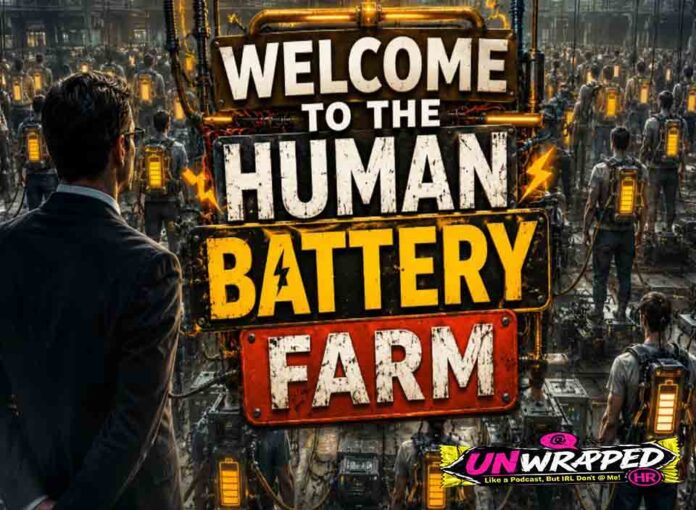
Please step through the shiny glass doors and enter the most successful farm in human history:
The Human Battery Farm.
Do not worry. This is not one of those cruel old farms with cages, chains, whips, or obvious villains in black hats laughing beside a chimney.
No, no.
This is a modern farm.
The cages are ergonomic.
The chains are wireless.
The whips are push notifications.
The fences are terms and conditions.
The feed is content.
The milking machines are apps.
And the humans are told, repeatedly, that they are free.
Very important, that bit.
Never forget it.
You are free.
Free to choose between forty-seven brands of cereal.
Free to build your personal brand.
Free to monetise your trauma.
Free to ruin your sleep looking at strangers having a better breakfast than you.
Free to pay monthly for things your grandparents bought once and owned forever.
Free to be available at all times.
Free to compare yourself to everyone on Earth.
Free to call burnout ambition.
Free to call loneliness independence.
Free to call surveillance convenience.
Free to call your own exhaustion a mindset issue.
Marvelous.
Please collect your wristband at reception.
It will track your steps, your sleep, your spending, your mood, your location, your heart rate, your shopping habits, your rage patterns, your face, your friends, your weaknesses, and whether you briefly looked at a pair of shoes in 2019 and might still be emotionally vulnerable to ankle boots.
Enjoy your freedom.
Exhibit One: The Feed Trough of Infinite Pellets
Here we observe the modern human in its natural habitat:
Bent neck.
Dead eyes.
Thumb moving like a tiny desperate windshield wiper.
The human is not hungry, exactly.
It is restless.
So the machine gives it pellets.
A dancing dog.
A war crime.
A recipe.
A millionaire crying in a podcast studio.
A man yelling in a car about discipline.
A woman with perfect skin telling you her life changed when she started waking up at 4:30.
A child being used as family content.
A murder.
A joke.
A body.
A panic.
A sale.
A stranger’s kitchen.
A headline designed to make your blood stand up.
A celebrity apology written by a committee.
A smoothie.
A tragedy.
A cat wearing a hat.
Pellet.
Pellet.
Pellet.
Pellet.
The human says:
“I’m just relaxing.”
The machine says:
“Of course you are, darling.”
Then it measures how long the human stares at sadness before moving on to tits, then how long it stares at tits before moving on to rage, then how long rage keeps the thumb warm.
This is called engagement.
Not addiction.
Not farming.
Engagement.
A beautiful word.
Like two people getting married.
Except one of them is a trillion-dollar machine and the other is lying in bed at 1:43am with dry eyes, a stiff neck, and a brain full of other people’s noise.
Exhibit Two: The Comparison Aquarium
Please gather around the glass.
Inside this tank, humans are shown carefully selected fragments of other humans.
Not lives.
Fragments.
A holiday.
A jawline.
A promotion.
A baby.
A kitchen island.
A body photographed in lighting so flattering it should be taxed.
A couple smiling on a beach despite privately hating each other since Lisbon.
A man beside a rented sports car saying the word “mindset” like he invented oxygen.
A woman selling peace from a house that costs more than a hospital wing.
The observing human presses its face to the glass and whispers:
“Why isn’t my life like that?”
Excellent.
The machine has activated lack.
Lack is one of the farm’s most profitable crops.
Once the human feels lack, we can sell it almost anything.
Skincare.
Fitness plans.
Crypto.
Courses.
Clothes.
Therapy language without therapy.
A productivity journal.
A detox tea that tastes like lawn clippings and regret.
A monthly subscription to an app that reminds it to breathe, as if breathing has not become difficult specifically because of the world we built around it.
The trick is simple.
Show people edited lives until their real life feels like failure.
Then sell them tools to edit themselves.
Exhibit Three: The Productivity Hamster Wheel
Here we have the high-functioning adult.
Notice the posture.
Notice the laptop.
Notice the coffee large enough to baptise a raccoon.
This human has been taught that rest is suspicious.
Stillness is lazy.
Free time is waste.
Sleep is negotiable.
Hobbies should become side hustles.
Pain should become content.
Personality should become brand.
Friendship should become networking.
Every waking moment must be useful, trackable, improvable, optimised, monetised, or at least posted as proof that the human is not rotting.
A speaker above the wheel says:
“Rise and grind.”
The human rises.
The human grinds.
The human becomes powder.
The machine collects the powder in a small silver tray marked Q4 Performance.
Once upon a time, people worked to live.
Now they are encouraged to live in a way that makes them better at working.
Eat for productivity.
Sleep for productivity.
Exercise for productivity.
Meditate for productivity.
Read for productivity.
Heal your inner child so you can reply to emails with cleaner energy.
Even self-care has been dragged into the factory wearing a little helmet.
You are not resting.
You are maintaining the equipment.
And the equipment is you.
Exhibit Four: The Subscription Stable
In the old days, humans bought things.
Silly system.
Far too simple.
Now they rent access to the feeling of almost owning things.
Music? Monthly.
Films? Monthly.
Storage? Monthly.
Software? Monthly.
Fitness? Monthly.
News? Monthly.
Food boxes? Monthly.
Security camera? Monthly.
Doorbell? Monthly.
Car features? Monthly.
The ability to use the thing you already purchased? Monthly, you cheeky little peasant.
The Subscription Stable is where money goes to die quietly.
Each month, tiny sums are nibbled from the human’s bank account by companies with cheerful logos and dead eyes.
£4.99.
£7.99.
£12.99.
£16.99.
Little bites.
Nothing dramatic.
Just a soft financial piranha attack.
Cancel anytime, they say.
So the human tries.
First, it must log in.
It does not remember the password.
It resets the password.
The reset email goes to an address it no longer uses.
It verifies a phone number from three phones ago.
It clicks “manage plan.”
It is offered a discount.
It clicks “continue cancellation.”
It is asked why.
It says “too expensive.”
The website looks wounded.
It offers a cheaper plan with adverts.
It asks again.
It says:
“Are you sure you want to lose your benefits?”
Benefits.
A word now used to describe not being charged for something that was normal ten years ago.
Eventually the human gives up.
The farm smiles.
This is not customer retention.
This is a lobster pot with graphic design.
Exhibit Five: The Outrage Milking Parlour
Please keep your hands away from the machinery.
It bites.
Here, humans are gently connected to the outrage pumps.
On screen, they are shown something annoying.
Then something unfair.
Then something stupid.
Then someone being smug about something stupid and unfair.
The human’s jaw tightens.
Good.
A vein appears.
Excellent.
The machine begins milking.
Rage is powerful.
Rage keeps people awake.
Rage makes people click.
Rage makes people share.
Rage makes people feel alive for a moment inside a life that keeps numbing them.
Rage gives shape to helplessness.
The farm does not care what side the human is on.
That is the genius.
Left rage.
Right rage.
Old rage.
Young rage.
Parent rage.
Student rage.
Driver rage.
Cyclist rage.
Taxpayer rage.
Tenant rage.
Landlord rage.
Man rage.
Woman rage.
Everyone rage.
All milk.
All useful.
The machine does not need people to agree.
Agreement is actually less profitable.
It needs them hot.
It needs them twitching.
It needs them certain that the real enemy is not the machine, not the owners, not the structure, not the quiet theft of their time and attention and future.
No.
The real enemy is some other exhausted bastard with a different opinion, a worse haircut, and an account called @TruthFalcon1974.
Fight him.
Fight her.
Fight them.
Bleed into the comments.
The farm will sell advertising beside the wound.
Exhibit Six: The Loneliness Vending Machine
This is one of our proudest innovations.
First, separate the humans.
Make them move away from family for work.
Price them out of their communities.
Close the places they meet.
Turn pubs into luxury flats.
Turn libraries into memories.
Turn parks into development opportunities.
Turn shared life into private struggle.
Make everyone busy.
Make everyone tired.
Make everyone suspicious.
Make everyone reachable but unavailable.
Then sell connection back to them.
Dating apps.
Friendship apps.
Networking apps.
Parasocial relationships.
Premium chat features.
Livestream gifts.
AI companions.
Influencers calling strangers “bestie” before selling them powder.
Podcasters filling the silence where friends used to be.
Delivery drivers bringing dinner to people who have not heard their own name spoken kindly all day.
The human places its coins into the Loneliness Vending Machine.
Out comes a notification.
Someone liked your photo.
Tiny sugar.
Gone instantly.
Insert more loneliness.
The machine hums.
There has never been so much communication.
There has never been so little being known.
A human can now broadcast its breakfast to 800 people and still have nobody to call when the room gets dark inside its head.
That is not a technology problem.
That is a civilisation problem wearing wireless earbuds.
Exhibit Seven: The Self-Improvement Furnace
Here, humans who have been bent by impossible conditions are told the problem is their attitude.
They arrive tired, ashamed, overstimulated, underpaid, overexposed, under-loved, terrified of slipping, unable to rest, unable to focus, unable to keep up with the thousand tiny demands bouncing around their skull like bees in a jam jar.
A man with white teeth steps onto a stage and says:
“Nobody is coming to save you.”
The audience claps.
This sounds strong.
It is often just abandonment with biceps.
Nobody is coming to save you.
Fine.
But who built a world where needing help became embarrassing?
Who benefits from everyone believing they are alone?
Who decided the highest form of adulthood is pretending you do not need anybody?
The furnace demands fuel.
Books.
Courses.
Retreats.
Supplements.
Coaching.
Challenges.
Blueprints.
Masterclasses.
Morning routines.
Masculine energy.
Feminine energy.
Monk mode.
Beast mode.
Soft life.
Hard life.
Main character energy.
Healing era.
Villain era.
Five steps.
Seven habits.
Ten secrets.
One weird trick.
Every generation gets sold a new costume for the same old terror:
“Maybe I am not enough.”
Beautiful.
Throw that into the furnace.
It burns forever.
Exhibit Eight: The Authenticity Theatre
In this room, humans are encouraged to be authentic.
Very important.
Authenticity performs extremely well.
The human stands under soft lighting and says:
“I wasn’t going to post this, but…”
It was absolutely going to post this.
It has done three takes.
There is a ring light reflected in its pupils like a tiny corporate moon.
The farm loves authenticity because fake perfection became too obvious.
So now imperfection must be styled.
Messy bun, but correctly messy.
Vulnerability, but not ugly vulnerability.
Honesty, but brand-safe honesty.
Sadness, but with good lighting.
Anger, but monetisable.
Trauma, but edited into a carousel.
Healing, but partnered with a sponsor.
Even the breakdown has a content strategy.
The human cries.
The caption says:
“Just being real.”
The algorithm says:
“Excellent. More face moisture, please.”
There is something especially cursed about a world where people must package their wounds beautifully before anyone will look at them.
A world where pain has to be legible, attractive, brief, and shareable.
A world where “raising awareness” often means turning suffering into a little digital snow globe people shake for three seconds before moving on to a dog in sunglasses.
The farm does not care whether you are happy or broken.
It only asks:
“Can we use it?”
Exhibit Nine: The Choice Maze
This is where humans are told they are empowered because they have options.
So many options.
A wall of toothpaste.
A wall of streaming services.
A wall of insurance plans.
A wall of phone contracts.
A wall of careers that may vanish.
A wall of diets.
A wall of identities to perform.
A wall of opinions to defend.
A wall of products promising to fix problems caused by other products.
The human stands in front of the wall, paralysed.
A sign says:
Choice Is Freedom.
But too much choice can become fog.
And fake choice is not freedom.
Choosing between five exploitative delivery apps is not freedom.
Choosing which company gets your data is not freedom.
Choosing between being underpaid in an office or underpaid from home is not freedom.
Choosing which debt to prioritise is not freedom.
Choosing which part of your life to neglect because there are not enough hours in the day is not freedom.
A menu is not a meal.
A maze is not a road.
A thousand doors do not matter if they all lead back to the same room.
Exhibit Ten: The Childhood Preparation Zone
Please lower your voice.
The young humans are being trained.
They sit at desks learning that their worth will be measured.
Gold star.
Red mark.
Attendance percentage.
Reading level.
Exam score.
Behaviour point.
Fitness test.
University ranking.
Starting salary.
Credit score.
Performance review.
Mortgage approval.
Follower count.
Step count.
Body fat percentage.
Net worth.
Retirement pot.
Funeral cost.
From the beginning, the child is taught:
“You are a person.”
Then shown, every day, that they are also a number.
A ranking.
A result.
A future worker.
A future consumer.
A future debtor.
A future data profile.
A future exhausted adult standing in a supermarket aisle comparing pasta sauce prices while wondering when exactly life became a spreadsheet with teeth.
The child draws a picture of a house.
The teacher says it is lovely.
Thirty years later, the child cannot afford one.
This is called aspiration.
The Gift Shop
At the exit, every farm has a gift shop.
This one is enormous.
You may purchase:
A hoodie that says Mentally Ill But Make It Marketable.
A mug that says World’s Best Data Cow.
A tote bag that says I Went To The End Of Civilisation And All I Got Was This Push Notification.
A candle called Burnout Vanilla.
A planner titled Schedule Your Nervous Collapse.
A water bottle that says Hydrate While The Planet Catches Fire.
A framed print reading You Are Enough, priced at £39.99.
By the till is a mirror.
Above it, a sign says:
Thank You For Visiting The Human Battery Farm. Please Rate Your Experience.
You look into the mirror.
For a second, there is no joke.
Just a tired face.
A face that has been sold fear, then sold comfort.
Sold loneliness, then sold connection.
Sold insecurity, then sold improvement.
Sold exhaustion, then sold productivity.
Sold outrage, then sold identity.
Sold convenience, then sold its own privacy back in little pieces.
Sold freedom, then nudged, tracked, priced, ranked, compared, and harvested.
And the worst part?
Nobody had to kick the door down.
People walked in voluntarily.
Because the entrance said choice.
Because the cage looked like a phone.
Because the leash had Bluetooth.
Because the prison gave reward points.
Because every bad feeling had a payment plan.
The Raw Bit
The most diabolical thing about modern life is not that people are controlled by force.
It is that people are trained to participate in their own extraction and call it personality.
They are not just workers now.
They are brands.
Audiences.
Markets.
Profiles.
Users.
Consumers.
Content.
Data.
Engagement.
Leads.
Traffic.
Human capital.
Anything except what they actually are:
Frightened animals trying to be loved before the lights go out.
That is the truth under the clown makeup.
People do not need another app.
They need time.
They need each other.
They need public places that do not require buying a latte to exist in them.
They need homes where their nervous systems can unclench.
They need work that leaves enough life left over to live.
They need silence that is not filled by adverts.
They need boredom that is not immediately harvested.
They need privacy without having to become a monk in a cave.
They need community that is not a group chat full of unread messages and passive-aggressive thumbs-up reactions.
They need to stop being told every wound is a niche, every hobby is a hustle, every friendship is a network, every moment is content, and every human weakness is a market opportunity.
Because at some point, a society has to ask itself a very simple question:
Are we building lives?
Or are we just building better machines for draining them?
And if the answer is the second one, then perhaps the problem is not that people are anxious, lonely, distracted, angry, numb, exhausted, and strange.
Perhaps they are responding correctly.
Perhaps they are not broken.
Perhaps they are blinking in the fluorescent light of a farm that keeps calling itself freedom.
So welcome, valued mammal.
The exits are clearly marked.
They are just located behind the subscription settings, beneath the sponsored content, past the self-improvement furnace, across the outrage parlour, through the loneliness vending machine, and around the back of the gift shop.
Please leave whenever you like.
But before you go, the farm would love to know:
Would you accept cookies?