



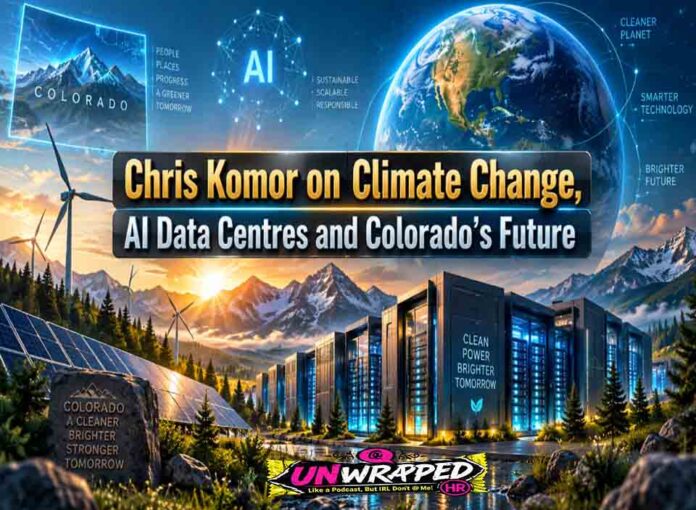
Climate change is often discussed in broad, global terms, but Chris Komor believes meaningful action can also begin at state level. In this episode of Peek Inside, Komor speaks with Arky Jones about his campaign for governor of Colorado, his long-standing concern for the environment and an ambitious proposal connecting carbon removal technology with the rapid expansion of AI data centres.
Komor traces his environmental interest back to childhood and the influence of his mother, who was involved in the back-to-nature movement of the 1960s and 1970s. By the age of 17, he had already written a newspaper opinion piece about cement production and pollution.
The conversation moves from those early influences into a much larger question: how can governments address environmental risks while still allowing communities, businesses and individuals to prosper?
Climate Change, Carbon Removal and AI Data Centres
Komor argues that conventional climate measures are no longer enough and believes much more direct intervention is required. One of the central ideas behind his campaign is the development of direct air carbon removal facilities in Colorado.
His proposal becomes more unusual when AI infrastructure enters the discussion.
Large data centres generate significant amounts of heat while requiring enormous quantities of electricity and cooling. Komor suggests pairing hyperscale data centres with carbon removal facilities so that waste heat from the computing infrastructure could potentially contribute to the carbon capture process.
He also describes captured carbon as a possible raw material rather than simply something to be stored underground. In his vision, recovered carbon could eventually contribute to construction materials, road aggregate or other manufactured products.
Arky challenges the proposal from an economic angle. If the system requires major infrastructure, who pays for it, and when do ordinary Colorado residents begin seeing a benefit?
Komor’s answer is that major technology and computing companies have access to the capital required. He believes Colorado could create an attractive enough environment for these companies to fund much of the infrastructure while gaining access to energy and facilities suited to their needs.
Balancing Economic Growth With Environmental Costs
The conversation also addresses one of the harder questions surrounding renewable energy and large infrastructure projects: even projects intended to produce long-term environmental benefits can create short-term disruption.
Arky raises concerns about land use, energy infrastructure and the effect renewable developments such as wind farms can have when poorly located. He also questions whether major data centre projects genuinely benefit local communities when construction teams can be brought in temporarily and the completed centres may employ relatively few people.
Komor agrees that data centres themselves are highly automated. He instead sees employment potential in the wider carbon-processing ecosystem — turning captured carbon into materials, manufacturing products, transporting them and supporting related industries.
Eastern Colorado plays an important role in his proposal. Komor says farmers in parts of the region have been affected by drought and pressure on aquifers, while the area also has access to wind, solar and geothermal resources. He suggests energy campuses could be developed there with the aim of operating largely independently of the existing public electricity grid.
Arky pushes the discussion further by suggesting local landowners should benefit directly rather than simply losing control of their land. Leasing arrangements, revenue sharing and long-term community participation, he argues, could help ensure development is something residents become part of rather than something imposed upon them.
Community, Policing and Bringing People Along
The final part of the discussion expands beyond climate policy.
Komor says he would like to strengthen community organisations and revive a stronger culture of public service. He points to groups such as Lions Clubs and Kiwanis as examples of organisations that historically helped create stronger local connections.
He also talks about changing the culture around policing in Colorado. Rather than focusing only on enforcement, Komor says he would like law enforcement to be seen more clearly as part of the community, with greater emphasis placed on protecting residents and strengthening trust.
Arky summarises the broader idea as one of interconnectedness: individuals matter, communities matter and the environment people live within matters too. At the same time, the conversation repeatedly returns to the practical challenge of bringing people along without pretending that major changes come without costs, trade-offs or disagreement.
Whether Komor’s proposals could work at the scale he imagines is ultimately a question for voters, policymakers, engineers and investors. What makes the conversation interesting is the attempt to connect climate action, AI infrastructure, employment, energy policy and community development rather than treating each as a separate issue.
For anyone interested in climate change, carbon capture, AI data centres, renewable energy or the future direction of Colorado politics, the full episode offers a much deeper look at Chris Komor’s ideas and the questions surrounding them.
Watch the full conversation on Peek Inside:
See Also Septemics Explained: Jim Marshall on Understanding Human Behaviour