

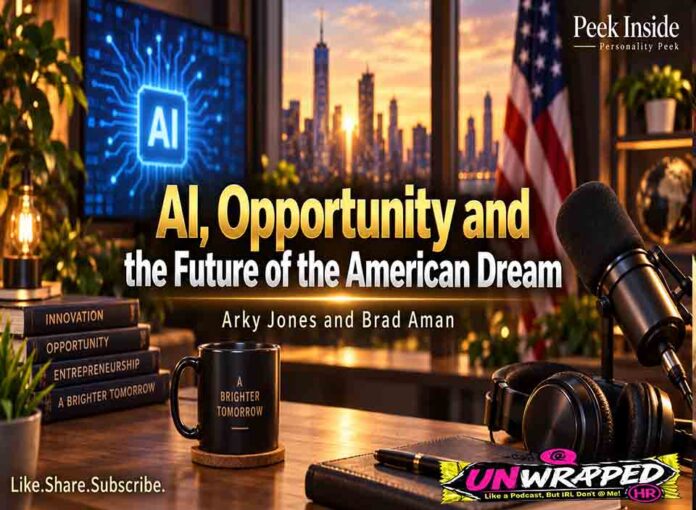
Artificial intelligence is changing the way people think about work, business and opportunity. For entrepreneur and author Brad Aman, that change is not simply about technology. It connects to a much older idea: whether people can still improve their circumstances through initiative, learning and hard work.
In this episode of Peek Inside, Arky Jones speaks with Brad about his own journey from a poor childhood to building and selling businesses, the role of motivation in success, and why Brad believes AI could open new paths for people willing to adapt. The conversation also includes a healthy amount of doubt, particularly around whether people might become too dependent on AI and lose some of the creativity and judgement that make human thinking valuable.
From a Poor Childhood to Business Ownership
Brad traces much of his entrepreneurial outlook back to childhood. He recalls wanting a new bicycle at around ten years old and deciding to sell chewing gum door to door because he knew his family could not afford it. That experience became an early lesson in taking action rather than waiting for circumstances to change.
As he grew older, Brad says he became interested in how successful people had built their lives. He would ask questions about where their money came from, whether they had inherited it, and what they had done differently. The answer he kept hearing, in his telling, was that progress required initiative and sustained effort.
Brad later built businesses by paying close attention to customer problems. One example involved commercial kitchens that struggled to source essential products. By identifying that gap and making those products easier to buy online, he says he was able to grow a business that eventually served customers across the United States and internationally.
Arky pushes the conversation beyond the familiar “work hard and succeed” story. He asks whether adversity itself helped shape Brad’s drive, and whether everyone has the same internal motivation to keep pushing forward. Brad acknowledges that people differ. Some are deeply motivated by ambition, while others may simply want a stable and comfortable life.
AI, Jobs and the Question of Human Creativity
The discussion then turns to artificial intelligence and the future of work.
Brad’s position is clear: he sees AI primarily as a tool, and he argues that people who learn to use it effectively may gain an advantage over those who avoid it. He suggests that administrative work, customer service and other routine roles are likely to face significant disruption, while people who become skilled at working alongside AI may be better placed to adapt.
Arky agrees that technological change has always replaced some jobs while creating others, but he raises a different concern. What happens if people stop using AI as a tool and start allowing it to dictate their thinking?
He questions whether increasingly capable systems could encourage people to rely too heavily on generated answers, potentially weakening independent judgement or creativity. Brad accepts the concern but remains more optimistic. In his view, human qualities such as empathy, leadership and judgement still matter, and the challenge is to use AI without surrendering those strengths.
The American Dream in an AI-Driven Economy
Brad’s broader argument is that the American Dream should not be understood only as an American idea. He describes it as the belief that people can improve their circumstances through action, learning and opportunity.
He also discusses his books and a 90-day programme designed to help people become more comfortable using AI. Later in the conversation, he talks about retraining, skilled trades and the possibility that some hands-on jobs could become more valuable as automation changes office-based work. Arky adds an Australian example, pointing to lift technicians as a trade where shortages have already pushed wages higher.
What makes the conversation interesting is that it never becomes a simple celebration of AI. Brad sees major opportunity, while Arky keeps returning to questions about risk, dependence and the importance of human agency.
That tension gives the episode its shape. It is not really about whether AI is “good” or “bad”. It is about how people respond to change, what they choose to learn, and whether they can use new tools without losing the ability to think for themselves.
For anyone interested in AI, entrepreneurship, the future of work or the changing meaning of opportunity, the full discussion offers plenty to consider.
Watch the full conversation on Peek Inside:
See Also: What Horses Can Teach Us About Trust, Pressure and Owning Our Mistakes | Arky Jones and Silvia Rizzo