



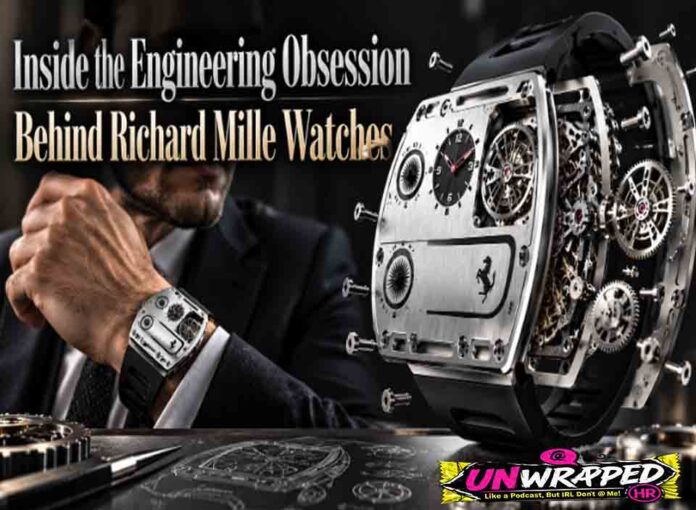
Few names in modern watchmaking generate as much conversation as Richard Mille. Founded in 2001, the brand built its reputation not on centuries of heritage but on an almost obsessive approach to materials science, borrowing techniques and components more commonly associated with motorsport and aerospace engineering. That approach has turned the brand into one of the most closely watched names in high horology, both for its technical ambition and for the intense demand its pieces generate at resale.
A Different Philosophy From the Start
Most established watchmaking houses built their reputations over generations, refining classic designs incrementally. Richard Mille took the opposite path, treating every watch as a fresh engineering problem. Cases are engineered using materials such as carbon composites, titanium alloys, and ceramic compounds chosen for strength-to-weight ratios rather than tradition. Movements are designed to survive shock loads that would damage conventional mechanical calibres, a deliberate response to the brand’s early partnerships with professional athletes who needed timepieces that could withstand real physical stress.
This philosophy extends to the finishing as well. Skeletonised movements are not just a stylistic choice; they reflect a design process that starts by asking how little material can be used while still preserving structural integrity and chronometric accuracy. Buyers browsing a dedicated Richard Mille watches selection will often notice how consistently this engineering-first mindset appears across the catalogue, from entry references through to the brand’s most complex tourbillon models.
Why Resale Demand Has Stayed So Strong
Limited production numbers are common across the luxury watch industry, but Richard Mille has leaned into scarcity more deliberately than most. Many references are produced in small numbered editions, and the brand has historically resisted scaling up manufacturing even as demand has grown. This has created a secondary market where certain models trade well above their original retail price, a dynamic that is relatively unusual even within the broader luxury watch category.
Collectors also point to the brand’s willingness to take risks with unconventional case shapes and construction methods, which has made individual references easier to identify and, in turn, easier to authenticate. A watch that is instantly recognisable at a glance tends to hold collector interest longer than a piece that could be mistaken for something else, and that recognisability has become part of the brand’s long-term value proposition.
The Technical Details That Matter to Collectors
Serious buyers in this category pay close attention to a handful of technical details before purchasing. Case material is one of the first considerations, since composites and exotic alloys behave differently under stress and wear than conventional stainless steel. Movement architecture is another, particularly whether a piece uses a manual winding calibre, an automatic movement with a skeletonised rotor, or a more complex configuration involving a tourbillon escapement. Buyers also examine the bracelet or strap construction, since some materials require more specialised care than traditional leather.
Servicing is a further consideration unique to this brand. Because many components are custom-engineered rather than sourced from standard industry suppliers, servicing generally needs to go through an authorised centre with access to brand-specific parts and calibration tools. This is worth understanding before purchase, since it affects long-term ownership costs in a way that differs from more conventional mechanical watches.
A Category Still Being Defined
Richard Mille remains a relatively young brand by watchmaking standards, and its long-term legacy is still being written. What is clear from current market behaviour is that the brand has succeeded in creating a distinct identity built around performance engineering rather than traditional dress-watch aesthetics, and that identity has translated into sustained collector interest. Industry commentary from outlets such as Reuters has periodically noted how strongly certain limited-production watch brands have performed at auction relative to broader luxury goods, a trend Richard Mille has been closely associated with over the past decade.
Background on the broader history of tourbillon movements, a complication frequently associated with the brand’s higher-end references, is well documented on sites such as Wikipedia, which traces the mechanism back to its origins as a solution for improving accuracy in pocket watches subject to the effects of gravity. Richard Mille’s modern application of the tourbillon, often paired with skeletonised bridges and exotic case materials, illustrates how a centuries-old horological concept can be reinterpreted through a distinctly contemporary engineering lens.
For collectors weighing a purchase, the appeal tends to come down to a simple question: do they want a watch that follows watchmaking convention, or one that actively challenges it. Richard Mille has built its entire identity around the second answer, and that has proven to be a durable proposition among buyers who see their timepiece as an extension of engineering achievement rather than simply a classic accessory. That combination of scarcity, technical ambition, and instantly recognisable design continues to set the brand apart in an already crowded luxury watch market.