


Why Napoleon Lost Waterloo: The Military Genius Who Couldn’t Control His Own Generals
Napoleon Bonaparte conquered nations, humiliated kings and rewrote the rules of warfare. But according to historian Andrew Roberts, the man who could command an empire had one rather embarrassing weakness: he couldn’t manage his own management team.
Imagine assembling 26 of the finest military commanders in Europe.
You give them enormous salaries, lavish estates, magnificent uniforms and titles that would make a medieval king blush. You promote men from humble backgrounds into positions of extraordinary power. You reward bravery, encourage ambition and convince them they’re making history.
Then, somehow, they all end up hating each other.
Welcome to Napoleon Bonaparte’s human resources department.
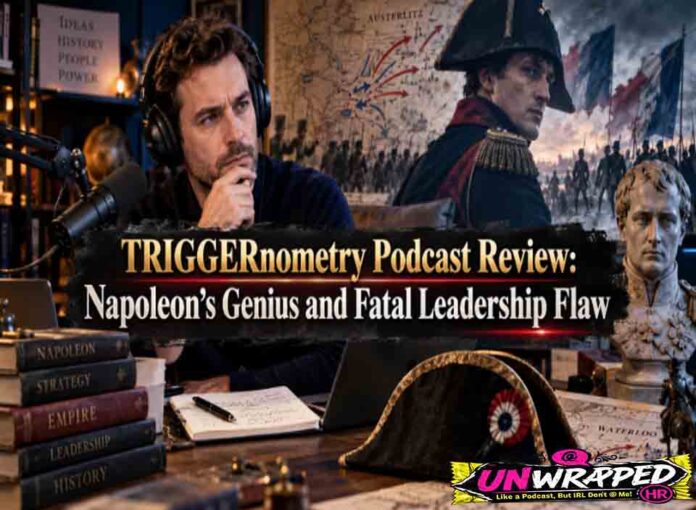
In a fascinating episode of TRIGGERnometry, titled “Everything You Know About Napoleon Is Wrong,” historian Lord Andrew Roberts joins Konstantin Kisin and Francis Foster to explore the extraordinary rise and fall of the French emperor.
Roberts, author of Napoleon and His Marshals: Victory, Rivalry, Betrayal, presents a Napoleon far more interesting than the familiar caricature of an angry little Frenchman with his hand permanently tucked inside his jacket.
This Napoleon was a military genius, an ambitious reformer, an extraordinary motivator and, when it came to his closest colleagues, something of a managerial catastrophe.
And therein lies one of history’s most fascinating contradictions.
From Impoverished Aristocrat to Europe’s Most Dangerous Man
Napoleon Bonaparte was born in Corsica in 1769, into a family with aristocratic credentials but rather fewer aristocratic comforts.
They had the pedigree. They didn’t have the money.
Fortunately, young Napoleon possessed something considerably more valuable: an almost unreasonable belief in his own abilities.
He also had the intelligence and work ethic to justify much of that confidence.
He devoured books on military strategy, philosophy, mathematics and history. While other young men were discovering the pleasures of ordinary life, Napoleon was preparing himself to command armies.
His timing was remarkable.
When the French Revolution erupted in 1789, the established order collapsed. Aristocrats fled, officers were executed and the traditional routes to power suddenly became irrelevant.
For ambitious young soldiers, it was an extraordinary opportunity.
Napoleon seized it.
By 24, following his success at the Siege of Toulon, he was a general.
And by the time most people today are wondering whether they should change careers, Napoleon was beginning to change Europe.
Yet his rise wasn’t simply the result of being in the right place at the right time.
He was genuinely brilliant at warfare.
Unfortunately for the rest of Europe, he was about to demonstrate just how brilliant.
Also Watch: Financial Chakras: The Connection Between Emotions, Money and Business Growth | Lyanne and Ash
What Made Napoleon Such a Military Genius?
European warfare in the late 18th century was frequently a ponderous affair.
Armies manoeuvred cautiously, besieged fortified cities and waited for enormous supply trains to catch up.
Napoleon had a different philosophy.
Move faster. Think faster. Strike before your enemy knows what’s happening.
He didn’t invent every tactic he employed. His genius was in combining innovative ideas and applying them with extraordinary speed and coordination.
Where traditional commanders might become bogged down in lengthy sieges, Napoleon frequently bypassed fortified positions and pushed onwards.
Where other generals kept their armies concentrated in cumbersome formations, he developed the corps system into a devastating instrument.
Each corps was effectively a miniature army, complete with infantry, cavalry, artillery and supporting services.
They could operate independently, hold an enemy in place or converge at the decisive moment.
Picture a boxer who can throw punches from three different directions while you’re still deciding which fist to watch.
That was Napoleon.
One of his favourite techniques involved attacking the junction between two enemy armies, separating them and defeating them individually.
It was an exceptionally effective strategy, particularly against opponents who were slow to coordinate.
At the Battle of Austerlitz in 1805, Napoleon delivered perhaps his greatest military masterpiece, defeating the combined Austrian and Russian armies through brilliantly coordinated manoeuvres.
But tactics were only half the story.
Napoleon understood something equally important.
An army fights with its weapons, but it marches on its beliefs.
The Man Who Could Electrify an Army
Napoleon wasn’t an especially impressive public speaker.
His Corsican accent amused some Frenchmen, and his voice was reportedly rather high-pitched.
He was also approximately five feet six inches tall, which was perfectly ordinary for a Frenchman of his era.
So much for the famous Napoleon complex.
But what he lacked in conventional oratory, he compensated for with an extraordinary ability to inspire soldiers.
Before the Battle of the Pyramids in Egypt, Napoleon famously invoked the weight of history, telling his troops that 40 centuries were looking down upon them.
Think about the psychological effect.
A tired soldier, thousands of miles from home, is suddenly told that he isn’t merely fighting another battle.
He’s participating in something that will be remembered for thousands of years.
Napoleon understood how to make ordinary men feel extraordinary.
He rewarded bravery, promoted talent and frequently recognised individual soldiers.
Through honours such as the Legion of Honour, military achievement could bring not only prestige but material rewards.
A man born into poverty might rise to the highest ranks of the army.
It was an intoxicating promise.
And it worked.
But Napoleon’s ability to manufacture enthusiasm wasn’t confined to the battlefield.
He was also remarkably good at manufacturing his own reputation.
Napoleon: The Original Master of Personal Branding
If Napoleon had possessed a social media account, Europe might never have survived the experience.
The man understood publicity long before publicity became an industry.
He brought printing presses on military campaigns, produced bulletins describing his victories and encouraged artists to depict him in heroic poses.
Take Jacques-Louis David’s famous painting of Napoleon crossing the Alps.
There he is, magnificent upon a rearing horse, pointing towards destiny as his cloak billows dramatically.
The reality was slightly less cinematic.
Napoleon crossed the Alps on a mule.
History, however, remembers the horse.
His Egyptian campaign offers an even more extraordinary example of reputation management.
In 1798, Napoleon invaded Egypt with grand ambitions, including dreams of following in the footsteps of Alexander the Great.
He won the Battle of the Pyramids and took Cairo.
But the British admiral Horatio Nelson destroyed the French fleet at the Battle of the Nile, leaving Napoleon’s army stranded.
An attempted advance towards Syria ended in failure at Acre.
Eventually, Napoleon returned to France, leaving much of his army behind.
You might imagine this would have caused serious difficulties for his career.
Not particularly.
Thanks partly to restricted communications and Napoleon’s careful cultivation of his image, the French public knew considerably more about his victories than his failures.
He returned as a hero.
The remarkable thing is that Napoleon didn’t merely survive a disastrous campaign.
He turned it into another chapter of his legend.
There was, admittedly, one enduring intellectual triumph from the Egyptian expedition.
Napoleon had taken scholars, scientists and artists along with his soldiers, helping to lay foundations for modern Egyptology. The famous Rosetta Stone was discovered during the campaign.
Conquest, scholarship and propaganda, all travelling in the same baggage train.
Napoleon was nothing if not ambitious.
Napoleon Didn’t Just Conquer France. He Rebuilt It.
One of the most interesting aspects of Roberts’ interview is his insistence that Napoleon’s domestic achievements deserve at least as much attention as his military victories.
It’s easy to remember Austerlitz.
It’s considerably harder to get excited about administrative reform.
Yet Napoleon’s lasting influence may owe more to paperwork than cannon fire.
After seizing power in 1799, he set about reorganising France.
He helped stabilise public finances, established the Bank of France, reformed education and transformed the machinery of government.
Most famously, he oversaw the creation of the Napoleonic Code, consolidating a confusing patchwork of laws into a more coherent civil system.
The code’s influence extended far beyond France, shaping legal systems across Europe and elsewhere.
It was hardly perfect. Its treatment of married women reinforced patriarchal authority, revealing clear limits to Napoleon’s enthusiasm for equality.
Nor was his government financed solely through commercial brilliance. Conquered territories supplied substantial revenue through imposed contributions and seized wealth.
Nevertheless, many of his administrative and institutional reforms proved remarkably durable.
The same man who spent years demolishing European armies also found time to worry about bridges, schools, drinking water and tax collection.
It’s a curious image.
Napoleon could spend the morning discussing troop movements across half a continent and the afternoon concerning himself with the functioning of a Parisian fountain.
He was, in many respects, both an emperor and a very intense local councillor.
And while his achievements as a ruler were formidable, his most revealing experiment concerned the men he placed immediately beneath him.
Napoleon’s Marshals: A Band of Brothers or a Nest of Vipers?
In 1804, Napoleon established the Marshalate of the Empire, initially appointing 18 men. Eventually, 26 would receive the honour.
These weren’t ordinary generals.
They were among the most accomplished, courageous and ambitious military figures of their generation.
Some came from aristocratic families. Others were sons of innkeepers, craftsmen and people who previously would have had little opportunity to reach the highest levels of society.
Napoleon was attempting something extraordinary.
He wanted to create a new elite based on achievement rather than ancestry.
And he assembled a spectacular cast of characters.
There was Louis-Nicolas Davout, a brilliant and disciplined commander whose victory at Auerstedt in 1806 remains one of the great feats of Napoleonic warfare.
There was Joachim Murat, the flamboyant cavalry commander who seemed to believe that the correct number of feathers on a military uniform was always more.
There was Michel Ney, celebrated for his astonishing courage.
And there was Louis-Alexandre Berthier, Napoleon’s indispensable chief of staff, whose extraordinary organisational abilities helped make the emperor’s lightning campaigns possible.
These were not men accustomed to hiding behind the front lines.
Roberts explains that Napoleon’s 26 marshals suffered a combined 94 wounds during their careers.
Nicolas Oudinot alone was wounded an astonishing 32 times.
At that point, you might reasonably consider another profession.
But these men had spent their lives pursuing military glory, and Napoleon offered them glory on an almost industrial scale.
There was just one problem.
They were all competing for it.
The Fatal Flaw: Napoleon Rewarded Talent but Encouraged Rivalry
Napoleon wanted his marshals to outperform one another.
He deliberately encouraged competition, reasoning that ambitious commanders would fight harder, achieve more and remain dependent upon his approval.
For a while, the system worked spectacularly.
Then it began to unravel.
Instead of producing a tightly coordinated leadership team, Napoleon created a collection of immensely powerful rivals.
The marshals quarrelled over prestige, seniority, assignments and credit for victories.
Some openly despised one another.
On several occasions, disputes became so heated that swords were drawn or duels threatened.
At the height of his power, Napoleon could contain much of this dysfunction through personal authority.
But as campaigns became more difficult and the empire expanded, the weaknesses became increasingly dangerous.
During the Peninsular War in Spain and Portugal, rival marshals frequently failed to cooperate effectively.
They withheld assistance, disputed orders and pursued their own ambitions.
Napoleon’s response was hardly designed to build team spirit.
He micromanaged them.
Relentlessly.
Even highly experienced generals received streams of instructions about matters they were perfectly capable of handling themselves.
It was a particularly disastrous arrangement in Spain, where communications between Paris and the front could take weeks or even months.
The emperor was attempting to control events from hundreds of miles away while refusing to grant sufficient authority to the commanders on the ground.
And perhaps the saddest detail in Roberts’ analysis is what these men actually wanted from Napoleon.
It wasn’t money.
He gave them fortunes.
It wasn’t status.
He made some of them princes and kings.
They wanted his respect.
Roberts argues that Napoleon repeatedly failed to provide the recognition and trust his senior commanders craved.
He could inspire an ordinary soldier with a few stirring words, yet frequently reduced his most talented generals to disgruntled subordinates.
There is something almost Shakespearean about it.
A man capable of defeating enormous armies found it difficult to say, in effect, “Well done. I trust your judgement.”
Russia: When Napoleon’s Genius Met Reality
By 1812, Napoleon’s empire had become entangled in a vast economic struggle with Britain.
His Continental System attempted to prevent European states from trading with the British.
Russia’s departure from that arrangement helped trigger one of history’s most disastrous military decisions.
Napoleon invaded Russia.
The familiar explanation is that the French emperor underestimated the Russian winter.
But Roberts offers a more interesting interpretation.
Napoleon knew perfectly well that Russia had winters.
He had studied earlier campaigns and understood the risks.
The problems began long before the deepest winter cold arrived.
Disease, exhaustion, supply failures, distance and Russian resistance devastated the invading army.
Typhus and other illnesses took a terrible toll.
When Napoleon finally reached Moscow, he discovered that occupying a city was not the same as forcing an enemy government to surrender.
The French eventually retreated through increasingly appalling conditions.
The scale of the disaster was staggering.
Roberts estimates that of approximately 615,000 men who entered Russia with Napoleon’s invasion force, only around 93,000 returned.
The precise figures vary between historians, but the outcome is beyond dispute.
The Grande Armée had been shattered.
An empire built on military supremacy had suffered a wound from which it would never fully recover.
And Napoleon’s relationships with his marshals deteriorated still further as the catastrophe unfolded.
The men who had once competed for the privilege of leading victories were now arguing bitterly over how to survive defeat.
The cracks had become chasms.
Waterloo: Why Did Napoleon Finally Lose?
Napoleon abdicated in April 1814 and was exiled to the Mediterranean island of Elba.
That might have been the end of the story.
But Napoleon had never shown much talent for accepting that a story was over.
After approximately ten months, he escaped.
In March 1815, he returned to France with a small force.
Troops sent to intercept him joined him instead.
The restored Bourbon monarchy collapsed almost without resistance, and Napoleon reclaimed power.
It was one of the most extraordinary political comebacks in history.
Unfortunately, the rest of Europe was not particularly enthusiastic about the reunion.
A new coalition mobilised to defeat him.
Napoleon marched north, hoping to strike the British-led and Prussian armies before larger Austrian and Russian forces could arrive.
The result was the Battle of Waterloo on 18 June 1815.
And here Roberts identifies one of the most revealing details of Napoleon’s downfall.
Of the 26 men who had held the rank of Marshal of the Empire, only two served alongside Napoleon on the Waterloo battlefield: Ney and Soult.
Others were dead, absent, politically estranged or commanding forces elsewhere.
Davout, arguably among Napoleon’s finest generals, had been left in Paris.
Grouchy, a newly appointed marshal, was operating separately with approximately 33,000 troops and failed to reach the battlefield.
Soult, a capable battlefield commander, had been appointed chief of staff despite lacking recent experience in that crucial role.
And Ney, fearless but frequently impulsive, was hardly the ideal partner for such a delicate operation.
Meanwhile, Wellington’s defensive skill and the arrival of Prussian forces under Blücher helped secure Napoleon’s final defeat.
Roberts doesn’t suggest that the absence of better marshals provides the entire explanation for Waterloo.
Wellington’s generalship mattered enormously.
So did the coalition’s superior combined resources.
Indeed, Roberts argues that even a French victory at Waterloo might not have saved Napoleon’s throne, given the vast additional armies advancing towards France.
But the missing marshals tell a larger story.
The emperor who had built the greatest military leadership team in Europe had reached his decisive battle without most of it.
Not every absence was his fault.
But the deterioration of trust, cooperation and loyalty within his command structure was partly his own creation.
For a man who understood the importance of coordination on the battlefield, it was a remarkable failure.
Was Napoleon a Great Leader or a Terrible One?
Perhaps both.
And that’s what makes Roberts’ interpretation so compelling.
Napoleon was not simply a conqueror who got carried away with his own success.
Nor was he an uncomplicated champion of progress.
He was a ferociously intelligent, extraordinarily hardworking and deeply ambitious man whose talents transformed European history.
He understood meritocracy, motivation, speed, organisation and the importance of making people believe they were part of something larger than themselves.
He brought lasting reforms to government, education and the law.
Yet he also relied on coercion, warfare, concentrated power and a sometimes ruthless pursuit of his own objectives.
Most significantly for Roberts’ argument, he never fully solved the problem of sharing authority with other brilliant men.
He could recognise talent.
He could reward it.
He could exploit it.
But trusting it was another matter entirely.
And as the pressures increased, his instinct was to tighten his grip rather than loosen it.
The consequences were felt from Spain to Russia and finally at Waterloo.
Napoleon’s Greatest Legacy Wasn’t His Empire
Napoleon spent much of his life fighting to dominate Europe.
But empires, as history repeatedly demonstrates, are temporary arrangements.
The bridges, legal institutions, educational reforms and administrative systems he helped establish proved considerably more enduring.
His military methods influenced generations of commanders.
His careers-open-to-talent philosophy challenged older assumptions about inherited privilege.
And his personal story remains one of history’s great examinations of ambition.
Yet the most memorable lesson from Andrew Roberts’ conversation may be a surprisingly human one.
Napoleon understood how to inspire thousands of men to risk their lives for him.
What he struggled to understand was how to make a few dozen extraordinarily talented men work together without turning their relationships into a battlefield of their own.
He could send an army across 600 miles of Europe with breathtaking precision.
He could coordinate multiple corps against a larger enemy.
He could persuade ordinary soldiers that the eyes of history were upon them.
But he couldn’t consistently give his closest commanders the trust and respect they needed.
And perhaps that’s the great irony of Napoleon Bonaparte.
He mastered the art of commanding armies, but never quite mastered the art of leading leaders.
The greatest threat to his empire wasn’t always waiting across the battlefield.
Sometimes it was sitting around his own table, wearing an extremely expensive uniform.
This article explores Lord Andrew Roberts’ appearance on TRIGGERnometry with Konstantin Kisin and Francis Foster, discussing his book Napoleon and His Marshals: Victory, Rivalry, Betrayal.
Listen to the full episode: Everything You Know About Napoleon Is Wrong – Historian Andrew Roberts.