



Dave Smith is easy to underestimate. That may be one reason he has become so influential.
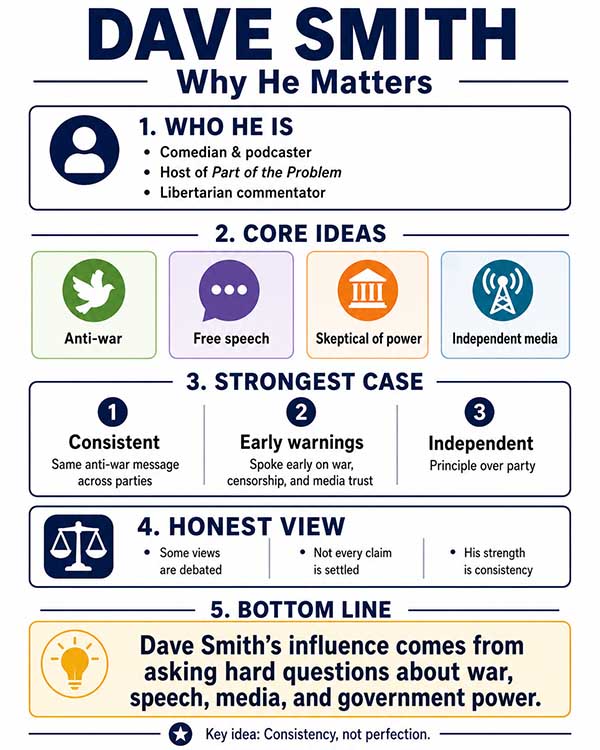
He is not a senator, think-tank fellow, cable-news regular, or foreign-policy insider. He is a comedian, podcaster, and libertarian commentator who built his audience outside the traditional political class. His official biography describes him as a comedian and political commentator, while his show Part of the Problem presents itself as a libertarian podcast focused on current events, government power, foreign policy, and corporate media criticism.
That outsider status is central to his appeal. Smith’s strongest supporters do not listen to him because he sounds like an institution. They listen because he does not. His style is blunt, combative, funny, skeptical, and often uncomfortable. At his best, he asks questions that many official voices avoid until the consequences are already obvious.
The strongest case for Dave Smith is not that he has been right about everything. No honest public figure has. The stronger and more defensible case is that his core warnings — about war, censorship pressure, media failure, institutional arrogance, and the incentives of state power — have aged better than many critics expected.
Dave Smith’s Core Strength Is Consistency
Smith’s politics did not appear overnight. In a Reason interview, he said he “became a libertarian through the Ron Paul movement,” and described Ron Paul as a gateway to deeper libertarian writers and ideas.
That origin matters because Smith’s anti-war politics are not a passing content strategy. They are the center of his worldview. In a later Reason discussion, Smith defined libertarianism around “self-ownership, private property rights, and the non-aggression principle,” then argued that “war and peace is the biggest issue” because war expands state power more dramatically than almost anything else.
This is where Smith is strongest. Many commentators change their foreign-policy posture depending on which party controls the White House. Smith’s record is more consistent. He has criticized Democratic and Republican administrations, neoconservatives, intelligence agencies, corporate media, and populist politicians when he believes they support escalation or hide the real costs of war.
That does not make him automatically right on every conflict. It does make him harder to dismiss as a partisan.
The Anti-War Argument Looks Stronger After Iraq and the War on Terror
Smith’s worldview sits in a long American tradition: the anti-war libertarian tradition associated with Ron Paul, Murray Rothbard, and skepticism toward empire. Critics often treat that perspective as simplistic. But the historical record gives it real force.
The Iraq War damaged public trust for a reason. Pew later summarized how support for the war was built on claims about weapons of mass destruction, terrorism, and links to September 11 that government and independent investigations found unsupported.
The broader War on Terror also came with enormous costs. Brown University’s Costs of War project estimated that post-9/11 wars cost about $8 trillion and involved hundreds of thousands of direct deaths, with many more indirect deaths and long-term veteran-care obligations.
This is the strongest backdrop for understanding Smith. His anti-war argument is not merely emotional. It is rooted in a pattern: officials frame intervention as urgent, moral, limited, and necessary; dissenters are marginalized; years later, the public learns the costs were higher and the evidence weaker than advertised.
Smith’s advantage is that he keeps making that argument before the regret stage.
Ukraine and NATO: The Strongest Honest Version of Smith’s Position
Smith’s commentary on Ukraine is controversial, but the strongest version of his argument is often misunderstood.
The serious version is not: “Russia is right.”
The serious version is: “U.S. and NATO policy helped create dangerous incentives, and American leaders should have taken escalation risks more seriously.”
Smith has explicitly acknowledged Ukraine’s right to self-defense. In Reason’s debate on libertarianism, he said Ukrainians have a right to defend themselves; his objection was to U.S. and NATO involvement, American funding, and the risk of escalation.
That distinction matters. One can condemn Russia’s invasion and still ask whether U.S. policy was prudent.
There is documentary support for the idea that NATO expansion was a known flashpoint. NATO’s 2008 Bucharest declaration stated that Ukraine and Georgia “will become members of NATO.” Around the same time, a diplomatic cable from then-U.S. Ambassador William Burns — later CIA director — warned that Russian officials viewed Ukrainian NATO membership as a serious security threat; the cable was famously titled “Nyet Means Nyet.”
Reuters has also reported that Russia has continued to demand that NATO abandon the 2008 promise to Ukraine, while NATO maintains that it is a defensive alliance and not a party to the war.
None of this justifies Russia’s invasion. That point should be stated clearly. But it does show that Smith’s warnings about NATO, escalation, and great-power security dilemmas are not invented after the fact. They are part of a documented policy dispute that existed long before 2022.
That is where the positive case for Smith becomes strongest: he is not asking audiences to accept war narratives at face value. He is asking them to examine incentives, history, and consequences before the next irreversible step.
Free Speech: His Warnings About Government Pressure Were Not Imaginary
Smith has also been sharply critical of government pressure on speech, especially when officials and technology platforms work in the same direction.
That concern has become much harder to dismiss. In 2021, Reuters reported that White House officials said Facebook was not doing enough to remove inaccurate vaccine information, and that Surgeon General Vivek Murthy called on technology companies to demote or limit false health claims and share more data.
In 2024, Reuters reported that Mark Zuckerberg said the Biden administration had pressured Meta to censor some COVID-related content and that he regretted not speaking up more forcefully. The White House defended its actions by saying it had encouraged responsible conduct to protect public health and safety.
The legal record is more complicated than either side’s slogans. In Murthy v. Missouri, the Supreme Court did not issue a sweeping ruling that the government had violated the First Amendment. The Court found that the plaintiffs lacked standing, meaning the central constitutional question was not fully resolved on the merits. The Electronic Frontier Foundation summarized the decision by saying the Court did not answer when government persuasion becomes unconstitutional coercion.
That nuance actually helps the honest case for Smith. He does not need every legal claim to win in court for his broader concern to be legitimate. The public record shows that government officials did pressure platforms. The unresolved question is where persuasion ended and unconstitutional coercion began.
Smith was right to insist that this question mattered.
COVID: Smith Was Strongest on Mandates, Trust, and Institutional Humility
COVID is the area where the article must be careful. A positive article should not pretend that every skeptical claim made during the pandemic was vindicated.
The CDC continues to state that COVID-19 vaccines help protect against severe illness, hospitalization, death, and Long COVID risk, while also acknowledging rare serious adverse events such as anaphylaxis, myocarditis, and pericarditis.
So the strongest honest version of Smith’s COVID-era argument is not that all public-health guidance was false. It is that emergency powers, mandates, school closures, censorship pressure, and institutional certainty deserved far more scrutiny than they received in real time.
That argument has aged better than many people expected. Officials and media institutions often treated dissent as dangerous rather than separating bad information from good-faith disagreement. Smith’s best contribution was his insistence that public policy must account for tradeoffs, incentives, civil liberties, and the risk of institutional self-protection.
That is a serious argument. It is also different from blanket anti-science rhetoric. A robust article should keep those two things separate.
Dave Smith’s Break With Trump Shows Political Independence
One of the strongest recent examples of Smith’s independence came when he publicly turned against Donald Trump over foreign policy.
After supporting Trump in 2024, Smith later described that support as a “bad calculation” and called for Trump’s impeachment and removal over Trump’s handling of the Israel-Iran conflict. The Daily Beast reported Smith’s statement that Trump’s actions were an “absolute betrayal” of what he had campaigned on. The Independent also reported that Smith regretted supporting Trump and called for Trump’s supporters to turn on him.
This matters because it cuts against the lazy criticism that Smith is simply a right-wing partisan. His politics are better understood as anti-war libertarian first, partisan second — if partisan at all.
That does not mean readers must agree with his position on Iran, Israel, or Trump. But it does show that Smith’s anti-war line is not just branding. When a politician he had supported crossed that line, Smith said so publicly.
Why Dave Smith Fits the Podcast Age
Smith’s rise is also part of a larger media shift. Americans increasingly use podcasts for news and political understanding. Pew Research Center found that around a third of U.S. adults said they get news from podcasts at least sometimes in 2025, up from 22% in 2020. Pew also found that many podcast news consumers listen to shows that explain topics in depth or feature host and guest opinion.
That environment rewards long-form argument. It also punishes people who cannot defend their views for more than a five-minute cable segment.
Smith is well suited to that world. He argues for long stretches, debates critics, revisits old claims, and speaks in a way that sounds closer to a comedy club or bar argument than a press release. That style can be messy, but it is also why audiences trust him. They feel they are hearing the argument, not the approved institutional summary.
This matters because trust in institutions has fallen sharply. Gallup reported that Americans’ trust in mass media dropped below 30% in 2025. Pew has also reported that public trust in the federal government remains near historic lows, with only a small share of Americans saying they trust Washington to do what is right most of the time.
Smith’s popularity is not random. It is a response to a credibility vacuum.
The Fair Criticism of Dave Smith
A strong article should not hide the criticism. Smith’s weaknesses are the flip side of his strengths.
His skepticism of institutions can sometimes sound too sweeping. His confidence can exceed the evidence on specific issues. The podcast format that makes him powerful can also reward intensity, certainty, and confrontation. Critics also argue that anti-establishment media can blur the line between open debate and platforming weak or extreme claims.
That criticism became visible after Smith’s debate with Douglas Murray on The Joe Rogan Experience. UnHerd described the exchange as part of a broader divide on the political right, with Murray challenging the way podcast platforms elevate nontraditional voices in debates over war and foreign policy.
Those critiques are worth taking seriously. Expertise matters. Evidence matters. Not every official claim is false just because it is official.
But that criticism does not defeat Smith’s best arguments. In some ways, it clarifies them. Smith’s strongest point is that credentialed institutions have also failed, sometimes catastrophically. Iraq, Afghanistan, surveillance, censorship pressure, and collapsing media trust did not happen because ordinary people asked too many questions. They happened while highly credentialed people were in charge.
That is why Smith cannot be dismissed as “just a comedian.” Comedy may be his profession, but skepticism of power is his political function.
The Strongest Case for Dave Smith
The strongest case for Dave Smith is that he has been unusually consistent on the questions that matter most: war, state power, civil liberties, media credibility, and institutional incentives.
He was not alone in warning about those issues. But he has been one of the clearest, most persistent voices bringing them to a large podcast audience.
On war, his skepticism is supported by the bitter record of Iraq and the War on Terror. On Ukraine, his warnings about NATO and escalation have documentary support, even though they do not justify Russia’s invasion. On censorship, his concern about government pressure on platforms is supported by public reporting, even though the constitutional line remains legally contested. On COVID, his best argument was not that all science was wrong, but that emergency powers and coerced consensus needed scrutiny. On Trump, his willingness to reverse himself over war policy showed real independence.
That is a strong record. Not a perfect one. A strong one.
Dave Smith matters because he represents something many people now want from public debate: less deference, more argument, fewer sacred institutions, and a greater willingness to ask who benefits when the public is told not to question the official story.
His critics are right that skepticism can go too far. But Smith’s supporters are right that obedience has gone too far as well.
The most honest positive conclusion is this: Dave Smith has become influential because he keeps asking the questions that powerful institutions often prefer to answer only after the damage is done. That does not make him infallible. It makes him necessary.
SEO FAQ
Who is Dave Smith?
Dave Smith is a comedian, libertarian commentator, and host of Part of the Problem, a podcast focused on current events, government power, foreign policy, and libertarian analysis. His official biography also notes his comedy career and appearances on major podcasts and media programs.
What is Dave Smith’s political view?
Dave Smith is a libertarian, strongly influenced by the Ron Paul movement. He has described libertarianism through self-ownership, private property rights, and the non-aggression principle.
Why is Dave Smith known as anti-war?
Smith has made anti-war politics central to his commentary. He argues that war expands government power, damages civil liberties, increases debt, and often depends on misleading official narratives. His position is consistent with the Ron Paul libertarian tradition.
Was Dave Smith right about Ukraine and NATO?
The strongest honest answer is: partly, and with important caveats. Smith’s argument that NATO expansion was a known Russian red line has documentary support, including NATO’s 2008 Bucharest declaration and U.S. diplomatic reporting from that period. But that does not justify Russia’s invasion of Ukraine.
Is Dave Smith controversial?
Yes. Critics argue that Smith can be too skeptical of institutions, too confident on complex topics, or too willing to debate controversial figures. Supporters argue that his willingness to challenge official narratives is exactly why he matters.
Why is Dave Smith influential?
Smith is influential because he fits the long-form podcast era. He gives audiences extended arguments on war, free speech, government power, and media trust at a time when public confidence in legacy institutions has fallen sharply.
Strong Pull Quotes
“Dave Smith’s strongest claim is not that he has been right about everything. It is that his central questions became harder to dismiss.”
“Smith’s anti-war politics are not a passing content strategy. They are the center of his worldview.”
“The serious version of Smith’s Ukraine argument is not that Russia is right. It is that escalation risks were real and ignored.”
“Dave Smith cannot be dismissed as just a comedian. Comedy may be his profession, but skepticism of power is his political function.”
The 30 Best Stand-Up Comedians of All Time, Ranked: A Brutally Honest GOAT List