


Please Bring Three Forms of ID, a Dead Relative, and Proof You Deserve to Eat
Are you bored of ordinary escape rooms?
Tired of solving little riddles about pirate treasure, haunted mansions, or whether a key hidden inside a plastic skull opens the cupboard full of fake spiders?
Then step right up, citizen, and try the most immersive experience on Earth:
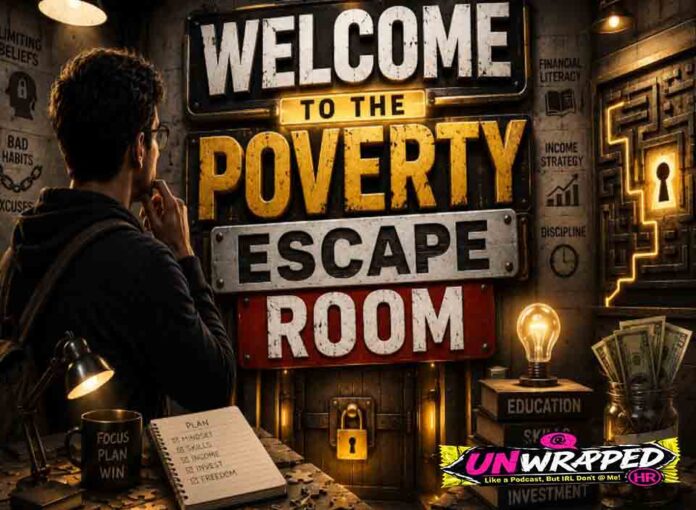
The Poverty Escape Room.
Unlike normal escape rooms, this one lasts your entire life, the clues are written by a committee, the doors are locked from the outside, and every time you nearly get out, a man in a fleece gilet appears and says:
“Have you considered budgeting?”
Welcome to the funhouse. Welcome to the maze. Welcome to the world’s most popular game show:
Can You Survive Being Poor Without Becoming an Inspirational Story for Someone Rich?
The rules are simple.
You have no money.
Everything costs money.
Having no money costs extra money.
And everyone with money thinks the solution is for you to have planned better before you were born.
Lovely.
There is a complimentary bottle of tap water by the entrance, but unfortunately it requires a subscription, a smart meter, a login code, an app update, and a letter from your landlord confirming you are allowed to be thirsty.
Good luck.
Room One: The Rent Goblin’s Mouth
Your first challenge is housing.
On the wall, painted in cheerful corporate font, are the words:
“Everyone deserves a safe place to live.”
Underneath that, in smaller text:
“Subject to affordability checks, deposit, references, guarantor, admin fees, income requirements, landlord vibes, and whether your face makes the letting agent feel optimistic.”
In the middle of the room sits The Rent Goblin.
He is nine feet tall, smells faintly of damp carpet, and wears a tiny crown made of estate agent business cards. Every month, he opens his enormous wet mouth and screams:
“SEVENTY PERCENT OF YOUR INCOME, PLEASE.”
You hand it over because you enjoy not sleeping under a bridge.
The Rent Goblin belches and says:
“Excellent. Unfortunately, the boiler is broken, the wall is growing mushrooms, and the cupboard contains a mysterious brown sadness. I’ll send someone round between March and death.”
You ask whether the rent can be lowered because the ceiling is leaking.
The Goblin laughs so hard a studio flat falls out of his pocket.
He tells you the market decides.
This is a very important phrase: the market decides.
It means nobody is responsible. Not the landlord. Not the government. Not the developers. Not the people who bought six houses and call themselves “property entrepreneurs” because “dragon guarding stolen treasure” looked bad on LinkedIn.
No. The market decided.
The market is apparently a weather event. Like rain. Or fog. Or a plague of buy-to-let locusts in chinos.
You must respect the market.
The market has feelings.
You, however, do not.
Room Two: The Benefits Labyrinth
Congratulations. You have lost your job, become ill, had your hours cut, escaped violence, developed a disability, entered old age, had a child, or made the unforgivable mistake of needing help while alive.
Please enter The Benefits Labyrinth.
At the door, a sign says:
“Support is available.”
This is technically true in the same way treasure is available at the bottom of the ocean if you own a submarine and are immune to pressure.
Inside the labyrinth is a form.
The form asks you 643 questions, including:
Are you poor?
Are you poor enough?
Are you poor in a way we approve of?
Can you prove you are poor?
Can you prove you tried not being poor first?
Have you considered simply becoming less poor?
Are you sad?
Are you sad because you are poor, or poor because you are sad?
Can you explain the gap in your employment history between “life collapsed” and “the collapse continued”?
Do you own a kettle?
Why?
Could the kettle be sold?
Have you ever smiled in a photograph?
Explain.
You try to answer honestly, but the website times out after 19 minutes because the government hired a consultancy firm called Sensible Future Solutions Ltd, which appears to be three men in quarter-zips pouring public money into a broken login portal.
You call the helpline.
A recorded voice says:
“Your call is important to us.”
This is the first lie of the trial.
The second lie is the flute music.
No music played for 47 minutes on a benefits helpline has ever been composed by a human being. It is generated by a haunted printer trying to remember joy.
Eventually someone answers.
They are exhausted too.
That is the genius of the system. The person you speak to is often also trapped in it. Underpaid, over-monitored, taking abuse from desperate people while reading scripts written by someone who has never had to choose between heating and eating because their biggest monthly dilemma is whether to upgrade the kitchen island.
You are not connected to help.
You are connected to another drowning person holding a clipboard.
The labyrinth works because it makes victims fight clerks while architects sip coffee.
Room Three: The Printer of Shame
To continue, you must print a document.
This is because every government system secretly believes it is 2004.
You do not own a printer because you are not a regional manager named Keith.
So now you must locate a printer in the wild.
The library has one. It is open between 10:17 and 10:43 every second Wednesday, except during staff training, local cuts, school holidays, national despair, and whenever the council notices poor people using it.
The printer costs 20p per page.
You need 37 pages.
You have £2.10.
The printer jams.
A woman behind you coughs with the force of a Victorian chimney sweep.
You ask the staff member for help. They are lovely, but they are also doing the work of six people because the library has been “modernised,” which means someone removed half the staff, added a beanbag, and called it community resilience.
Eventually the form prints.
You feel proud for three seconds.
Then you see the final page:
“Please upload this document online.”
This is not bureaucracy.
This is psychological warfare wearing reading glasses.
Room Four: The Employment Circus
You are told work is the way out.
Lovely idea.
Beautiful, even.
Work can give people dignity, structure, money, community, purpose. Fantastic. Big fan of work when work is not a Victorian punishment ritual with a Teams login.
So you apply.
The job advert says:
“Entry level position.”
Then asks for:
Three years’ experience.
A degree.
A driving licence.
Weekend availability.
Evening availability.
Emotional flexibility.
Physical stamina.
Passion.
A positive attitude.
A willingness to be part of a family.
Never trust a workplace that calls itself a family.
Families are where people borrow money, shout in kitchens, and know what you looked like during puberty. A workplace is not a family. A workplace is a place where someone pays you less than the value you create, then puts up a poster about mental health beside the broken microwave.
You get an interview.
It is at 9am, 23 miles away.
The bus is late because public transport has been designed by someone whose daily commute is from the ensuite to the breakfast bar.
You arrive sweaty, anxious, and £9 poorer.
The interviewer asks:
“Why do you want to work here?”
You cannot say:
“Because rent is hunting me through the trees.”
So you say:
“I’m passionate about customer service.”
Nobody is passionate about customer service.
Some people are good at it. Some people are patient. Some people are kind. But nobody wakes up with tears in their eyes whispering, “Today, I shall help a man return a toaster without a receipt.”
The interviewer nods.
They ask about the gap in your CV.
Ah yes. The gap.
That suspicious gap where your mother died, your health failed, your relationship exploded, your childcare collapsed, your depression wrapped itself around your ankles like a wet duvet, and every morning felt like climbing out of a hole using only your eyelashes.
But sure. Let’s call it a gap.
You tell them you were “dealing with personal circumstances.”
They write something down.
You do not get the job.
Three weeks later, they send an email beginning:
“Unfortunately…”
The national anthem of the poor.
Room Five: The Bank’s Tiny Punishment Machine
You are now skint.
This is expensive.
People who have never been poor think being poor means buying fewer luxuries.
Adorable.
Being poor means paying more for the same life, but in smaller, shittier, panic-sized pieces.
You cannot afford the annual bill, so you pay monthly and get charged more.
You cannot afford bulk groceries, so you buy the smaller pack and get charged more.
You cannot afford to live near work, so you travel further and pay more.
You cannot afford a reliable car, so you buy a cheap car that breaks and costs more.
You cannot afford dental care, so a small problem becomes a big problem and costs more.
You cannot afford to be late, but the bus is late, so now your wages are late, so your rent is late, so your bank charges you for being poor in a way they found administratively untidy.
The bank sends you a notification:
“You have been charged £12 because you did not have £3.”
This is the purest sentence in capitalism.
It belongs in a museum.
Future children should stand before it in silence.
A guide should whisper:
“Here we see the ancient ritual of punishing empty pockets for failing to contain coins.”
The bank calls it a fee.
Let’s call it what it is:
A tiny electric fence around poverty.
Touch the edge and it shocks you back in.
Room Six: The Healthcare Waiting Room of Eternity
You are unwell.
Perhaps physically. Perhaps mentally. Probably both, because poverty does not politely choose one organ. It gets into your back, your teeth, your sleep, your stomach, your heart, your temper, your memory, your ability to answer emails without staring at the wall like a stunned goat.
You try to book an appointment.
The receptionist says:
“Call at 8am.”
At 8am, everyone in the country calls at 8am.
The phone line collapses like a deckchair under a horse.
You finally get through.
No appointments.
Try again tomorrow.
Your body, inconsiderately, continues existing.
By the time you are seen, your small problem has become a medium problem wearing a hat.
The doctor is kind but has seven minutes, a computer older than some religions, and the haunted eyes of someone asked to patch a sinking ship with Post-it notes.
They recommend rest.
Rest.
Wonderful.
You’ll just schedule that between the late payment notice, the school run, the zero-hours shift, the landlord inspection, the pain, the dread, the phone queue, and the deep spiritual fatigue of living in a country where every institution has the vibe of a vending machine eating your last coin.
Then society says:
“Why are people so unhealthy?”
Because they are marinating in stress, Sandra.
Because the body keeps the score and the landlord keeps the deposit.
Because “prevention is better than cure” sounds lovely until prevention requires stable housing, decent food, clean air, safe streets, secure work, spare time, and a government that does not treat public health like a subscription add-on.
Room Seven: The Resilience Workshop
Now comes the best room.
The funniest room.
The room where satire has to sit down for a minute because reality has become too stupid to parody.
Welcome to The Resilience Workshop.
After stripping away support, underfunding services, letting wages stagnate, allowing housing to become a casino, turning healthcare into a queue, making benefits humiliating, and forcing people to live one unexpected bill away from disaster, society gathers everyone in a community hall and says:
“Have you tried breathing?”
A woman with a lanyard tells you stress is about mindset.
She has a PowerPoint.
The PowerPoint contains a stock photo of a pebble.
The pebble is on a beach.
The beach is probably private.
Slide two says:
“You are stronger than you think.”
This is what powerful people say when they are not planning to help.
Resilience is a fine quality.
People need resilience.
Life is hard.
But there is a difference between encouraging strength and glorifying abandonment.
A bridge should be resilient.
So should a roof.
So should a society.
But somehow we only ever demand resilience from the people being crushed, never from the systems doing the crushing.
Nobody asks the landlord to be resilient and accept less rent.
Nobody asks the energy company to be resilient and survive smaller profits.
Nobody asks the billionaire to be resilient and try owning only one yacht shaped like a divorce settlement.
No.
You be resilient.
You breathe through the panic.
You download the app.
You attend the workshop.
You repeat the affirmation:
“I am enough.”
Then you go home to a letter saying you are not.
Room Eight: The Respectability Trap
This room is full of mirrors.
In every mirror, society shows you a different version of yourself it might consider helping.
The deserving poor.
The hardworking poor.
The grateful poor.
The quiet poor.
The poor who never smoke, never drink, never laugh, never buy a birthday present, never own a phone newer than a potato, never make a bad decision, never show anger, never look tired in a way that makes middle-class people uncomfortable.
To receive compassion, you must become a perfect victim.
You must suffer, but attractively.
You must struggle, but responsibly.
You must be desperate, but not dramatic.
You must be hungry, but not fat.
You must be mentally ill, but not difficult.
You must need help, but not too much help.
You must be poor because of circumstances, not choices, unless the choices were understandable, documented, witnessed, notarised, and made while wearing a cardigan.
Here is the truth:
People are messy.
Poor people are messy because people are messy, not because poverty is a moral defect.
Middle-class people make stupid decisions too. They just make them with a safety net, a spare room, a parent who can transfer £500, and a fridge containing emergency hummus.
When a comfortable person messes up, it is a learning experience.
When a poor person messes up, it is evidence.
That is the scam.
The same human weakness gets different names depending on the postcode.
Room Nine: The Personal Responsibility Cannon
At random intervals, a cannon fires the phrase PERSONAL RESPONSIBILITY directly into your face.
Boom.
You should have saved.
Boom.
You should have studied.
Boom.
You should have moved.
Boom.
You should have left sooner.
Boom.
You should have chosen better.
Boom.
You should have worked harder.
Boom.
You should have known the economy would kick your door in wearing steel boots.
Personal responsibility matters.
Of course it does.
Nobody serious is saying people have no agency, no choices, no obligations to themselves or others.
But personal responsibility without social responsibility is just cruelty with a motivational poster.
You cannot tell people to climb a ladder while removing the rungs, greasing the sides, charging rent for the wall, and then publishing a think piece about why nobody climbs anymore.
Yes, people make choices.
But choices are not made in a vacuum.
They are made inside wages, rents, trauma, schools, transport, childcare, healthcare, debt, disability, family, luck, geography, racism, class, violence, addiction, grief, and whether someone taught you how the bloody form works.
A rich person’s mistake becomes a funny story.
A poor person’s mistake becomes a life sentence.
That is not accountability.
That is a rigged fruit machine with a sermon attached.
Room Ten: The Final Door Marked Opportunity
At last, you reach the final door.
Above it, glowing in golden letters, is the word:
OPPORTUNITY
Beautiful.
You reach for the handle.
It does not move.
A voice from the ceiling says:
“The door is open to everyone.”
You try again.
Still locked.
The voice says:
“Maybe you lack confidence.”
You pull harder.
Nothing.
The voice says:
“Have you considered networking?”
You kick the door.
A panel opens.
Behind it is a man in a suit eating grapes.
He says:
“Actually, my grandfather came here with nothing.”
You ask when.
He says 1932.
You ask how much the house cost.
He changes the subject to discipline.
This is the mythology room.
Here, society tells old stories about ladders that have since been pulled up, burned, sold to private equity, and replaced with a webinar.
You are told anyone can make it.
And yes, some do.
Some people escape.
Some people are brilliant, lucky, relentless, supported, healthy enough, young enough, close enough, charming enough, connected enough, or simply somehow able to crawl through the machinery without being minced.
And when they escape, society points at them and says:
“See? The system works.”
No.
A handful of survivors does not prove the obstacle course is fair.
It proves some people can run through fire.
The existence of escape is not evidence of justice.
A casino has winners too.
That does not make it a school.
The Real Joke
The real joke is that none of this is hidden.
That is the maddening part.
It is all happening in broad daylight.
We know insecure housing ruins lives.
We know debt traps people.
We know stress makes people sick.
We know early help prevents later disaster.
We know stable work matters.
We know children cannot thrive in chaos.
We know bureaucracy keeps people from support.
We know poverty is expensive.
We know shame does not feed anyone.
We know a society cannot run on food banks, unpaid carers, exhausted nurses, underpaid teachers, charity shops, GoFundMe pages, and the emotional endurance of people who are one bad week away from collapse.
We know.
That is what makes it diabolical.
The cruelty is not ignorance.
The cruelty is maintenance.
The machine is not broken in the way they pretend.
A lot of the time, the machine is doing exactly what it was built to do: delay, deter, exhaust, shame, filter, frighten, and make people give up quietly enough that the statistics look manageable.
Not always because there is a smoky room full of villains stroking cats.
That would almost be comforting.
No, it is worse.
It is thousands of small decisions made by people who call themselves practical.
A cut here.
A threshold there.
A frozen allowance.
A closed office.
A longer wait.
A stricter test.
A missing bus.
A rejected claim.
A rent rise.
A fee.
A sanction.
A letter.
A login.
A queue.
A delay.
A shrug.
And then, after the system has spent years grinding people into paste, someone on television asks:
“Why are people so angry?”
Because they are not stupid.
Because they can feel the boot even when it has been rebranded as efficiency.
The Exit
At the end of the Poverty Escape Room, there is a gift shop.
Of course there is.
In the gift shop, you can buy:
A mug that says Live Laugh Leverage.
A tote bag that says I Survived Austerity And All I Got Was Complex Trauma.
A scented candle called Administrative Delay.
A children’s puzzle book titled Where’s Daddy? He’s On Hold To The Council.
A mindfulness journal with the prompt: List Three Things You Are Grateful For Besides Basic Stability, Which We Have Not Provided.
By the till stands a cardboard cutout of a politician giving a thumbs-up.
A speech bubble says:
“We’re helping people into work.”
Behind the cutout is a staff door.
Through the gap, you can see the truth.
The truth is not complicated.
People need homes they can afford.
Work that pays enough to live.
Healthcare before crisis.
Benefits that do not humiliate them.
Schools that are not crumbling.
Transport that exists.
Childcare that does not cost a kidney.
A justice system that sees poverty as pressure, not proof of bad character.
A government that understands dignity is cheaper than despair.
This is not utopian.
This is basic.
This is not asking for gold-plated hammocks and taxpayer-funded swan butlers.
This is asking for a society where ordinary people are not forced to spend their whole lives solving stupid little survival puzzles designed by people who have never missed a meal unless it was part of a cleanse.
The hardest truth is this:
Most people are not asking to be carried.
They are asking for the boot to be taken off their neck long enough to stand up.
And for this outrageous request, they are called entitled.
Lazy.
Scroungers.
Irresponsible.
Negative.
Difficult.
A burden.
But maybe the burden is not the single mother filling out forms at midnight.
Maybe the burden is not the disabled man proving, again, that he is still disabled.
Maybe the burden is not the worker doing twelve-hour shifts and still choosing which bill to ignore.
Maybe the burden is not the pensioner sitting in one heated room wearing a coat indoors.
Maybe the burden is not the teenager trying to study in a house full of damp, debt, and shouting.
Maybe the burden is a society wealthy enough to prevent misery but spiritually committed to means-testing compassion through a broken website.
Maybe the burden is a political class that calls poverty unfortunate while building policy around making it more survivable for landlords than tenants.
Maybe the burden is a culture that worships wealth so hard it started mistaking bank balances for virtue.
Maybe the burden is all the comfortable people standing around a locked door, congratulating themselves on how open it is.
So yes.
Welcome to the Poverty Escape Room.
The timer is running.
The clues are missing.
The staff are underpaid.
The rules keep changing.
The exit is real but guarded.
And somewhere, from a balcony above the maze, someone who inherited the building is shouting:
“Have you tried working harder?”
The correct answer is:
“Have you tried building a society that doesn’t eat its own people and then complain about the mess?”