


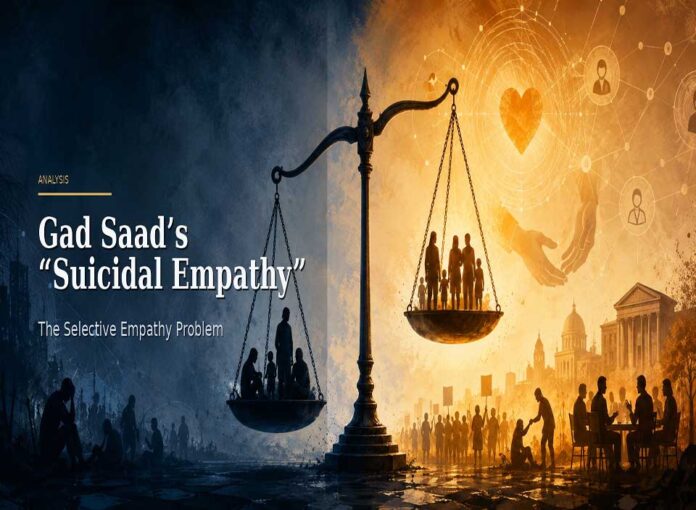
Gad Saad’s idea of “suicidal empathy” is powerful because it begins with a truth: empathy can go wrong.
Empathy can be sentimental. It can be partial. It can be manipulated by politics, media, ideology, and vivid individual stories. A society can become so focused on one group’s suffering that it forgets another group’s suffering entirely. A justice system can over-focus on offenders and neglect victims. Immigration policy can sentimentalise hardship while ignoring security, assimilation, and social trust. Gender policy can prioritise one vulnerable group while imposing costs on another.
So the strongest critique of Saad is not that empathy is always good. It is not.
The stronger critique is this: Saad has not escaped selective empathy. He has built a theory for condemning other people’s selective empathy while preserving his own.
Saad’s publisher describes Suicidal Empathy as an argument that empathy in politics can lead to “civilizational collapse,” and presents his concept as a “disease” in which the West may be “terminally infected.” The official description frames the problem through examples such as criminals over victims, squatters over homeowners, illegal migrants over citizens and veterans, and transgender women over biological women.
Those examples matter. They are not politically neutral. They form a pattern.
What Saad Gets Right About Empathy
A serious critique should begin by giving Saad his due.
Empathy is not the same as wisdom. It is not the same as justice. It is not the same as good policy. Feeling another person’s pain does not automatically tell us what laws to pass, what borders to enforce, how to punish crime, or how to balance competing rights.
This is not only Saad’s point. Psychologist Paul Bloom has argued that empathy can be biased and narrow, especially because people are often more moved by identifiable individuals than by statistical realities or large-scale consequences.
That point is hard to dismiss. Compassion without tradeoffs can become reckless. A society that asks only “Who is suffering?” but never asks “Who else is harmed?” will make bad decisions.
So far, Saad is on solid ground.
The problem begins when he decides which empathy counts as “suicidal.”
https://www.goodreads.com/author/list/403686.Gad_Saad
The Key Weakness: “Wrong Targets”
In Saad’s own framing, the issue is not empathy itself but empathy directed toward the wrong people, causes, or policies. In a Northwood essay, he describes Suicidal Empathy as dealing with empathy “deployed on the wrong targets,” connecting the idea to his earlier work on “parasitic ideas.”
That phrase — wrong targets — is where the whole doctrine becomes vulnerable.
Wrong according to what rule?
A neutral cost-benefit test?
Equal human dignity?
National self-preservation?
Victim protection?
Biological kin preference?
Western civilisational loyalty?
Religious or cultural compatibility?
Majority preference?
Evolutionary psychology?
These are not the same standard. They can overlap, but they can also conflict.
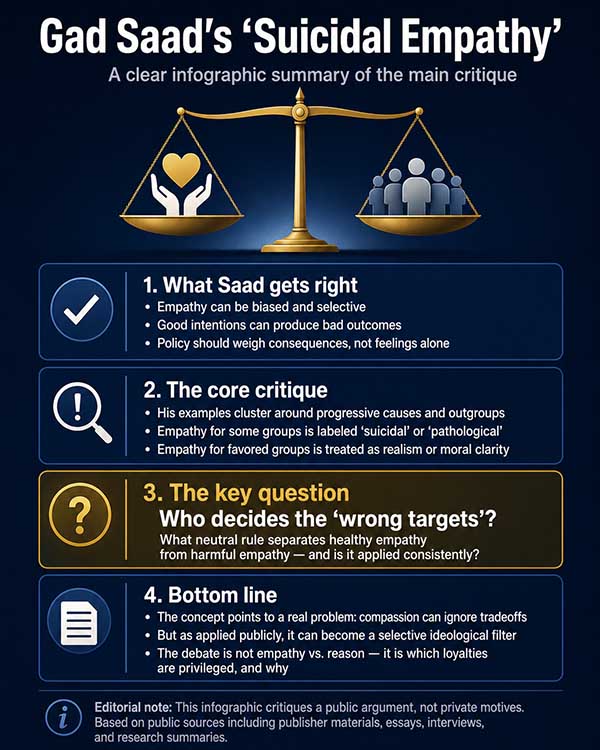
If “suicidal empathy” means “empathy that produces more harm than good,” then Saad needs a consistent test for harm. But if “suicidal empathy” mostly means “empathy for groups Saad already views as dangerous, parasitic, anti-Western, criminal, progressive, or destabilising,” then the concept is doing ideological work while presenting itself as neutral analysis.
That is the central criticism.
The Public Examples Point in One Direction
Saad’s examples of pathological empathy repeatedly cluster around progressive-coded causes and outgroups.
In a 2021 post titled “The Orgiastic Nature of Pathological ‘Empathy,’” he lists examples including removing advanced placement classes because they may marginalise less academically talented students, restricting speech to avoid hurt feelings, and other examples associated with progressive education, speech, religion, gender, borders, and anti-racism discourse.
Again, the issue is not that every example is invalid. Some may raise legitimate policy questions. The issue is the pattern.
Empathy for criminals is suspect.
Empathy for migrants is suspect.
Empathy for trans women is suspect.
Empathy for the homeless is suspect.
Empathy for religious or cultural minorities is suspect.
Empathy for progressive causes is suspect.
But empathy for victims, citizens, veterans, homeowners, biological women, Jews, Israel, America, or Western civilisation is not treated with the same suspicion. It is treated as realism, moral clarity, or survival instinct.
That may be a defensible moral hierarchy. But it should be named honestly.
It is not an escape from selective empathy. It is a rival system of selective empathy.
Saad Does Not Oppose Selective Empathy. He Opposes Rival Selective Empathy.
This is the strongest version of the argument:
Saad does not actually reject selective empathy. He rejects the wrong kind of selective empathy.
Every serious moral and political system prioritises. Parents usually care more about their own children than strangers. Citizens may owe special obligations to fellow citizens. A legal system may prioritise victims over offenders. A liberal society may protect women’s rights, free speech, or constitutional principles even when doing so hurts someone’s feelings.
None of that is automatically hypocritical.
But once Saad admits that empathy must be selectively ordered, he cannot simply call his opponents’ empathy “suicidal” while treating his own preferred loyalties as objective truth.
The real debate is not empathy versus reason. It is which loyalties should be morally privileged, and why.
That is a political and ethical argument. It is not settled by calling one side “pathological.”
The Immigration Example Shows the Risk
Immigration is one of the clearest examples of why Saad’s framework needs a stricter evidence test.
It is perfectly legitimate to argue that immigration policy must consider borders, assimilation, criminal screening, wages, housing, public services, national identity, and social trust. No serious country can run immigration policy on compassion alone.
But it is also easy to use vivid crimes or shocking anecdotes to imply a broader group threat. That is exactly the kind of emotional reasoning Saad says he opposes.
The broader evidence on immigration and crime is more complicated than fear-based narratives suggest. The Cato Institute’s 2024 analysis of Texas data found that from 2013 to 2022, illegal immigrants in Texas had a homicide conviction rate of 2.2 per 100,000, compared with 3.0 per 100,000 for native-born Americans; legal immigrants had a rate of 1.2 per 100,000. Migration Policy Institute also summarises research finding that immigrants in the United States commit crimes at lower rates than the U.S.-born population, including across unauthorised immigrant groups.
This does not mean every immigration concern is false. It does not mean no immigrant commits crime. It does not mean borders are irrelevant.
It means that if Saad demands rationality from pro-immigration empathy, he must also demand rationality from anti-immigration fear.
Otherwise, “suicidal empathy” becomes a one-way accusation: compassion must prove itself with data, but suspicion gets to travel by anecdote.
The Problem Is Not Bad Faith. It Is Asymmetry.
The careful argument is not that Saad is lying. It is not that he lacks empathy. It is not that he secretly hates the groups he criticises.
Those claims would be speculative and unfair.
The argument is better than that:
As publicly presented, Saad’s framework lacks a neutral falsification test.
What evidence would make Saad conclude that empathy toward migrants is wise rather than suicidal?
What evidence would make him conclude that empathy toward offenders is justified rather than pathological?
What evidence would make him call empathy for citizens, victims, veterans, Israel, or Western civilisation excessive, distorted, or self-destructive?
If the answer is unclear, then the theory has a problem. A serious concept needs to be capable of cutting against its author’s preferences. If it only condemns the empathy of one political tribe, it is not a general theory. It is a weaponised label.
“Pathology” Language Raises the Stakes
Saad’s rhetoric also matters.
In the Northwood essay, he connects his work to “idea pathogens” and “parasitic ideas,” arguing that certain intellectual movements hijack rational thinking and emotional systems. That language is memorable, but it is also dangerous.
Once disagreement is framed as infection, opponents become less like people making contestable moral judgments and more like hosts carrying a disease. Their compassion is not merely mistaken. It is parasitic. Their politics is not simply wrong. It is pathological.
That framing lowers the burden of argument.
Instead of proving, case by case, that a policy causes more harm than good, one can simply say it is another example of suicidal empathy. The label does the work.
That is exactly why the concept must be scrutinised.
The Better Standard: Rational Compassion
There is a stronger alternative to both naïve empathy and Saad’s selective version of anti-empathy.
Call it rational compassion.
Rational compassion starts with human suffering but does not end there. It asks:
Who is suffering?
Who else is affected?
What incentives are being created?
What are the base rates?
What are the long-term consequences?
What rights are in conflict?
What evidence would change our minds?
This standard applies to everyone.
It applies to migrants and citizens.
It applies to offenders and victims.
It applies to trans women and biological women.
It applies to homeless people and neighbourhood residents.
It applies to religious minorities and secular liberals.
It applies to Israel and Palestine.
It applies to the West and the non-West.
That is the difference between a genuine analytical framework and a partisan slogan.
The Strongest Criticism of Gad Saad’s “Suicidal Empathy”
The strongest criticism is not that Saad is wrong about empathy. He is right that empathy can mislead.
The strongest criticism is that his concept, as he applies it publicly, appears to diagnose empathy as pathological when it flows toward groups he already distrusts, while exempting his own preferred loyalties from equivalent scrutiny.
That does not make his argument worthless. It makes it incomplete.
“Suicidal empathy” contains a real warning: compassion without consequences can become destructive. But it also contains a real temptation: to rename your opponents’ compassion as disease while calling your own compassion moral clarity.
That is the selective empathy problem.
Conclusion: A Useful Warning, a Dangerous Slogan
Gad Saad’s “suicidal empathy” is a useful phrase when it reminds us that good intentions can produce bad outcomes. It is right to ask whether compassion is being directed wisely, whether victims are being forgotten, whether incentives are being distorted, and whether emotional politics is overriding evidence.
But the concept becomes dangerous when it is applied selectively.
If empathy for outsiders is always suspect, while empathy for insiders is always noble, then the issue is not reason versus emotion. It is one moral tribe accusing another moral tribe of having feelings in the wrong direction.
The fairest conclusion is also the hardest-hitting:
Saad has not solved the problem of selective empathy. He has renamed his opponents’ selective empathy “suicidal” while leaving his own selective empathy largely untouched.
That is not science defeating ideology.
It is ideology with a stronger vocabulary.
FAQ
What does Gad Saad mean by “suicidal empathy”?
Saad uses “suicidal empathy” to describe forms of empathy that, in his view, become self-destructive when societies prioritise compassion for the wrong people, causes, or policies over survival, order, or rational consequences. His publisher frames the book as a critique of empathy in politics leading to civilisational decline.
Is Gad Saad wrong that empathy can be harmful?
No. Empathy can be biased, narrow, and politically manipulated. Paul Bloom has made a separate argument that empathy can be a poor guide to social policy because it often favours vivid individual cases over broader evidence.
What is the main criticism of “suicidal empathy”?
The strongest criticism is that Saad’s public examples appear ideologically selective. Empathy for progressive-coded groups is often treated as pathological, while empathy for Saad’s preferred groups or causes is treated as rational, protective, or civilisational.
What would make Saad’s argument stronger?
A neutral test. Saad’s framework would be stronger if he clearly stated what evidence distinguishes healthy empathy from suicidal empathy — and then applied that test equally to causes he supports and causes he opposes.
Disclaimer / Editorial Note
This article is an opinion and analysis piece based on publicly available material, including publisher descriptions, essays, interviews, articles, and research sources. It critiques Gad Saad’s public argument about “suicidal empathy” as a political and rhetorical framework. It does not claim to know Saad’s private motives, intentions, beliefs, or character.
Terms such as “selective,” “ideological,” “asymmetrical,” and “dogmatic” are used as analytical judgments about the public application of an argument, not as allegations of dishonesty, hatred, bad faith, or personal malice.
The article aims to steelman Saad’s strongest point — that empathy can be misdirected and can produce harmful policy outcomes when detached from evidence, tradeoffs, and consequences — while also testing whether his own framework is applied consistently. Readers are encouraged to consult the original sources and draw their own conclusions.
References
- HarperCollins. Suicidal Empathy: Dying to Be Kind by Gad Saad. Official publisher page. HarperCollins describes the book as arguing that “empathy in politics leads to civilizational collapse” and frames “suicidal empathy” as a disease affecting the West.
- Saad, Gad. “Parasitic Ideas and Suicidal Empathy Are Killing the West.” Northwood University, January 5, 2025. Saad describes “idea pathogens,” connects The Parasitic Mind to Suicidal Empathy, and says the new book concerns empathy “deployed on the wrong targets.”
- Saad, Gad. “The Orgiastic Nature of Pathological ‘Empathy.’” GadSaad.com, June 18, 2021. Saad lists examples of what he calls pathological empathy, including education policy and speech restrictions.
- Bloom, Paul. “Against Empathy.” Boston Review, August 20, 2014. Bloom argues that empathy can be biased and may be a poor guide to social policy, especially because it favours identifiable individuals and people similar to ourselves.
- Nowrasteh, Alex. “Illegal Immigrant Murderers in Texas, 2013–2022: Illegal Immigrant and Legal Immigrant Conviction and Arrest Rates for Homicide and Other Crimes.” Cato Institute, Policy Analysis No. 977, June 26, 2024. The analysis states that immigrant conviction and arrest rates in Texas were lower than native-born rates for homicide and all crimes during 2013–2022, while warning that some non-homicide data should be interpreted cautiously.
- Ruiz Soto, Ariel G. “Immigrants and Crime in the United States.” Migration Policy Institute, October 2024. MPI summarizes research finding that immigrants in the United States commit crimes at lower rates than the U.S.-born population, including unauthorized immigrants.
- “#2497 — Gad Saad.” The Joe Rogan Experience Transcript, Happy Scribe, May 2026. Transcript source used cautiously for Saad’s public discussion of “suicidal empathy” in long-form interview context.