


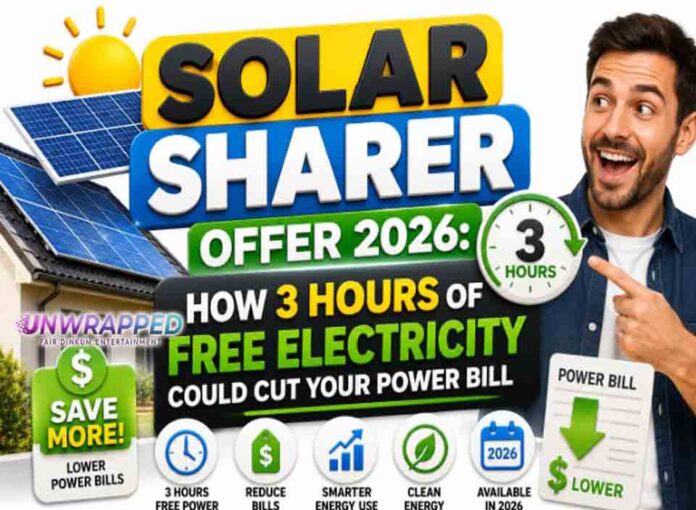
From 1 July 2026, eligible households in New South Wales, South East Queensland and South Australia are expected to be able to sign up for a new electricity offer with at least 3 hours of free electricity in the middle of the day.
The offer is called the Solar Sharer Offer, or SSO. The key point is simple: you do not need rooftop solar panels to benefit. You can rent or own. The main requirement is that you live in an eligible region, have a smart meter and choose to opt in through an electricity retailer. The Australian Government says the offer is designed to help households use more of the low-cost solar power available in the middle of the day, while also reducing pressure on the grid during expensive evening peaks.
But there is a catch that every household should understand before switching: free electricity does not automatically mean a lower total bill. The real saving depends on how much of your electricity use you can move into the free window and what the retailer charges outside that window.
This guide explains how the Solar Sharer Offer works, who is eligible, how much you could save, which appliances to run during the free period and what traps to check before signing up.
| Quick answer Solar Sharer is an opt-in electricity offer for eligible households with smart meters. It is expected to provide at least 3 hours of free electricity each day in the middle of the day from 1 July 2026 in NSW, South East Queensland and South Australia. You do not need rooftop solar, and renters can participate. The biggest savings are likely to go to households that can shift high-energy use into the free period, such as EV charging, electric hot water, pool pumps, dryers, home batteries and scheduled appliances. |
What is the Solar Sharer Offer?
The Solar Sharer Offer is a new regulated electricity offer being introduced through reforms to the Default Market Offer, commonly called the DMO. The DMO is the electricity price safety net that applies to residential and small business standing offers in New South Wales, South East Queensland and South Australia.
Under the Solar Sharer Offer, electricity retailers will be required to offer eligible households with smart meters a daily period of free electricity during the middle of the day, when solar generation is typically strongest. The Department of Climate Change, Energy, the Environment and Water says households will be able to access up to 24 kWh of free electricity during the daily window, and that the offer will be available to renters and homeowners, with or without rooftop solar.
The idea is to make better use of Australia’s midday solar generation. Reuters reported that households will benefit directly only if they shift electricity use into the zero-cost period, such as by running appliances or charging vehicles during the middle of the day.
Solar Sharer at a glance
| Question | Answer |
| Start date | Expected to be available from 1 July 2026. |
| Initial locations | New South Wales, South East Queensland and South Australia. |
| Do you need solar panels? | No. The offer is designed for households with or without rooftop solar. |
| Can renters use it? | Yes, renters can participate if the electricity account and meter arrangement allow it. |
| Do you need a smart meter? | Yes. A smart meter is required because usage must be measured by time of day. |
| Is it automatic? | No. It is expected to be an opt-in offer through electricity retailers. |
| How long is the free period? | At least 3 hours each day in the middle of the day. |
| Is there a cap? | Yes. Government information says customers will be able to access up to 24 kWh of free electricity during the daily window. |
| Will the rest of the day be free? | No. Usage outside the free window will still be charged under the plan. |
| Who benefits most? | Households that can shift high-energy tasks into the free window. |
Who is eligible for Solar Sharer?
The basic eligibility rules are straightforward, although the final plan details and sign-up process will sit with electricity retailers.
| Eligibility factor | What it means |
| Location | The first rollout is in NSW, South East Queensland and South Australia. |
| Smart meter | You need a smart meter so your retailer can measure how much electricity you use during the free window. |
| Household customer | The Solar Sharer Offer is described as a household offer. DMO rules also cover small business pricing, but Solar Sharer is aimed at residential customers. |
| Renter or owner | You can be a renter or homeowner. You do not need to own the property. |
| Solar panels | Not required. Households without rooftop solar are specifically included. |
| Opt-in | You will need to choose the offer through a retailer. It is not expected to be automatically applied to every household. |
| Other states and territories | Other regions are being considered, but the initial 1 July 2026 rollout is not national. |
The Australian Energy Regulator says Energy Made Easy can help households compare plans and can show whether a plan is eligible for smart meters under the plan details.
What time will the free electricity window be?
The official Solar Sharer policy sets the principle: free electricity should be available during the middle of the day, when solar generation is at its peak. The exact free window is being handled through the AER DMO process.
In the AER’s draft 2026-27 DMO decision, the free usage periods were set at 11 am to 2 pm in New South Wales and South East Queensland, and 12 pm to 3 pm in South Australia. The AER also said the Solar Sharer Offer would have the same annual cost as the DMO time-of-use tariff, with free energy in the middle of the day and slightly higher prices outside the free period.
| Region | Draft free electricity window | Status |
| New South Wales | 11 am to 2 pm | Draft AER detail. Check final retailer plan. |
| South East Queensland | 11 am to 2 pm | Draft AER detail. Check final retailer plan. |
| South Australia | 12 pm to 3 pm | Draft AER detail. Check final retailer plan. |
| Before publishing after late May 2026 The AER said it would release the final 2026-27 DMO decision by 26 May 2026, with the new DMO taking effect on 1 July 2026. If you publish this article after the final decision is available, update this section with the final confirmed free-window times and tariff rules. |
How much free electricity can you use?
Government information says customers will be able to access up to 24 kWh of free electricity during the daily Solar Sharer window. For most households, 24 kWh in 3 hours is a high ceiling. Many households will not get close to it unless they have large flexible loads such as an EV charger, electric hot water, a battery, a pool pump or high heating and cooling demand.
Another-Must-Read: DIY Solar Ovens: A Guide to Cooking Without Electricity
Solar Sharer savings calculator: how to estimate your saving
The simplest way to estimate Solar Sharer savings is to work out how many kilowatt-hours you can move into the free window each day. A kilowatt-hour, or kWh, is the unit used on your electricity bill.
| Simple estimate: Daily saving = free-window kWh x your normal usage rate Annual saving = daily saving x 365
Better estimate: Net annual benefit = avoided free-window charges – higher outside-window charges – any extra daily supply charge |
For appliances with energy rating labels, the Australian Government says running costs can be estimated by multiplying the appliance’s kWh consumption by the electricity rate shown on your bill.
Example savings at different electricity rates
These figures are estimates only. They assume every listed kWh would otherwise have been charged at the stated usage rate, and they do not subtract any higher rates outside the free period.
| Free-window usage per day | At 30c/kWh | At 35c/kWh | At 45c/kWh |
| 1 kWh/day | $109.50/year | $127.75/year | $164.25/year |
| 3 kWh/day | $328.50/year | $383.25/year | $492.75/year |
| 5 kWh/day | $547.50/year | $638.75/year | $821.25/year |
| 10 kWh/day | $1,095/year | $1,277.50/year | $1,642.50/year |
| 24 kWh/day | $2,628/year | $3,066/year | $3,942/year |
| Reality check The 24 kWh/day row shows the theoretical value of using the full daily free allowance every day. Many households will use far less. The practical question is not “how much is free?” It is “how much of my real household usage can I safely and consistently move into that window?” |
A more realistic household example
Imagine a household in NSW that can move the following into the 11 am to 2 pm period most days:
| Load shifted into the free period | Approximate shifted usage |
| Dishwasher | 1 kWh |
| Washing machine or dryer load | 2 kWh |
| Electric hot water top-up or pool pump | 3 kWh |
| Total shifted usage | 6 kWh/day |
At a usual rate of 35c/kWh, 6 kWh/day of usage moved into the free period could be worth about $2.10 per day, or about $766 per year before accounting for any higher usage charges outside the free window.
That is why the offer can be genuinely useful for some households. But if the same household only moves one dishwasher cycle every few days, the saving will be much smaller.
Best appliances to run during the Solar Sharer free period
The best appliances for Solar Sharer are not always the ones people think of first. The biggest savings usually come from loads that use a lot of electricity and can be scheduled safely.
| Appliance or load | Why it suits Solar Sharer | Practical tip |
| EV home charging | It can use a large amount of electricity in a short period. | Schedule charging inside the free window. A 7 kW charger can add roughly 21 kWh in 3 hours if the car and charger allow it. |
| Electric hot water | Hot water can be a major household load and may be shiftable. | Ask your retailer or installer whether your system can be timed or controlled for midday operation. |
| Home battery charging | A battery may let you store free midday energy for evening use. | Check whether your inverter and retailer plan allow grid charging, and whether it affects warranties or tariff rules. |
| Pool pump | Pool pumps often run for hours and are easy to schedule. | Move pump cycles into the free window where water quality and equipment settings allow. |
| Clothes dryer | Dryers can use more energy than many small appliances. | Use delay-start where safe. Clean lint filters and do not run heat appliances unattended if the manufacturer warns against it. |
| Dishwasher | Easy to schedule and usually low effort. | Use delay-start and an efficient cycle. The saving per cycle may be modest, but it is simple. |
| Washing machine | Easy to schedule, especially for warm or hot washes. | Cold washes usually use less electricity; warm or hot cycles have more shiftable value. |
| Air conditioning pre-cooling or pre-heating | Can reduce evening peak use if done carefully. | Pre-cool or pre-heat modestly rather than overusing energy just because it is free. |
Who is likely to save the most?
| Household type | Likely Solar Sharer value | Why |
| EV owner with home charging | Very high | EV charging is one of the easiest ways to use several kWh during a 3-hour window. |
| Household with electric hot water | High | Hot water is a large load if it can be timed for midday. |
| Home battery owner | High | A battery can potentially store free midday electricity for later use. |
| Household with pool pump | Medium to high | Pool pumps are easy to schedule and can run during the free period. |
| Family with dishwasher, washer and dryer | Medium | Several household tasks can be stacked into the free window. |
| Work-from-home household | Medium | More daytime presence makes it easier to manage appliances and comfort. |
| Apartment renter without EV or large appliances | Low to medium | There may still be savings, but fewer large flexible loads. |
| Household that cannot shift usage | Low | The offer only pays off if enough usage happens during the free period. |
The traps: when free electricity may not save you money
The phrase “free electricity” is powerful, but the plan still needs to be judged like any other electricity plan. Compare the whole offer, not just the free hours.
| Trap | What to check |
| Higher rates outside the free window | The AER draft said the Solar Sharer Offer would have slightly higher prices outside the free period than the DMO time-of-use tariff. Check the full rate table. |
| Daily supply charge | You still pay a daily supply charge, even if some usage is free. |
| Free usage cap | The offer is expected to include a cap. Government information says up to 24 kWh can be accessed during the daily window. |
| Low shiftable usage | If you can only move a few small loads each week, the saving may be modest. |
| Smart meter requirement | If you do not have a smart meter, ask your retailer how and when one can be installed. |
| Controlled load complications | Electric hot water may be on a separate controlled-load tariff. Ask whether it can actually use the Solar Sharer window. |
| Solar export changes | If you already have rooftop solar, check whether the plan changes your feed-in tariff or export settings. |
| Embedded networks | Some apartment buildings, caravan parks and retirement villages have embedded networks. Availability may differ. |
| Safety and convenience | Do not run appliances in a way that creates fire, water, heat or noise problems just to chase a small saving. |
Should you switch to a Solar Sharer plan?
Use this simple decision guide.
| Your situation | Likely verdict |
| You have an EV and can charge at home during the free window. | Strongly worth checking. |
| You have electric hot water that can be shifted to midday. | Strong candidate. |
| You have a home battery that can charge from the grid. | Strong candidate, but check plan and equipment rules. |
| You have a pool pump or other scheduled equipment. | Likely worth checking. |
| You work from home or can use appliance timers. | Possibly worthwhile. |
| You rent and have only small appliances. | Potentially useful, but savings may be smaller. |
| You cannot shift usage and have no major daytime loads. | May not be worth switching unless the whole plan is still cheaper. |
| The plan has much higher peak rates or supply charges. | Be careful. Run the numbers before switching. |
How to compare a Solar Sharer plan before signing up
- Find your current rates. Look at your latest bill for your usage charge, supply charge, tariff type and any controlled-load rate.
- Estimate your free-window usage. List what you can realistically run during the 3-hour window on most days.
- Ask for the full Solar Sharer rate table. Do not accept a headline claim. Get the free-window rate, peak/off-peak rates, supply charge, feed-in tariff and any demand charge.
- Compare the annual estimate. Use Energy Made Easy or your retailer’s written estimate. Compare total annual cost, not only the free window.
- Check your smart meter status. Ask whether you already have a smart meter and whether any meter change could affect your tariff.
- Trial the behaviour before switching. For a week, try running appliances during the likely free window. If it is annoying now, it may not work long term.
- Review after the first bill. Compare your actual free-window usage and total cost against your old bill pattern.
See Also: Quantum Dot Solar Cells in Extreme Climates: Unlocking Off-Grid Energy in Harsh Conditions
What if you already have rooftop solar?
Rooftop solar owners should not assume Solar Sharer is automatically better or worse. It depends on your daytime self-consumption, feed-in tariff, battery setup and household behaviour.
If you already generate plenty of solar electricity in the middle of the day, your biggest bill pressure may be the evening peak after solar output falls. In that case, Solar Sharer may be most useful if it lets you charge a battery, run electric hot water, pre-cool the house or charge an EV without sacrificing valuable solar exports. But if the plan reduces your feed-in tariff or raises evening rates, the benefit may shrink.
Solar households should compare three numbers before switching: how much solar they currently use themselves, how much they export, and how much grid electricity they buy in the evening.
What if you are a renter?
Renters are one of the most important groups for Solar Sharer because the offer is designed to share the benefits of cheap daytime solar with households that may not be able to install rooftop panels.
The easiest renter wins are usually appliance timers, delay-start dishwashers, washing machines, dryers where safe, portable smart plugs for suitable appliances and shifting work-from-home charging or cooling into the free window. Renters with an EV should check whether their parking and charging setup allows daytime charging at home.
If you are renting, check who controls the electricity account, whether you are in an embedded network, whether your meter is smart, and whether your landlord or strata rules affect meter upgrades or appliance use.
What if you do not have a smart meter?
A smart meter is required because Solar Sharer needs time-of-use measurement. Without a smart meter, your retailer cannot accurately separate usage inside and outside the free period.
If you do not know whether you have a smart meter, check your bill, your retailer app or your physical meter. A smart meter is usually digital and may allow remote readings. When in doubt, ask your retailer directly: “Do I have a smart meter, and am I eligible for Solar Sharer plans from 1 July 2026?”
Why Solar Sharer exists
Solar Sharer is not just a consumer discount. It is also a grid-management idea.
Australia has so much midday solar generation that parts of the grid can experience very low demand and low or negative wholesale prices during sunny periods. The University of Queensland explains that the offer is intended to make the benefits of solar more accessible, including to households without rooftop solar, but that it will only work if consumers know about it, trust it and actively shift usage.
Bottom line: is Solar Sharer worth it?
Solar Sharer is worth serious attention if you can shift meaningful electricity use into the free window. It could be especially valuable for EV owners, households with electric hot water, homes with batteries, pool owners and families that can schedule laundry, dishwashing and other appliance use.
It is less compelling if you cannot shift usage, do not have a smart meter, are outside the eligible regions or the retailer plan charges too much outside the free period.
The best way to think about Solar Sharer is this: it is not a magic discount. It is a reward for using electricity when the grid has more cheap solar power available. If your home can match that timing, the savings could be real. If your usage stays mostly in the evening peak, the offer may not move your bill much at all.
Solar Sharer FAQ
When does the Solar Sharer Offer start?
The Solar Sharer Offer is expected to be available from 1 July 2026 in the initial eligible regions.
Where is Solar Sharer available?
The first rollout is in New South Wales, South East Queensland and South Australia. Other areas are being considered, but they are not part of the initial rollout.
Do I need solar panels to get Solar Sharer?
No. The offer is available to households with or without rooftop solar.
Can renters get Solar Sharer?
Yes. Government information says renters can participate. The practical details depend on your electricity account, meter and retailer.
Do I need a smart meter?
Yes. Solar Sharer requires a smart meter because your retailer needs to measure electricity use by time of day.
Is Solar Sharer automatic?
No. It is an opt-in offer. You will need to sign up through a retailer.
Is the electricity really free?
During the free window, eligible usage should be charged at $0/kWh, up to the applicable cap. But your total bill can still include usage outside the free period, daily supply charges and other plan conditions.
How much free electricity can I use?
Government information says customers will be able to access up to 24 kWh of free electricity during the daily window.
What time is the free period?
The AER draft decision set the free periods at 11 am to 2 pm in NSW and South East Queensland, and 12 pm to 3 pm in South Australia. Check the final AER decision and your retailer plan before relying on those times.
Will prices go up outside the free period?
The AER draft said the Solar Sharer Offer would include free midday electricity and slightly higher prices outside that period compared with the DMO time-of-use tariff. Always compare the full rate table.
Can I charge my EV for free?
Potentially, yes, if your EV is at home, plugged in, able to charge during the free window and your plan allows it. A home charger can use a large share of the free daily allowance.
Can I use Solar Sharer with a home battery?
Potentially, yes, but you need to check whether your battery and inverter allow grid charging, whether your retailer permits it and whether it affects warranties or plan conditions.
Is Solar Sharer good for people without solar?
Yes, that is one of the main points of the offer. It is meant to let households without rooftop solar access some of the benefit of cheap midday solar generation.
Is Solar Sharer available in Victoria?
Not as part of the initial 1 July 2026 rollout. Victoria has its own energy market arrangements. Check Victorian Energy Compare and state announcements for local options.
Is Solar Sharer available in Western Australia?
Not as part of the initial rollout. Western Australia is not in the DMO regions covered by the first Solar Sharer rollout.
What is the best appliance to run during the free period?
The best options are high-energy loads that can be safely scheduled, such as EV charging, electric hot water, pool pumps, dryers, dishwashers, washing machines and battery charging.
Sources used
- Australian Government – Solar Sharer Offer to cut electricity bills
- DCCEEW – Default Market Offer and Solar Sharer Offer
- Australian Energy Regulator – Draft Default Market Offer 2026-27 release
- Australian Energy Regulator – Default market offer 2026-27 review page
- University of Queensland – Free electricity offer soon, but do Australians know about Solar Sharer?
- Energy Made Easy – government electricity plan comparison service
- Australian Energy Regulator – Consumer rights and smart meters
- energy.gov.au – Energy Ratings
- energy.gov.au – Appliances
- energy.gov.au – Research before you buy: dishwashers, clothes washers and dryers
- Reuters – Australia to offer three hours free solar per day to millions