



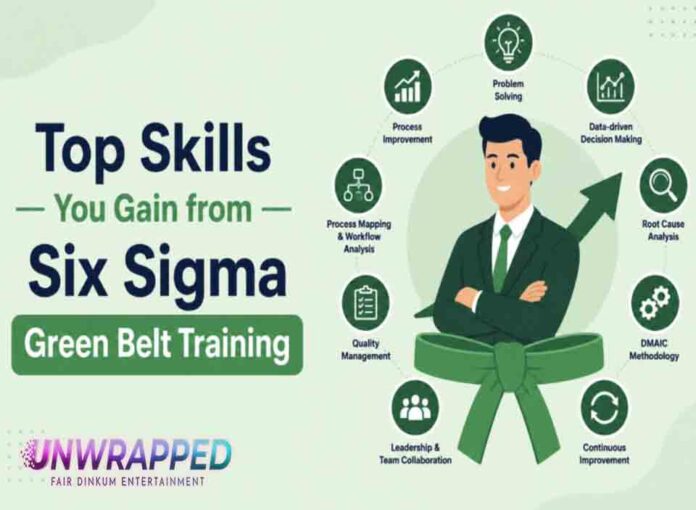
Have you ever seen someone at work quickly fix a process issue while others spend days trying to figure it out? That usually comes down to the skills they have built over time. Six Sigma Green Belt Training helps professionals understand how to solve problems and make daily tasks more organised and efficient. It is not only useful for quality teams but also for anyone who wants to handle work in a smarter way. Many professionals also choose Lean and Six Sigma Training to improve their confidence and grow in roles where process improvement and teamwork matter the most.
In this blog, you will explore the top skills gained from Six Sigma Green Belt Training.
Key Skills You Learn from Six Sigma Green Belt Training
Below are the key skills professionals develop through Six Sigma Green Belt Training to improve quality and workplace performance:
Problem Solving Skills
Structured issue solving is one of the best abilities acquired during Six Sigma Green Belt Certification. Instead of making assumptions or short-term remedies, professionals learn how to properly identify problems.
This strategy aids companies in resolving operational issues more successfully and preventing future mistakes. Additionally, it boosts self-assurance when managing tasks at work and reinforces the practical knowledge acquired during Lean and Six Sigma Training.
Process Improvement Skills
Companies are always searching for methods to increase output and decrease inefficiency. Professionals who complete Green Belt training learn how to evaluate workflows and pinpoint process weak points.
This ability aids businesses in increasing productivity and preserving more seamless departmental and team operations. Professionals with Lean and Six Sigma Training are now preferred by many organisations because they know how to effectively increase business performance.
Data driven Decision Making
Before making business decisions, modern businesses rely greatly on correct information. Green Belt experts acquire the skills necessary for accurate data collection, measurement, and analysis.
Teams are better able to make judgements based on facts rather than conjecture as a result. Additionally, it enhances operational planning and reporting accuracy.
Root Cause Analysis
Because businesses primarily deal with surface-level concerns, many workplace problems persist. Professionals who have received Green Belt training are better able to pinpoint the root cause of operational difficulties.
Because it enables companies to develop long-term solutions rather than short-term fixes, this ability is extremely significant. Additionally, it promotes improved process stability.
DMAIC Methodology Understanding
The acronym DMAIC represents Define, Measure, Analyse, Improve, and Control. One of the most crucial frameworks covered in Six Sigma Green Belt Training is this one.
In order to enhance quality, efficiency, and operational consistency inside businesses, professionals learn how to use an organised process improvement strategy.
Quality Management Skills
The success of a corporation is significantly influenced by quality management. Green Belt experts know how to uphold standards while lowering errors and enhancing service quality.
This ability is helpful in a variety of sectors where corporate performance is directly impacted by quality, including manufacturing, healthcare, IT, finance, and customer service.
Process Mapping and Workflow Analysis
Professionals who complete Green Belt training learn how to use process mapping tools to analyse workflows. This facilitates the identification of operational delays or superfluous tasks.
Professionals can suggest improved methods of operation and increase operational efficiency by having a good understanding of workflows. Lean and Six Sigma Training in various industries frequently strengthens these useful working skills.
Waste Reduction and Efficiency Improvement
Reducing waste in business operations is a key component of Lean Six Sigma Green Belt training. Experts understand how to eliminate activities that do not bring value.
This increases production, lowers expenses, and saves time for businesses. These abilities are frequently necessary for businesses to stay effective and competitive.
Conclusion
The skills developed through Six Sigma Green Belt Training help professionals improve processes and support operational efficiency with confidence. From data analysis and quality management to leadership and waste reduction, these capabilities remain valuable across many industries. Organisations today prefer professionals who can contribute to continuous improvement and smarter decision making.
For those looking to strengthen these practical workplace abilities further, Lean and Six Sigma Training can support long term professional growth and business success.