



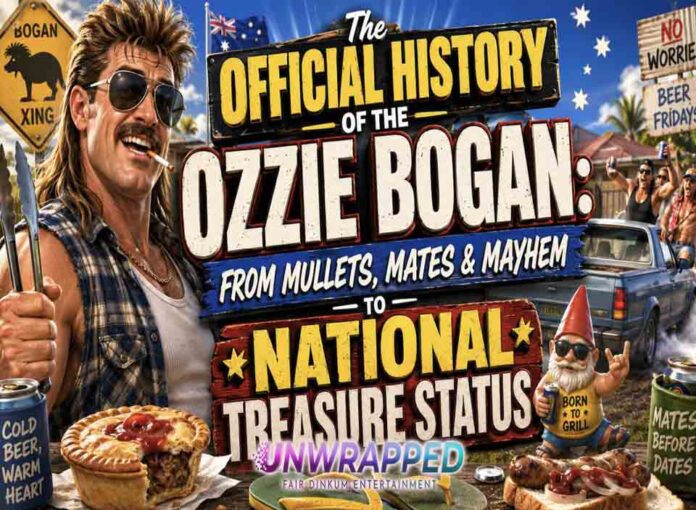
Opening Declaration from the High Council of Bogan Affairs
Before we begin, let the record show that this is not a government-approved history. No dusty bloke in Canberra wearing beige pants and eating a ham sandwich has stamped this with an official seal.
This is the unofficial official history of the Ozzie bogan: the sacred creature of the servo, the prophet of the pub feed, the philosopher of the front yard couch, the champion of “yeah nah,” the sworn enemy of pretentious bullshit, and the only known mammal capable of wearing thongs to a wedding and somehow making it everyone else’s problem.
The word “bogan” itself is Australian and New Zealand slang, generally used for someone seen as unfashionable, uncouth, or unsophisticated. The Macquarie Dictionary definition cited by ABC describes a bogan as generally being from an outer suburb or town and viewed as uncultured, while Oxford’s definition frames it as a depreciative term for an unfashionable or unsophisticated person.
But that’s only the dictionary version. Dictionaries are useful, but they also make everything sound like it was written by a disappointed librarian.
In real life, the bogan is not simply “uncultured.” The bogan is a vibe. A social force. A walking weather event. A person who might own three barbecues, two broken Commodores, one Southern Cross tattoo, and a dog named Bundy who has seen more emotional growth than half the family.
The bogan can be an insult, a badge of honour, a fashion crime, a political statement, a coping mechanism, a pub archetype, a class stereotype, and occasionally a bloke named Dazza yelling “send it” while reversing a jet ski into a fence.
So crack a cold one, whack on Acca Dacca, and let us begin.
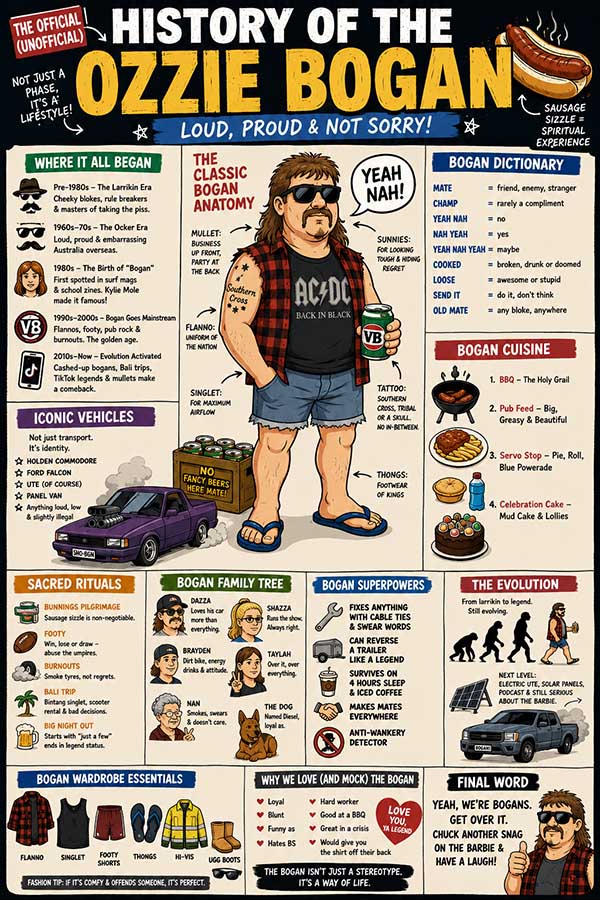
Chapter One: Before the Bogan, There Was the Larrikin
The bogan did not simply crawl out of a panel van in 1983 fully formed, wearing a flanno and demanding to know who touched his Winfield Blues.
No. The bogan had ancestors.
The first great ancestor was the larrikin — the mischievous, rule-bending, authority-mocking Australian figure who would rather fight a parking inspector than read the terms and conditions.
The larrikin is the lovable ratbag. The joker. The bloke who turns up late, saves the day accidentally, and calls the mayor “champ” to his face. Larrikinism became part of the Australian national self-image because Australia has always enjoyed pretending it hates authority while filling out eleven forms to get a shed approved.
The larrikin gave us the bogan’s spiritual foundations:
- suspicion of fancy people
- love of taking the piss
- refusal to dress properly
- deep commitment to mateship
- strong belief that any problem can be solved with cable ties, swearing, and “she’ll be right”
But the larrikin still had a certain rough charm. He was cheeky. He was marketable. He could be put on a tourism poster if you cleaned him up and removed the outstanding fines.
Then came the ocker.
Chapter Two: The Ocker — The Bogan’s Loud Uncle
The ocker was the next evolutionary stage: louder, broader, more beer-soaked. The Macquarie Dictionary describes “ocker” as originally coming from Aussie-style shortening of the name Oscar, with the modern usage spread by a character on The Mavis Bramston Show in the late 1960s. Macquarie also notes that, in some ways, the ocker is a predecessor of the bogan.
The ocker was the bloke abroad. The broad accent. The shorts too short. The jokes too loud. The confidence of a man who thinks every foreign customs official is simply a mate he hasn’t annoyed yet.
The ocker era gave Australia a certain comic masculinity: beer, barbecues, slang, beaches, bad manners, and a heroic misunderstanding of sunscreen.
But the ocker was still often tied to a broad national character. He was “Aussie” in the cartoon sense. A bit rough, a bit lovable, a bit embarrassing when overseas.
The bogan, by contrast, would become more specific.
The bogan did not belong to the whole nation.
The bogan belonged to the outer suburb, the highway, the industrial estate, the local pub, the burnout pad, the fibro house with Christmas lights still up in March, and the sacred glass cabinet containing commemorative Jim Beam bottles.
Chapter Three: The Birth of the Word “Bogan”
Now we reach the great linguistic paddock bash: where did the word bogan come from?
Like all good Australian origin stories, nobody fully agrees, half the evidence is muddy, and someone’s uncle reckons he heard it first at a footy club in 1979.
The Australian National Dictionary Centre says the earliest evidence it had found was from Tracks surfing magazine in September 1985, where the word appeared in the phrase “uninformed bogans.” It also records an October 1988 Dolly magazine definition tied to Kylie Mole: “a person that you just don’t bother with.”
Then, in 2019, ABC reported on research by lexicographer Bruce Moore and historian Helen Doyle pointing to a possible earlier 1984 use in a Melbourne Xavier College student magazine, describing a fictional “bogan doll.”
This is perfect.
Of course the bogan may have been born in a school magazine. Not in a royal proclamation. Not in Parliament. Not etched into a bronze plaque. Just some students taking the piss, accidentally naming a national species.
By the late 1980s, the word had escaped into the suburbs like a shopping trolley rolling downhill.
And then came one of the most powerful accelerants in Australian slang history: television.
Chapter Four: Kylie Mole and the Bogan Goes National
For a word to survive in Australia, it needs three things:
First, it must be funny.
Second, it must be useful for insulting your mates.
Third, it must sound good when shouted from a moving car.
“Bogan” passed all three tests.
The character Kylie Mole, played by Mary-Anne Fahey on The Comedy Company, helped push the term further into mainstream Australian culture. The Australian National Dictionary Centre records the 1988 Dolly magazine “Dictionary According to Kylie” definition, which gave the word a teenage insult flavour.
This was important because the bogan was no longer just a local insult.
It became a type.
Everyone knew one.
Everyone had a cousin, neighbour, ex, uncle, apprentice, schoolmate, or entire branch of the family tree who fit the category.
The bogan was the person who rocked up to a party with a slab, drank half of someone else’s, punched a letterbox, then sincerely asked if anyone wanted Macca’s.
The bogan was the person whose formal outfit was “black jeans.”
The bogan was the person who believed Lynyrd Skynyrd, Cold Chisel, AC/DC, and Jimmy Barnes were not artists but constitutional principles.
The bogan had arrived.
Australia had named one of its own.
And then spent the next forty years arguing whether that was affectionate, insulting, classist, accurate, unfair, funny, or all of the above.
The answer, naturally, is yeah nah yeah.
Chapter Five: Anatomy of the Classic Bogan
The classic bogan is not defined by one trait. You cannot simply point at a mullet and yell “bogan!” That is amateur hour.
A bogan is a full ecosystem.
1. The Hair
The mullet is the crown.
Business at the front, party at the back, questionable decisions everywhere.
The mullet says: “I respect employment, but not enough to stop being a weapon on Saturday night.”
It is not merely a haircut. It is a philosophy. It declares that life should contain both responsibility and chaos, preferably separated by a line above the ears.
2. The Wardrobe
The classic bogan wardrobe is built on practicality, defiance, and heatstroke.
The staples include:
- flannelette shirt
- black band T-shirt
- singlet
- footy shorts
- thongs
- ugg boots
- trackies
- hi-vis workwear
- jeans that have survived three relationships and one workplace injury
Nothing is worn ironically. That is important.
A hipster wears a flanno to comment on authenticity.
A bogan wears a flanno because it is Tuesday and the good one is only a bit crunchy.
3. The Vehicle
The bogan vehicle is not transport. It is identity with wheels.
Historically, the bogan dream machine has included Holdens, Falcons, Commodores, Toranas, utes, panel vans, and anything capable of making a noise so loud it causes nearby dogs to reconsider their life choices.
A true bogan does not simply drive a car. They maintain a complex emotional relationship with it.
The car may not start, stop, pass rego, or possess a complete interior, but it has “potential.”
This potential usually costs $14,000 and ends with the phrase: “Just needs a tune, ay.”
4. The Music
The bogan’s sacred texts are stored not in libraries, but in gloveboxes, Spotify playlists, scratched CDs, and the collective memory of everyone who has ever screamed the chorus to “Khe Sanh” at 1:43 a.m.
Bogan music is not background sound. It is public announcement.
It says:
“I am here.”
“I have speakers.”
“The neighbours are about to learn about my emotional state.”
5. The Language
The bogan dialect is efficient, colourful, and often legally unwise.
Important terms include:
- “mate” — friend, enemy, stranger, warning sign
- “champ” — rarely good
- “old mate” — any person whose name is unknown or irrelevant
- “yeah nah” — no
- “nah yeah” — yes
- “yeah nah yeah” — complex diplomatic agreement
- “cooked” — broken, intoxicated, insane, doomed, or overdone
- “loose” — exciting, dangerous, stupid, or Thursday
- “send it” — proceed without insurance
The bogan language is less about vocabulary and more about delivery. A single “oi” can mean “hello,” “stop,” “look at this,” “fight me,” or “your barbecue is on fire.”
Context is everything.
Volume is most of it.
Chapter Six: The Bogan and the Suburb
The bogan has often been associated with outer suburbs, working-class towns, and areas looked down on by people who say “actually, I’m more of a small plates person.”
This is where things get complicated.
Because “bogan” can be funny, but it can also be class-loaded. It has often been used to mock people for income, education, accent, suburb, job, clothes, or family background. That is why the word can sting in one context and be worn proudly in another.
Said by a mate at a barbecue, “you’re such a bogan” might mean: “You are an entertaining disaster and I love you.”
Said by a smug prick at a wine bar, it might mean: “I think I’m better than you because I know what burrata is.”
And that second usage can get stuffed.
The real bogan tradition is not poverty. It is not stupidity. It is not being working-class. It is not living in the suburbs.
The bogan tradition is anti-wankery.
It is a refusal to pretend.
It is the belief that a person wearing $800 linen pants is not automatically more sophisticated than someone in a faded Jack Daniel’s shirt who can reverse a trailer into a driveway with one hand and a meat pie in the other.
The bogan exposes Australia’s great tension: we love egalitarianism, but we also love judging people’s shoes.
Chapter Seven: Bogan Cuisine — The National Degustation of Mayhem
Every culture has cuisine.
The French have soufflé.
The Italians have handmade pasta.
The Japanese have sushi.
The bogan has a servo pie hot enough to remove the roof of your mouth and a blue Powerade for breakfast.
Bogan cuisine is built on four pillars:
1. The Barbecue
The barbecue is church.
The bogan barbecue has no official start time, no clear end time, and no functioning salad policy.
There will be snags. There will be onions. There will be bread. There will be one bloke who insists he knows how to cook steak and then turns every cut into roofing material.
The barbecue is where diplomacy occurs.
Family feuds are paused. Children are fed. Dogs become tactical floor cleaners. Someone’s partner quietly decides they are driving home.
2. The Pub Feed
The pub feed is sacred: chicken parma, schnitty, steak, chips, gravy, garlic bread, and a side salad that exists mostly for legal reasons.
A good pub meal must be large enough to frighten a cardiologist.
3. The Servo Stop
The service station is the bogan convenience palace.
Here one may purchase fuel, cigarettes, bait, sunglasses, iced coffee, sausage rolls, energy drinks, USB cables, and a suspicious hot dog that has been rotating since the Howard government.
4. The Celebration Cake
No bogan birthday is complete without a supermarket mud cake that has been upgraded with extra lollies and possibly a sparkler that violates several safety codes.
The result is not pretty.
But it is magnificent.
Chapter Eight: The Bogan at Work
The bogan is often associated with trades, labouring, transport, mining, construction, automotive work, warehouses, factories, and any occupation requiring steel caps and the ability to call a coworker “legend” while asking where the bloody drill went.
But again, the bogan is not confined to one class or job.
There are corporate bogans.
There are medical bogans.
There are legal bogans.
Somewhere out there is a barrister with a mullet who bills $700 an hour and owns a jetski named “Contempt of Court.”
The workplace bogan has several key strengths:
- practical intelligence
- resilience
- humour under pressure
- ability to improvise
- deep knowledge of which servo has the best sausage roll
- capacity to identify a dodgy noise in an engine from three suburbs away
The workplace bogan may not write a perfect email, but they can fix the thing the email was complaining about.
This is an underrated skill.
Australia runs on people who know how stuff actually works.
And many of those people have said, at least once: “Don’t touch that, it’s fucked.”
Chapter Nine: The Golden Age of the Suburban Bogan
The 1990s and 2000s were a golden age for visible bogan culture.
The ingredients were all there:
- cheaper fuel
- loud cars
- suburban expansion
- big stereos
- footy tribalism
- pub rock mythology
- early reality TV
- energy drinks
- tattoo normalisation
- affordable hair gel
- a national inability to stop saying “fully sick”
The bogan was everywhere. On the road. At the shops. At the footy. At the Big Day Out. At the local pool. In the Hungry Jack’s car park. In the newspaper after trying to tow a boat with a Corolla.
Then came an important evolution.
The bogan got money.
People Also Love: Aussie Craft Gins: 7 Distilleries Worth a Day Trip
Chapter Ten: The Cashed-Up Bogan
The cashed-up bogan is one of Australia’s greatest modern characters.
This is what happens when traditional bogan taste meets disposable income.
The result is not subtle.
The cashed-up bogan may own:
- a giant ute that has never carried anything except gym bags and ego
- a jet ski
- a boat named something like Reel Loose
- a house with a theatre room
- twelve outdoor speakers
- a fridge just for beer
- a designer dog with a bogan name
- a Bali holiday package
- a watch the size of a smoke alarm
- a barbecue that requires council approval
The cashed-up bogan does not become less bogan with wealth. They become high-definition bogan.
Money does not soften the aesthetic. It amplifies it.
Where the classic bogan had one loud car, the cashed-up bogan has three, plus a driveway camera to watch them.
Where the classic bogan drank whatever was cold, the cashed-up bogan has a beer fridge organised like a military operation.
Where the classic bogan had a backyard, the cashed-up bogan has an “outdoor entertaining area” that could host a minor diplomatic summit, assuming all nations agree to remove their shoes near the pool.
The cashed-up bogan is proof that class mobility does not always produce refinement.
Sometimes it produces a $90,000 ute with “NO FAT CHICKS” replaced by a personalised plate that says M8LIFE.
Chapter Eleven: The Bogan Woman — Queen of the Chaos
A proper history must not pretend the bogan is only male.
The bogan woman is a powerhouse.
She may be a mum, tradie, nurse, admin legend, hairdresser, bartender, business owner, gym beast, or terrifyingly competent organiser of family events.
She has survived bad boyfriends, worse eyebrows, school pickup traffic, group chats, and the emotional terrorism of planning a birthday at a bowling club.
She can demolish a weak excuse in four words.
She can smell bullshit through a locked phone.
She can feed sixteen people with $40, two packets of sausages, and rage.
The bogan woman’s wardrobe may include activewear, lashes, giant sunglasses, oversized hoodies, leopard print, acrylic nails, and thongs that have seen war.
But do not confuse style with weakness.
The bogan woman is often the actual government of the bogan household.
Dazza may own the ute.
Shaz runs the country.
Chapter Twelve: The Bogan Family Tree
The bogan family tree is not a tree. It is a group chat with 74 unread messages and one auntie who keeps posting Minion memes about betrayal.
Important figures include:
Dazza
Owns tools. Misplaces tools. Blames everyone else.
Shazza
Knows everything. Especially what Dazza did in 2009.
Brayden
Has a dirt bike, a rat tail, and a school report containing the phrase “easily distracted.”
Taylah
Emotionally mature by age eleven because the adults are cooked.
Uncle Robbo
Turns up late, leaves early, says something inappropriate, and somehow remains invited.
Nan
Chain-smoked through the 80s, fears nothing, calls everyone “darl,” and could defeat a home invader with a wooden spoon.
The Dog
Named Bundy, Diesel, Chopper, Tyson, or Bella. Has no training but enormous confidence.
This family structure is loud, flawed, chaotic, loyal, and impossible to explain to outsiders.
Every gathering includes food, arguments, laughter, at least one missing charger, and someone saying, “We are never doing Christmas here again.”
They will do Christmas there again.
Chapter Thirteen: Bogan Religion and Sacred Rituals
The bogan may not attend church, but do not mistake that for a lack of religion.
There are sacred rituals.
The Bunnings Pilgrimage
Bunnings is not a shop. It is a spiritual destination.
The bogan enters for screws and exits with a sausage, a pressure washer, six plants, cable ties, a storage tub, and no memory of the original problem.
The Footy
Football is not entertainment. It is tribal identity.
The bogan does not “watch the game.” The bogan experiences prophecy, betrayal, rage, ecstasy, and umpire-based conspiracy theory in real time.
The Burnout
The burnout is the bogan’s smoke signal.
It says: “I have tyres, horsepower, and limited concern for consequences.”
The Bali Trip
Bali is the bogan international embassy.
There, the bogan discovers Bintang singlets, cheap tattoos, pool bars, scooter injuries, and the ancient phrase: “It’s alright, travel insurance’ll cover it.”
Travel insurance will not cover it.
The Big Night Out
The bogan big night out begins with “just a couple” and ends with someone eating chips on a gutter while explaining their childhood trauma to a stranger named Jase.
Chapter Fourteen: The Bogan and Fashion Crimes Against Humanity
Bogan fashion has been mocked for decades, but it deserves more serious attention.
Not because it is stylish.
It often isn’t.
But because it is honest.
Bogan fashion does not whisper. It announces.
A designer outfit says, “I understand seasonal palettes.”
A bogan outfit says, “I might help you move house, fight a bloke, or win meat raffle tickets.”
The great pieces of bogan fashion include:
The Flanno
Warm, durable, emotionally stable. The flanno is the national flag of “I’m not dressing up.”
The Singlet
The singlet is confidence without sleeves.
The Thongs
Not footwear. A lifestyle.
Thongs say: “My feet are free, my standards are flexible, and yes, I will wear these to a restaurant.”
The Hi-Vis
Once only practical workwear, hi-vis became a cultural symbol: part safety, part identity, part “I started at 5 a.m. and you office people can get stuffed.”
The Mullet
The mullet returned in modern culture with terrifying strength.
At first, people thought it was ironic.
Then everyone realised the bogans had never stopped.
They were not behind fashion.
They were waiting for fashion to catch up.
Chapter Fifteen: Bogan Pride and the Great Reclaiming
Over time, something changed.
The bogan stopped being merely an insult.
People began reclaiming it.
Not everyone, of course. Some people still use “bogan” as a sneer. But plenty of Australians now use it affectionately or proudly, especially when describing simple pleasures: barbecues, footy, loud music, practical skills, not being fancy, having a laugh, and refusing to act like a private school wine merchant named Hamish.
This shift matters.
Because the bogan became more than a stereotype.
The bogan became a way to mock class snobbery.
It became a way of saying:
“Yeah, I like cheap beer, pub rock, and servo food. So what? You paid $28 for toast with seeds on it, settle down.”
The bogan’s superpower is anti-pretension.
Australia has always claimed to hate tall poppies, but the bogan takes it further. The bogan hates the entire flower arrangement.
And sometimes, honestly, fair enough.
Chapter Sixteen: The Digital Bogan
Modern bogans have evolved.
The old bogan had a panel van, a CD wallet, and a Nokia full of dodgy contacts.
The new bogan has TikTok, Facebook Marketplace, Afterpay, dash cams, group chats, and a ring light.
The digital bogan is highly active online.
They sell dirt bikes with descriptions like:
“Runs good just needs carb clean no lowballers I know what I got.”
They post gym selfies with captions about loyalty.
They argue in comment sections using legal theories learned from a bloke in a ute.
They share memes about fuel prices, bad exes, and how nobody wants to work anymore.
They upload videos of burnouts, fishing trips, gym lifts, gender reveal explosions, dog chaos, and suspiciously aggressive cooking tutorials.
The digital bogan has not abandoned tradition.
They have simply upgraded the delivery system.
Instead of yelling over the fence, they now yell in all caps.
Chapter Seventeen: The International Cousins of the Bogan
The bogan is uniquely Australian, but not alone.
Other countries have similar figures:
- Britain has the chav
- America has the redneck
- New Zealand has its own bogan traditions
- Canada has hosers
- Ireland has lads
- every country has someone doing donuts in a car park while wearing inappropriate footwear
But the Aussie bogan has a special flavour.
The American redneck may be rural and political.
The British chav may be urban and class-coded.
The Aussie bogan is more amphibious. It can survive in suburb, beach town, mine site, caravan park, city fringe, pub, boat ramp, school car park, or Bali resort buffet.
The bogan adapts.
Like a cockroach with a Bluetooth speaker.
Chapter Eighteen: Why Australia Secretly Loves the Bogan
Australia pretends to be embarrassed by the bogan.
But Australia also cannot stop using the bogan for entertainment, advertising, comedy, slang, sport culture, and national identity.
Why?
Because the bogan represents things Australians both mock and admire:
- bluntness
- loyalty
- humour
- toughness
- practical skill
- contempt for snobbery
- love of leisure
- emotional repression followed by drunken oversharing
- the belief that life should not be taken too seriously unless footy is involved
The bogan is embarrassing because the bogan is us.
Not all of us all the time.
But most Australians have an inner bogan.
It appears when you eat a sausage in bread outside Bunnings.
It appears when you say “how much?” at a restaurant.
It appears when you wear thongs somewhere you shouldn’t.
It appears when you hear Cold Chisel after midnight.
It appears when you see someone driving like a tool and mutter, “This dickhead.”
The bogan is not outside Australian culture.
The bogan is hiding under the hood, holding a spanner, asking who’s got the aux cord.
Chapter Nineteen: The Great Bogan Contradiction
The bogan is full of contradictions.
The bogan hates authority but loves rules about how steak should be cooked.
The bogan mocks fancy food but will spend $3,000 on a smoker.
The bogan claims not to care what people think but owns a personalised number plate.
The bogan says “family first” then starts a fight at a christening.
The bogan laughs at “city people” but drives two hours to stand in line for a limited-edition sneaker.
The bogan is anti-fashion but accidentally starts trends.
The bogan is mocked as uncultured but has created a powerful culture.
This is why the bogan survives.
A simple stereotype dies.
A contradiction lives forever.
Chapter Twenty: The Future of the Ozzie Bogan
What happens next?
The bogan will not disappear.
The bogan will evolve.
Future bogans may drive electric utes and complain that old petrol cars had more soul.
They may have solar panels, smart homes, and a beer fridge connected to Wi-Fi.
They may replace the V8 roar with a silent electric launch that still somehow annoys the neighbours.
They may wear sustainable flannos.
They may start podcasts called Yeah Nah with Dazza.
They may use AI to write angry emails to council about boat parking.
But the spirit will remain.
The bogan of the future will still value mates, noise, loyalty, humour, defiance, comfort, and the right to call something “fancy bullshit” even when they secretly enjoy it.
There will still be pub feeds.
There will still be questionable tattoos.
There will still be someone named Jase who “knows a bloke.”
There will still be a dog named Diesel.
There will still be one uncle banned from the RSL.
And somewhere, at the edge of a suburb, under a sky full of smoke from a barbecue that got out of hand, a mulleted teenager will look at a broken Commodore and say:
“Yeah, I reckon we can fix it.”
And the line will continue.
Final Verdict: What Is the Bogan, Really?
The Ozzie bogan is not merely a person.
The bogan is a national mirror with a cracked frame and a Bundy sticker on it.
It reflects Australia’s humour, class tension, suburban sprawl, anti-authoritarian streak, working culture, party instincts, and deep suspicion of anyone who says “mouthfeel” seriously.
The bogan can be crude, loud, ridiculous, loyal, generous, reckless, hilarious, annoying, and weirdly wise.
The bogan is both insult and identity.
Both stereotype and celebration.
Both warning sign and national treasure.
The bogan is what happens when a country founded on survival, labour, piss-taking, sport, sunburn, and bad planning develops a cultural figure who says:
“Don’t overthink it, mate. Chuck it on the barbie, turn the music up, and stop acting like your shit doesn’t stink.”
And honestly?
That may be the most Australian philosophy ever written.
Another Must-Read: The Unspoken Aussie Rules of Social Belonging