


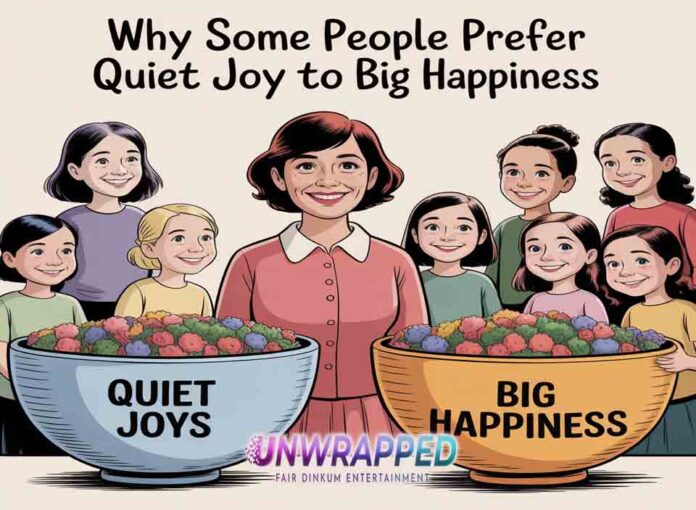
Modern culture often defines happiness in bold strokes. Big celebrations, visible success, high-energy experiences, and public milestones are treated as proof that life is being lived “fully.” Social feeds amplify this idea, turning happiness into something loud, performative, and measurable.
Yet many people quietly opt out of this definition. They feel more fulfilled by calm mornings, familiar routines, gentle laughter, and moments that never make it online. Quiet joy is not a lesser form of happiness—it is a different psychological orientation toward well-being. Understanding why some people prefer quiet joy to big happiness reveals how temperament, nervous system regulation, values, and meaning shape what actually feels good over time.
Quiet Joy vs Big Happiness: A Useful Distinction
Big happiness is often intense and short-lived. Quiet joy is subtle and enduring.
High-arousal positive emotions (excitement, thrill, euphoria) and low-arousal positive emotions (contentment, peace, ease) activate the brain differently. Neither is superior—but people vary in which feels most regulating.
In simple terms:
Big happiness feels expansive and energizing
Quiet joy feels grounding and stabilizing
Preference depends less on personality “strength” and more on internal wiring.
People Also Love: Why Some People Feel Safer Being Unknown
The Role of the Nervous System
One of the strongest predictors of this preference is nervous system sensitivity.
Individuals with more responsive nervous systems process stimulation deeply. Loud environments, emotional highs, and intense social settings can feel overwhelming rather than pleasurable.
For these individuals:
Calm equals safety
Subtle pleasure equals balance
Emotional steadiness equals well-being
Quiet joy soothes rather than spikes the system.
Why Intensity Can Feel Draining Instead of Rewarding
High-intensity happiness often comes bundled with:
Anticipation
Social comparison
Performance pressure
Post-event emotional drop
Emotional highs are frequently followed by emotional crashes. For people who value consistency and emotional equilibrium, this cycle feels exhausting.
Quiet joy, by contrast:
Requires less recovery
Produces fewer emotional swings
Integrates smoothly into daily life
Stability becomes the reward.
Temperament Shapes What Feels Like “Enough”
Temperament—the biologically influenced baseline of emotional responsiveness—plays a major role.
Introverted or highly reflective temperaments tend to favor low-stimulation environments. This does not mean avoiding happiness; it means choosing happiness that does not demand self-expansion.
These individuals often value:
Depth over novelty
Familiarity over spectacle
Meaning over intensity
Quiet joy aligns naturally with these priorities.
Quiet Joy Is Often Meaning-Driven
Big happiness is frequently outcome-based: achievements, milestones, wins. Quiet joy is process-based.
Meaning-driven well-being is more strongly associated with long-term life satisfaction than momentary pleasure. Quiet joy often arises from alignment rather than excitement.
Common sources include:
Feeling useful
Being present
Experiencing belonging
Living according to values
These moments rarely look dramatic—but they endure.
Cultural Pressure to Appear Happy
One reason quiet joy is misunderstood is that it does not perform well socially.
Public expressions of happiness are often shaped by norms rather than authentic experience. Big happiness is easier to signal. Quiet joy is harder to display.
As a result:
Loud happiness gets validated
Quiet contentment gets overlooked
Subtle satisfaction gets mistaken for neutrality
The preference is real—even if it is less visible.
Why Quiet Joy Feels Safer
Big happiness often raises the stakes. When joy is intense and public, people may fear losing it, failing to sustain it, or being judged for it.
Quiet joy:
Lowers expectations
Reduces comparison
Minimizes emotional risk
Low-arousal positive states increase resilience because they are easier to maintain under stress.
Safety and joy coexist.

The Longevity of Quiet Joy
One of quiet joy’s greatest strengths is durability.
While big happiness:
Peaks quickly
Depends on conditions
Is vulnerable to disruption
Quiet joy:
Accumulates gradually
Survives change
Becomes a baseline
Psychologists emphasize that well-being is less about emotional peaks and more about emotional sustainability.
Why Some People Outgrow Big Happiness
Preferences can change over time. Life experience often reshapes emotional priorities.
People increasingly value predictability and emotional regulation.
With maturity, many people shift toward:
Fewer highs, more steadiness
Less display, more depth
Less chasing, more appreciating
Quiet joy becomes intentional, not accidental.
Quiet Joy and Self-Trust
Quiet joy often signals strong self-trust.
Choosing understated pleasure requires:
Confidence in personal preferences
Willingness to resist comparison
Comfort with being misunderstood
People who trust themselves are less dependent on external validation—which makes quiet joy possible.
When Quiet Joy Is Misread
Because it is subtle, quiet joy is often mistaken for:
Low ambition
Emotional flatness
Fear of risk
In reality, it frequently reflects emotional literacy—the ability to recognize what genuinely nourishes rather than what merely impresses.
Quiet joy is not avoidance. It is discernment.
How Quiet Joy Shows Up in Daily Life
It often appears in ordinary moments:
A peaceful morning routine
Deep focus on meaningful work
Comfortable silence with trusted people
Small rituals that bring calm
These moments do not announce themselves—but they accumulate.
Call to Action
If quiet joy resonates, it may be worth honoring rather than questioning. Readers are encouraged to reflect on which moments genuinely restore energy—and which merely look like happiness from the outside.
Share this article with someone who values subtle fulfillment, or subscribe for more psychology-based insights into emotional well-being and self-understanding.
Conclusion
Not all happiness needs to be loud. Quiet joy offers steadiness, meaning, and emotional sustainability in a world that often rewards intensity over depth. It asks less from the nervous system and gives more back over time.
Choosing quiet joy is not settling—it is selecting a form of happiness that lasts. When life feels calmer, clearer, and more aligned, joy does not need to shout to be real.
Another Must-Read: Why Some People Are Drawn to Intense People