


Real life does not need magic to be strange. Nature, history, and science have already produced things so bizarre that they sound like rejected ideas from a fantasy writer who had too much coffee.
From wasps that turn cockroaches into obedient zombies to jellyfish that can reverse their own ageing process, the real world is packed with oddities that feel almost impossible. The best part is that these are not myths, urban legends, or made-up internet nonsense. These are real creatures, real behaviours, and real phenomena.
Here is an A-to-Z list of bizarre real-life facts that sound completely fake — but are absolutely real.
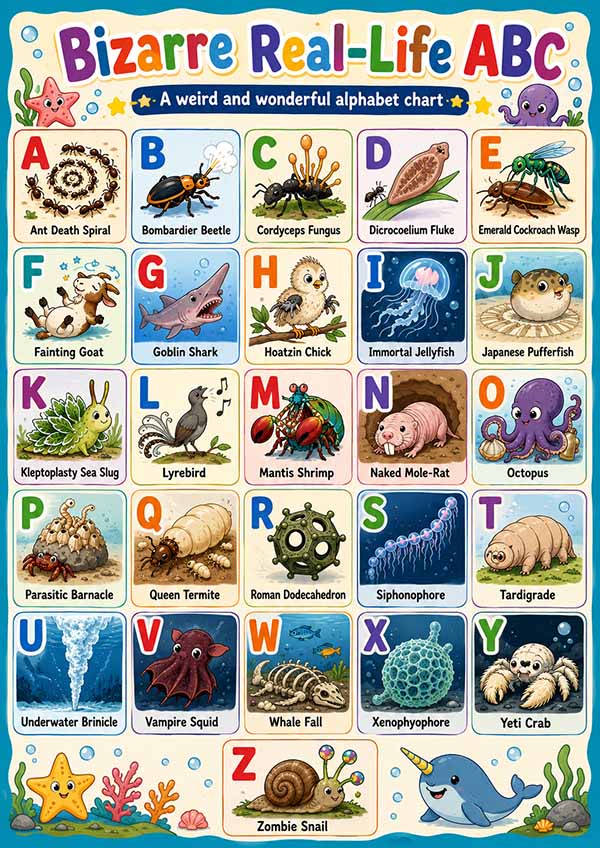
A — Ant Death Spirals
Some army ants can accidentally trap themselves in a fatal loop known as an ant mill. Because they rely heavily on scent trails, a group of ants can begin following each other in a circle.
Once the loop forms, the ants may continue marching until they collapse from exhaustion. It is one of nature’s strangest examples of teamwork going horribly wrong.
B — Bombardier Beetles
Bombardier beetles have one of the most dramatic defence systems in the insect world. When threatened, they spray a hot chemical blast from the rear of their body.
The spray is irritating, rapid, and accurate enough to scare off predators. In simple terms, this beetle has evolved into a tiny walking chemical cannon.
C — Cordyceps Zombie Fungus
Cordyceps fungi are famous for infecting insects and altering their behaviour. Some species infect ants, manipulate where they walk, and eventually kill them in a location that helps the fungus spread.
The fungus then grows from the dead insect’s body and releases spores. It is one of the creepiest examples of mind-altering parasitism in nature.
D — Dicrocoelium Liver Fluke
The Dicrocoelium liver fluke has a life cycle that feels designed by a villain. This parasite can affect ants in a way that makes them climb onto grass, where they are more likely to be eaten by grazing animals.
Once inside the grazing animal, the parasite continues its life cycle. It is a brutal reminder that in nature, even behaviour can be hijacked.
E — Emerald Cockroach Wasp
The emerald cockroach wasp may be one of the most disturbing insects on Earth. It stings a cockroach in a precise way that affects the roach’s nervous system.
The cockroach is not simply killed. Instead, it becomes strangely passive. The wasp can then lead it into a burrow, lay an egg on it, and leave it as living food for the wasp larva.
That is not fantasy horror. That is real-life biology.
F — Fainting Goats
Fainting goats do not technically faint. When startled, their muscles temporarily stiffen because of a genetic condition called myotonia congenita.
The result is that the goat may suddenly freeze and fall over. It looks ridiculous, but the cause is a real muscular condition rather than fear alone.
G — Goblin Sharks
The goblin shark looks like something dragged up from a nightmare. Its most bizarre feature is its jaw, which can shoot forward to grab prey.
This gives the shark a sudden snapping attack that looks almost mechanical. Deep-sea creatures are already strange, but the goblin shark is in a category of its own.
See Also: Overcoming Zoophobia Effective Strategies to Conquer Fear of Animals
H — Hoatzin Chicks
Hoatzin chicks are baby birds with claws on their wings. These claws help them climb through branches when they are young.
The feature gives them a strangely prehistoric appearance, almost like a living reminder of the connection between birds and dinosaurs.
I — Immortal Jellyfish
The immortal jellyfish, Turritopsis dohrnii, has a remarkable ability: under certain conditions, it can revert to an earlier stage of its life cycle.
This does not mean it cannot be eaten, injured, or killed. But biologically, its ability to reverse development makes it one of the strangest animals ever discovered.
J — Japanese Pufferfish Crop Circles
Male Japanese pufferfish create beautiful geometric patterns in the sand on the seafloor. These structures can look like underwater crop circles.
The purpose is not decoration for humans. The male builds them to attract females and create a suitable nesting site. It is one of the most unexpectedly artistic behaviours in the ocean.
K — Kleptoplasty
Some sea slugs can steal chloroplasts from algae and keep them functioning inside their own bodies. Chloroplasts are the parts of plant and algae cells that help with photosynthesis.
This means the slug can temporarily gain energy from sunlight in a way that sounds almost like science fiction. A solar-powered slug is real.
L — Lyrebirds
Lyrebirds are some of the greatest mimics in the animal kingdom. They can copy other birds, camera shutters, chainsaws, car alarms, and even human-made mechanical sounds.
Their mimicry can be so accurate that it feels unnatural. If a forest ever sounds like a construction site, a lyrebird may be involved.
M — Mantis Shrimp
The mantis shrimp has one of the fastest and most powerful punches in nature. Some species strike prey with such speed that they create cavitation bubbles in the water.
When those bubbles collapse, they produce shockwaves that can stun or damage prey. For a small marine animal, that is an absurd amount of violence.
N — Naked Mole-Rats
Naked mole-rats are strange in almost every possible way. They live in colonies like insects, have wrinkled pink skin, and can survive low-oxygen conditions that would kill many other mammals.
Their biology is so unusual that scientists study them for clues about ageing, pain resistance, and survival under extreme conditions.
O — Octopus Suckers
Octopuses do not just grab things with their suckers. They can also detect chemicals through them, which means their arms help them taste and touch the world at the same time.
An octopus arm is not just an arm. It is a flexible, intelligent, sensory-rich tool that helps the animal explore, hunt, and understand its surroundings.
P — Parasitic Barnacles
The parasitic barnacle Sacculina invades crabs in a way that sounds almost unreal. It grows inside the crab, takes over its body resources, and can interfere with its reproductive system.
In some cases, infected crabs behave as if they are caring for the parasite’s offspring. It is one of the most unsettling examples of parasitic control.
Q — Queen Termites
Termite queens can become enormous egg-laying machines. In some species, the queen’s body swells dramatically as she produces huge numbers of eggs.
The colony depends on her reproductive output, turning her into the living centre of an underground society.
R — Roman Dodecahedrons
Roman dodecahedrons are mysterious 12-sided objects found across parts of the former Roman Empire. They are usually made of metal, with holes of different sizes and small knobs on the corners.
The bizarre part is that nobody knows for certain what they were used for. Theories include tools, measuring devices, ritual objects, or decorative items, but the mystery remains unsolved.
S — Siphonophores
A siphonophore may look like one animal, but it is actually a colony of specialised individuals called zooids. Each zooid performs a different role, such as feeding, movement, or reproduction.
Together, they function as one organism. It is like a living colony pretending to be a single creature.
T — Tardigrades
Tardigrades, also known as water bears, are microscopic animals famous for surviving extreme conditions. They can endure freezing, drying out, intense radiation, and even exposure to space-like environments.
They are tiny, soft-bodied animals that look almost cute under a microscope, but their survival abilities are ridiculous.
U — Underwater Brinicles
A brinicle is sometimes called an underwater “finger of death.” It forms beneath sea ice when extremely cold, salty brine sinks into seawater and freezes the water around it.
As it grows downward, it can freeze small sea creatures in its path. It looks like a deadly icicle forming underwater.
Another Must-Read: 5 Unbelievably Unusual Facts About Animals in Australia
V — Vampire Squid
The vampire squid has a name that sounds dramatic, and honestly, it deserves it. When threatened, it can turn its webbed arms inside out over its body, creating a dark cloak-like shape covered in spines.
Despite the name, it does not suck blood. It is simply one of the strangest-looking deep-sea animals alive.
W — Whale Falls
When a whale dies and sinks to the deep ocean floor, its body can become an entire ecosystem. This is known as a whale fall.
The carcass feeds scavengers, worms, microbes, and deep-sea organisms for years. In the deep ocean, death can become a whole neighbourhood.
X — Xenophyophores
Xenophyophores are giant single-celled organisms found in the deep sea. Some can grow to sizes that seem impossible for a single cell.
They challenge the everyday idea that cells must be microscopic. In the deep ocean, even single-celled life can get weirdly huge.
Y — Yeti Crabs
Yeti crabs are deep-sea crabs with hairy-looking claws. Those “hairs” can host bacteria, which the crabs may farm and eat.
Imagine waving your furry arms around near deep-sea vents to grow your own food. That is basically the yeti crab lifestyle.
Z — Zombie Snails
The parasite Leucochloridium can infect snails and make their eye stalks pulse with bright, colourful patterns. These infected eye stalks look like caterpillars.
The display attracts birds, which eat the snail and allow the parasite to continue its life cycle. It is grotesque, clever, and completely real.
Why Real Life Is Stranger Than Fiction
The strangest thing about these bizarre real-life facts is not just that they exist. It is that they evolved naturally.
A wasp that turns cockroaches into obedient hosts. A jellyfish that can reverse its life cycle. A bird that mimics chainsaws. A tiny fish that builds geometric sand art to impress a mate.
None of it needs magic. The natural world is already full of monsters, miracles, tricks, and mysteries. The more closely we look at real life, the more it starts to feel unreal.
Frequently Asked Questions
What is the most bizarre real-life animal?
The emerald cockroach wasp is one of the most bizarre real-life animals because it can manipulate a cockroach’s behaviour before using it as a host for its young.
Are zombie ants real?
Yes. Some fungi and parasites can alter the behaviour of insects, including ants. The most famous example is Cordyceps fungus, which can influence infected ants before killing them.
Is the immortal jellyfish really immortal?
The immortal jellyfish can reverse its life cycle under certain conditions, but it can still die from injury, disease, or being eaten. It is biologically extraordinary, not invincible.
What animal can survive in space?
Tardigrades are famous for surviving extreme conditions, including exposure to the vacuum of space in scientific experiments.
What is the weirdest thing in the ocean?
The ocean has many strange creatures, but goblin sharks, vampire squid, siphonophores, yeti crabs, and pufferfish sand-circle builders are among the weirdest.