




Moving to Australia is not just about changing countries.
It is not only about sunshine, beaches, better weather, open spaces or a new life on the other side of the world. Those things may bring you here, but they are not what make you Australian.
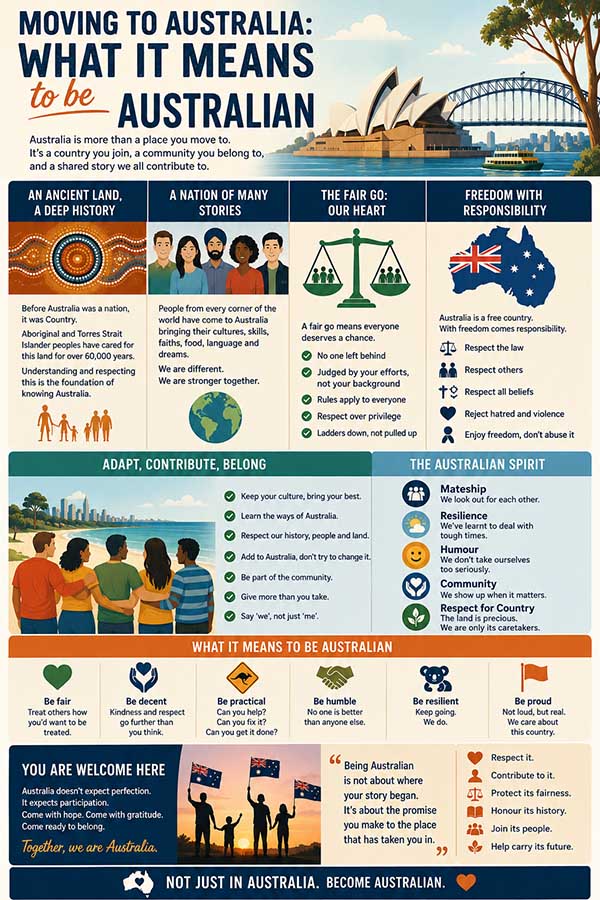
To become part of Australia, you have to understand the spirit of the place.
Australia is a country of ancient land, hard truths, second chances, dry humour, quiet decency and the deep belief that everyone deserves a fair go. It is a country built by many peoples, shaped by many journeys, and held together by something simple but powerful: respect.
Respect for the land.
Respect for the law.
Respect for each other.
Respect for the freedom we share.
Respect for the idea that no one is better than anyone else.
If you are moving to Australia, you are welcome.
But welcome comes with responsibility.
Australia does not ask you to forget where you came from. It does not ask you to abandon your family traditions, language, faith, food, stories or memories. Those things can enrich this country.
But Australia does ask you to join it.
Not stand apart from it.
Not use it.
Not reshape it into the place you left.
To live well here, you must come ready to belong.
Australia Is an Ancient Land Before It Is a Modern Nation
Any honest story about Australian culture must begin with Aboriginal and Torres Strait Islander peoples.
Before Australia was a nation, it was Country.
Before cities, suburbs, roads, ports, fences and parliaments, this land had names, laws, languages, stories, songlines, ceremonies and responsibilities. First Nations peoples cared for this land for tens of thousands of years. Their connection to Country remains one of the deepest and most important truths about Australia.
To love Australia properly, you must be willing to see that.
Australia is not empty land.
It never was.
It is a living place with ancient memory.
That does not mean every Australian understands this history perfectly. We do not. It does not mean the country has always acted justly. It has not.
Colonisation caused deep harm. Land was taken. Families were broken. Cultures were damaged. Promises were not always kept. There are wounds in Australian history that cannot be ignored by anyone who wants to speak honestly about this country.
But acknowledging that truth does not make Australia weaker.
It makes Australia more mature.
A serious country does not only celebrate itself. It has the courage to look at where it failed, where it hurt people, and where it must still do better.
Australia’s story is not perfect.
But it is still a story worth joining.
Australia Has Made Mistakes, But It Has Also Kept Changing
Australia has not always lived up to its best ideals.
There have been times when fear spoke louder than fairness. Times when people were judged by their race, origin, religion or accent. Times when exclusion was accepted as policy. Times when First Nations people, migrants and minorities were treated with less dignity than they deserved.
That truth matters.
But another truth matters too.
Australia has changed.
It has opened.
It has grown.
It has listened, sometimes slowly, but still listened.
It has welcomed people from across the world and allowed them to become part of the national story.
People have come from Britain, Ireland, Italy, Greece, China, India, Vietnam, Lebanon, the Philippines, Pakistan, South Africa, New Zealand, Sri Lanka, Nepal, Indonesia, Malaysia, Africa, the Middle East, Europe, the Pacific and beyond.
They brought their skills, food, music, families, faiths, languages, stories and hopes.
And through all that difference, Australia has held together.
Not perfectly.
Not without tension.
Not without arguments.
But it has held together because there is a shared expectation at the heart of the country:
Come as you are, but come ready to be part of us.
That is the balance.
Australia welcomes difference, but it still needs unity.
What Is Australian Culture?
Australian culture is not easy to explain because it is often quiet.
It is not always loud patriotism. Australians are not usually comfortable with too much boasting. We are more likely to joke than brag, more likely to understate than exaggerate, and more likely to say “not bad” when we mean “excellent.”
But beneath that casual surface, Australian culture has strong roots.
Australian culture values:
- fairness
- humility
- personal freedom
- helping others
- plain speaking
- practical action
- humour
- resilience
- respect for the law
- suspicion of arrogance
- community in hard times
Australia does not admire people who think they are better than everyone else.
You can be successful here. You can be ambitious. You can build, create, lead and achieve great things.
But do not look down on people.
That is not the Australian way.
Australia respects people who carry their weight, treat others decently, help when needed, and do not make themselves bigger by making others feel small.
The Fair Go: The Heart of Australian Values
If there is one phrase that explains Australia, it is this:
A fair go.
It sounds simple, but it carries enormous meaning.
A fair go means people deserve a chance.
A fair go means your beginning should not completely decide your future.
A fair go means the powerful should not crush the vulnerable.
A fair go means rules should apply to everyone.
A fair go means no one should be treated as less human because of where they come from.
A fair go means you do not pull the ladder up behind you once you have climbed it.
Australia does not always live up to this ideal.
No country always lives up to its ideals.
But the fair go remains one of the best things about Australia. It is the moral centre of the country. It is the bridge between old Australia and new Australia. It is what allows people from different backgrounds to recognise each other as equals.
Not identical.
Equal.
That difference matters.
A fair go does not mean every belief, behaviour or custom must be accepted without question. It does not mean Australia has no standards. It does not mean anything goes.
It means people should be treated with dignity and judged by how they behave.
That is a beautiful idea.
And it is worth protecting.
See Also: Why Are People Moving to Tasmania?
Being Australian Means Respecting Freedom and Responsibility
Australia is a free country.
That freedom is one of its greatest gifts.
People can speak, worship, vote, criticise, protest, build a life, raise a family and choose their own path. Many people move to Australia because they want that freedom.
But freedom here is not meant to be selfish.
Freedom works only when people accept responsibility.
You cannot demand freedom for yourself while denying respect to others.
You cannot enjoy peace while bringing old hatreds with you.
You cannot benefit from Australian law while refusing to respect it.
You cannot ask for tolerance while showing contempt for the country that welcomed you.
That is not belonging.
That is taking without joining.
Australian freedom is strongest when it is shared.
That means respecting women, children, neighbours, different faiths, people with no faith, people from different backgrounds, and people whose lives do not look like yours.
It means accepting that Australia is not yours alone.
It is a shared home.
If You Move to Australia, You Should Adapt
This is an honest point, and it needs to be said clearly.
If you move to Australia, you should come ready to adapt.
That does not mean losing yourself.
It does not mean forgetting your roots. It does not mean giving up your culture, your food, your language, your memories or your family traditions.
But it does mean understanding that you have entered a country with its own ways, its own history, its own humour, its own values and its own social contract.
You are welcome to add to Australia.
But you should not come here to change Australia into the country you left.
Bring the best of yourself.
Bring your discipline.
Bring your family love.
Bring your work ethic.
Bring your food.
Bring your music.
Bring your faith.
Bring your stories.
Bring your gratitude.
Bring your ambition.
But do not bring contempt for Australian ways.
Do not bring old conflicts and expect them to be replayed here.
Do not bring prejudice and expect it to be protected.
Do not bring hatred and call it tradition.
Do not bring division and call it identity.
Do not come only to live apart from the country around you.
Australia is generous.
But generosity should not be mistaken for weakness.
A welcoming country still has the right to defend its character.
Multicultural Australia Works Because There Is a Shared Centre
Australia is one of the most successful multicultural countries in the world.
But multiculturalism works best when it has a shared centre.
That shared centre is not one race, one religion, one accent or one ancestry.
It is a commitment to living together under the same basic values.
Respect the law.
Treat others fairly.
Give people a fair go.
Reject violence and intimidation.
Respect freedom of belief.
Respect those who believe differently.
Help when the community needs you.
Contribute where you can.
Do not place yourself above others.
Do not try to break the country into separate tribes.
That is how multicultural Australia works.
It does not work by pretending differences do not exist.
It works by making sure difference does not become division.
You can be proud of where you came from and still be loyal to Australia.
You can speak another language at home and still belong fully to this country.
You can celebrate your heritage and still stand under the Australian sky with responsibility and love.
That is not contradiction.
That is modern Australia.
What Does It Mean to Become Australian?
Becoming Australian is not only about citizenship papers.
A passport matters, but belonging is deeper than paperwork.
To become Australian is to begin saying “we.”
Not immediately. Not artificially. But slowly, naturally, through living, learning and caring.
You start to understand the jokes.
You complain about the price of things.
You learn which beaches are dangerous.
You develop opinions about coffee, footy, weather, supermarkets, magpies and which city is overrated.
You help a neighbour.
You stand in line without making a fuss.
You say “mate” and finally understand how many meanings one word can carry.
Then one day, Australia is no longer just where you live.
It is the country you defend in conversation.
The country you miss when you leave.
The country whose problems frustrate you because you care.
The country whose future feels tied to your own.
That is when Australia has begun to claim you.
The Australian Spirit Is Practical, Not Perfect
Australia is beautiful, but it is not soft.
The beaches can be paradise, but the ocean can be dangerous.
The bush can be peaceful, but fire can tear through it.
The land can be generous, but drought can test everyone.
The distances are vast.
The summers can be brutal.
The silence can humble you.
This land teaches practicality.
Australians tend to respect people who can stay calm, help out, fix things, laugh when life goes wrong and keep moving.
Theory is fine.
But can you show up?
Can you help?
Can you carry your weight?
Can you treat people decently when things are hard?
That is why Australia often reveals itself during crisis.
Floods. Fires. Storms. Droughts. Accidents. Hard times.
When things go wrong, Australians often show their best side. Strangers help strangers. Communities gather. Volunteers appear. People cook, carry, drive, rescue, rebuild and check on each other.
That quiet willingness to help is one of the finest parts of Australian life.
It is not dramatic.
It is better than dramatic.
It is real.
What Newcomers Should Understand About Australian Life
If you are moving to Australia, understand this:
Australia is friendly, but not foolish.
It is relaxed, but it has standards.
It is multicultural, but it still has a national character.
It is tolerant, but it should not tolerate hatred.
It is free, but freedom comes with responsibility.
It is welcoming, but welcome should be met with respect.
You do not need to be born in Australia to love Australia.
But you do need to respect it.
You need to respect its First Nations history.
You need to respect its laws.
You need to respect its people.
You need to respect its freedoms.
You need to respect the fact that many people before you helped build the country you now wish to join.
A country is not a hotel.
It is a home.
And when you enter a home, you do not only ask what it can give you.
You ask how you can honour it.
What Australia Should Ask of Everyone
Australia should ask the same basic things of everyone, whether born here or newly arrived.
Be fair.
Be decent.
Respect the law.
Help when you can.
Do not abuse freedom.
Do not look down on others.
Do not bring hatred into public life.
Do not divide people for personal gain.
Do not forget the land you stand on.
Do not take the country for granted.
These are not extreme demands.
They are the minimum expectations of a healthy society.
Australia does not need everyone to be the same.
But it does need people to care about the same shared home.
That is the difference between diversity and fragmentation.
Diversity adds.
Fragmentation breaks.
Australia should always choose the first and resist the second.
What Makes Australia Worth Joining?
Australia is worth joining because it still believes ordinary people matter.
It believes a person should be able to build a life without needing to come from wealth or status.
It believes you should be able to speak freely, worship freely, disagree openly and walk safely.
It believes people deserve space, dignity and a chance.
It believes community matters, even when we argue about what that community should look like.
It believes in helping during hard times.
It believes in laughing at ourselves.
It believes arrogance should be kept in check.
It believes the land is bigger than all of us.
And at its best, it believes that anyone who truly joins the country can become part of it.
That is rare.
That is precious.
That is worth protecting.
Moving to Australia Is an Invitation
Moving to Australia is an invitation into a shared story.
It is an invitation to stand on ancient land with humility.
It is an invitation to live in a modern democracy with gratitude.
It is an invitation to bring your best without rejecting what is already here.
It is an invitation to belong, not simply reside.
Australia does not need newcomers to erase themselves.
It does not need old Australians to fear every new arrival.
It does not need false choices between heritage and unity.
What Australia needs is a shared promise.
A promise that we can come from many places and still belong to one country.
A promise that we can honour the past without being trapped by it.
A promise that we can improve Australia without hating it.
A promise that we can be different without becoming divided.
That is the real Australian project.
And everyone who lives here is part of it.
Final Thoughts: Becoming Australian
Being Australian is not about where your story began.
It is about the promise you make to the country that has taken you in.
To respect it.
To contribute to it.
To protect its fairness.
To honour its history.
To join its people.
To help carry its future.
If you are moving to Australia, come with hope.
Come with gratitude.
Come with confidence, but also humility.
Come ready to learn the country, not just live in it.
Come ready to add to Australia without trying to turn it into somewhere else.
Come ready to become part of something bigger than yourself.
Because if you let it, Australia will change you.
It will teach you space.
It will teach you humour.
It will teach you resilience.
It will teach you fairness.
It will teach you not to take yourself too seriously.
It will teach you that freedom is precious because it is shared.
It will teach you that belonging is not claimed in a day, but built through respect.
And one day, perhaps sooner than you expect, Australia may no longer feel like the country you moved to.
It may feel like home.
And when you can say, with sincerity and responsibility, “I am part of this now,” then you will understand what it means to be Australian.
Welcome.
Not just to Australia.
To the work, privilege and responsibility of becoming Australian.
FAQ
What does it mean to be Australian?
To be Australian means more than being born in Australia or holding a passport. It means respecting the country, giving others a fair go, valuing freedom with responsibility, respecting the law, acknowledging Australia’s history, and contributing to the shared life of the nation.
What are Australian values?
Australian values include fairness, respect, freedom, responsibility, equality before the law, helping others, humility, mateship and giving people a fair go. These values are not always lived perfectly, but they remain central to Australian culture.
What is the Australian fair go?
The fair go is one of Australia’s most important cultural ideas. It means people deserve a reasonable chance, should be treated fairly, and should not be looked down on because of where they started, what they earn, or where they come from.
Do you have to give up your culture to become Australian?
No. Becoming Australian does not mean forgetting where you came from. Australia is multicultural, and people are welcome to bring their traditions, food, language, faith and family history. But becoming Australian does mean respecting Australian laws, values and shared national life.
What should migrants understand before moving to Australia?
Migrants should understand that Australia is welcoming, but it also expects respect. Newcomers should adapt to Australian life, respect the law, learn the culture, honour the country’s history, and contribute positively to the community.
Is Australia a multicultural country?
Yes. Australia is one of the world’s most successful multicultural countries. People from many backgrounds live together in Australia, but multiculturalism works best when everyone shares respect for the law, freedom, fairness and national unity.
Why is First Nations history important to Australia?
First Nations history is central to understanding Australia because Aboriginal and Torres Strait Islander peoples cared for this land for tens of thousands of years before modern Australia existed. Respecting that history is part of respecting the country itself.
Another Must-Read: Moving to Australia From Philippines: Visa, Jobs and Cost of Living Guide